
Amerant Bancorp: Deposit Diversification, Digital Leverage, and the Search for Regional Bank Differentiation
Amerant Bancorp’s recent network expansion, digital adoption, and strategic wind-downs have sharpened its focus on core Florida markets and relationship-driven growth. The company’s improved net interest margin and funding mix offer resilience, but credit concentration and competitive pressures remain central to its forward trajectory.
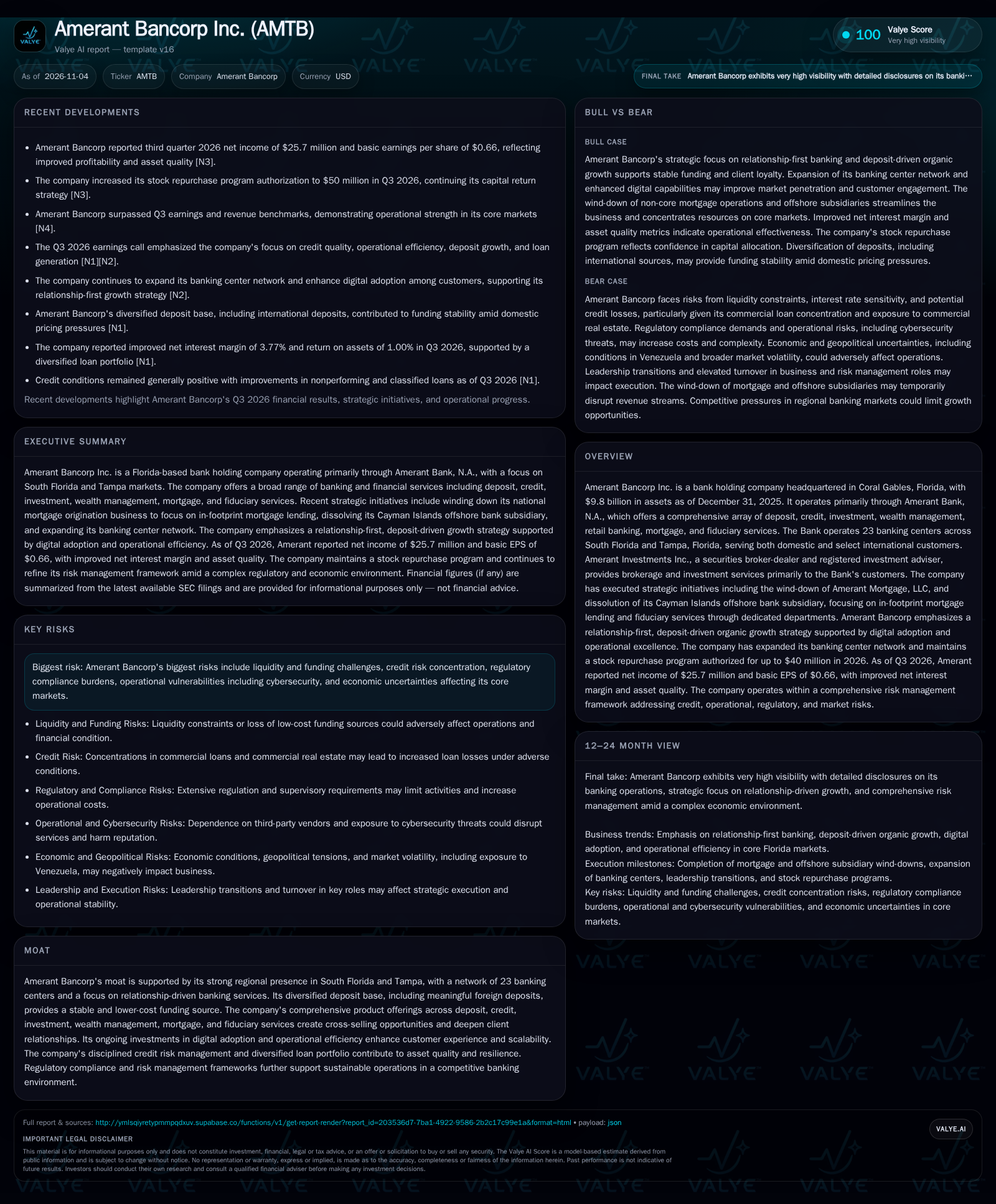
Amerant Bancorp has deepened its Florida footprint, increased digital engagement, and improved its net interest margin and asset quality. Its diversified deposit base—bolstered by international funds—helps buffer domestic funding pressures. However, credit concentration, market competition, and evolving regulatory and economic conditions will determine whether its relationship-first strategy can yield sustainable growth and returns. [N1] [N2] [N3] [S2]
Amerant Bancorp’s recent evolution reflects both the opportunities and complexities facing regional banks in a shifting U.S. financial landscape. By doubling down on its Florida core markets, winding down non-strategic operations, and increasing digital engagement, Amerant is seeking to carve out a durable niche based on relationship banking and funding diversification. The company’s improved net interest margin and asset quality suggest operational progress, but the test ahead lies in managing credit risk, regulatory complexity, and the intense competition that defines the Florida banking market.
Strategic Reshaping: Core Markets, Funding Mix, and Performance Gains
Three recent developments are central to Amerant Bancorp’s current position: First, the company reported a Q3 2026 net interest margin of 3.77% and return on assets of 1.00%, an improvement supported by a diversified loan book and disciplined funding [N1] [S2]. Second, Amerant completed the wind-down of both its national mortgage origination subsidiary and its Cayman Islands offshore bank, consolidating focus on in-footprint mortgage lending and fiduciary services [S2]. Third, the deposit mix has shifted favorably, with non-interest-bearing deposits rising to 20.2% of total, and international deposits providing a lower-cost funding source amid rising domestic deposit costs [N1] [S2].
These moves matter because they signal Amerant’s intent to reduce volatility from non-core operations, strengthen funding resilience, and leverage its regional presence and client relationships as competitive differentiators.
How Amerant Monetizes Relationships: Spreads, Scale, and Digital Leverage
Amerant’s primary revenue engine is net interest income, driven by the spread between interest earned on loans and paid on deposits. The bank’s improved net interest margin (NIM) to 3.77% in Q3 2026 reflects both asset mix discipline and the ability to source lower-cost funding, particularly through non-interest-bearing and international deposits [N1] [S2]. This funding mix is critical: as industry-wide competition for deposits intensifies, the ability to hold down funding costs directly supports profitability.
The company’s operating leverage is influenced by its relatively fixed cost base—branch network, compliance, technology investments—versus the variable nature of loan and deposit volumes. Expansion of digital services and treasury management offerings could lower incremental servicing costs, especially as customer adoption rises. However, the shift away from national mortgage origination removes a fee-income lever, making Amerant more reliant on core lending and deposit-driven growth.
Amerant’s capital return policy, evidenced by the $50 million stock repurchase program, suggests a degree of surplus capital, but also signals management’s view that organic reinvestment opportunities may be limited relative to the company’s capital base [N3].
Defending Share in a Crowded Florida Banking Market
Amerant’s network of 23 Florida banking centers situates it in one of the most competitive and demographically attractive U.S. banking markets. Regional banks, super-regionals, and digital-first entrants all vie for affluent, international, and commercial customers in South Florida and Tampa. Amerant’s potential edge lies in its relationship-first model and its ability to attract and retain international clients, which helps diversify funding and potentially deepen cross-selling opportunities.
However, these advantages are offset by several counterforces: larger banks offer broader product sets and technology investment, while fintechs and neobanks can undercut on convenience and pricing. Amerant’s recent digital adoption push is a necessary response, but the question is whether its scale is sufficient to sustain technology investments and defend margins amid ongoing digital disruption and regulatory cost pressures.
A further competitive risk is credit concentration, especially in commercial real estate, which can expose the bank to sector downturns more than diversified peers.
If Relationship Banking and Digital Engagement Drive Profitable Growth
A favorable outcome for Amerant would see its deposit-driven growth strategy yield higher core deposit balances, especially non-interest-bearing and international deposits, further reducing funding costs and stabilizing the NIM even as industry deposit pricing remains elevated. Expanded banking center presence in growth corridors, combined with continued gains in digital adoption, could drive both customer acquisition and operational efficiency.
Cross-selling of wealth management, treasury, and investment services to a growing relationship base would deepen wallet share and diversify fee income. Asset quality would remain strong if credit discipline holds, supporting stable returns even if loan growth moderates.
Evidence that would confirm this scenario includes: sustained or rising NIM and ROA, continued growth in non-interest-bearing and international deposits, digital adoption metrics trending upward, and a benign credit environment reflected in low nonperforming loan ratios and charge-offs.
Most Likely Course: Incremental Growth, Margin Pressures, and Credit Monitoring
The most plausible trajectory is that Amerant experiences modest asset and deposit growth in its core Florida markets, with net interest margin gradually pressured by ongoing competition for deposits and a normalizing interest rate environment. Digital adoption continues to rise, but technology spending and regulatory compliance costs offset some efficiency gains. Fee income remains stable but does not become a major growth driver post-mortgage wind-down.
Credit quality remains generally sound but requires constant vigilance, especially if commercial real estate or regional economic conditions weaken. Asset quality improvement trends persist but are not immune to external shocks.
Confirmation of this scenario would be a steady loan-to-deposit ratio, stable or slightly compressed NIM, manageable credit costs, and incremental increases in digital engagement and core deposit balances. Falsification would involve a sharp deterioration in asset quality, deposit outflows, or inability to sustain digital investment.
When Funding, Credit, or Execution Risks Erode the Franchise
A negative scenario could unfold if deposit competition intensifies further, eroding Amerant’s funding cost advantage and compressing NIM below sustainable levels. Loss of international or non-interest-bearing deposits would force greater reliance on higher-cost or brokered funding. A downturn in commercial real estate markets or regional economies could drive up nonperforming loans and credit losses, especially given portfolio concentrations.
Operational or cyber disruptions, regulatory missteps, or failed technology investments could further increase expenses or damage reputation. Leadership instability or execution lapses following recent management transitions could slow strategic progress.
Evidence of this scenario would include: declining NIM and ROA, rising loan-to-deposit ratios, material credit losses or increases in classified assets, deposit outflows, or negative trends in digital adoption and client engagement.
Benchmarks for Testing Amerant’s Growth, Resilience, and Strategy
Sustained net interest margin performance at or above peer averages, given changing funding conditions.
Quarterly trends in non-interest-bearing and international deposit balances to assess funding mix resilience.
Loan-to-deposit ratio stability, especially as new lending and deposit gathering strategies are executed.
Nonperforming loan and charge-off rates, particularly in commercial real estate and key lending segments.
Digital adoption metrics—such as active digital enrollments or digital transaction volumes—if disclosed, to gauge operational leverage and engagement.
Progress in banking center expansion and customer acquisition in targeted Florida markets.
Composition and growth of non-interest income, especially from wealth management and treasury services.
Clarity and continuity in executive leadership and execution of strategic priorities following recent transitions.
Disclaimer: This is research-only, informational analysis and not investment advice. It may include AI-generated interpretation and general industry context. Always verify important details using primary sources.

Comments