
Xometry’s AI Marketplace: Network Effects, Global Expansion, and the Test of Sustainable Scale
Xometry is pushing the boundaries of digital manufacturing with an AI-native platform that connects a growing global network of buyers and suppliers.
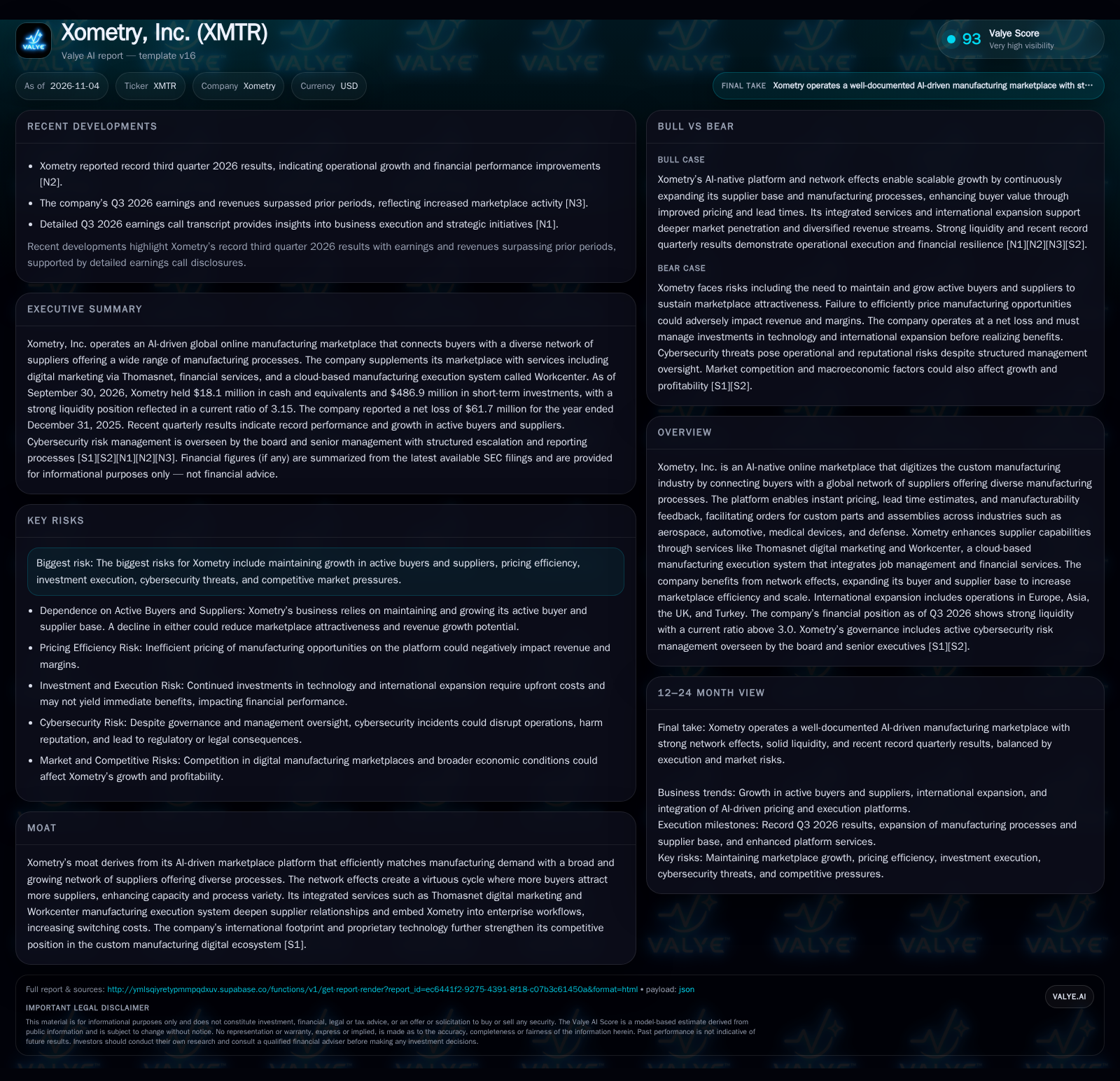
Xometry’s AI-driven manufacturing marketplace is showing tangible network growth and operational scale, with recent record results and a reported balance sheet position. The company’s expanding international footprint and embedded supplier services deepen its ecosystem. However, recurring net losses and the need to maintain marketplace vibrancy raise questions about the path to sustainable profitability as competition and execution risks remain in focus. [S1] [S2] [N2] [N3]
Xometry, Inc. is advancing the digital transformation of custom manufacturing with its AI-powered global marketplace, connecting engineers and procurement professionals to a diverse supplier base. The company’s recent record quarterly results and expanding international reach underscore strong execution and network effects, with active buyers and suppliers both posting double-digit growth. Yet, persistent net losses point to the unresolved challenge of scaling a two-sided marketplace to durable profitability. As Xometry leverages its financial resources to deepen ecosystem services and globalize its footprint, the core question becomes whether network effects and platform integration can ultimately yield sustainable margins in a competitive, rapidly evolving industry.
Marketplace Network Growth and Financial Position in 2026
Xometry’s marketplace demonstrated robust expansion in 2026, with active buyers reaching 81,821 (up 20% year-over-year) and active suppliers climbing to 4,996 (up 17%). This growth in both sides of the network suggests effective customer acquisition and retention, a critical dynamic for any platform business. Record third quarter results, with earnings and revenues surpassing prior periods, indicate elevated marketplace activity and operational momentum. On the balance sheet, Xometry reported $18.1 million in cash and equivalents and $486.9 million in short-term investments as of September 30, 2026, yielding a current ratio of 3.15 and a cash ratio of 2.33. However, the company remains loss-making, with a net loss of $61.7 million in 2025, highlighting the ongoing challenge of achieving break-even at scale. [S1] [S2] [N2] [N3]
How Xometry’s Platform Converts Network Activity into Revenue
At its core, Xometry monetizes by matching demand for custom parts with a global, diversified supply base, using AI to price jobs, estimate lead times, and facilitate order execution. Revenue is generated through transaction fees, potential markups, and ancillary services—including digital marketing (via Thomasnet), financial offerings, and Workcenter, a cloud-based manufacturing execution system for suppliers. The business model’s economics depend on achieving high transaction volumes and efficient pricing algorithms to balance buyer value (cost, lead time, quality) with supplier incentives.
Fixed costs are driven by technology development, network management, and international expansion, while variable costs relate to transaction processing and service delivery. Operating leverage is plausible if incremental transaction growth outpaces fixed cost increases, but persistent net losses suggest that current scale is insufficient to cover platform and growth investments. Additional capital is required to fund ongoing expansion and technology upgrades; Xometry’s sizable short-term investments provide a buffer, but the path to self-sustaining cash flows is not yet evident.
Pricing power is not guaranteed, as buyers can compare alternatives and suppliers may multi-home across platforms. However, integrated services like Workcenter and Thomasnet could create stickier supplier relationships and potentially increase switching costs.
Network Effects, Embedded Services, and Competitive Pressures
Xometry’s primary advantage lies in network effects: a larger buyer base attracts more suppliers, increasing process diversity and capacity, which in turn draws more buyers. This virtuous cycle can create a defensible position if scale leads to better matching, tighter execution, and superior data for AI-driven pricing. The addition of Thomasnet’s digital marketing and Workcenter’s workflow integration embeds Xometry deeper into supplier operations, potentially raising switching costs and making the platform harder to displace.
However, the digital manufacturing sector is highly competitive, with alternative platforms, traditional brokers, and vertically integrated suppliers all vying for similar customer segments. Technology adoption barriers, price sensitivity among buyers, and the risk of suppliers multi-homing (participating on multiple platforms) limit the durability of any single marketplace’s moat. International expansion opens new markets but also exposes Xometry to region-specific competitors and regulatory complexity.
Substitution risk remains: large buyers could negotiate directly with suppliers, or new entrants could undercut on fees or offer differentiated value (e.g., specialized quality assurance, local compliance). Thus, Xometry’s competitive position is contingent on sustaining network growth, deepening ecosystem integration, and demonstrating superior outcomes for both sides of the marketplace.
Virtuous Cycle: If Network Effects Deliver Operating Leverage
The most favorable scenario for Xometry is one in which continued growth in active buyers and suppliers drives higher transaction volumes, allowing the company to leverage its fixed investments in technology and international operations. As the platform scales, AI-powered pricing and execution could create efficiencies that improve gross margins, while embedded services (Thomasnet, Workcenter) increase supplier stickiness and reduce churn.
Confirmation would come from sustained double-digit growth in active buyers and suppliers, rising gross margins, and narrowing net losses—eventually flipping to positive net income. Additional evidence would include increased adoption of Workcenter and financial services, higher average order values, and supplier retention metrics (if disclosed) showing reduced multi-homing. The upside case would be undermined if network growth stalls, supplier churn rises, or margin improvement fails to materialize despite greater scale.
Scaling with Friction: Growth Continues but Profitability Lags
A plausible middle path is that Xometry maintains healthy growth in buyers and suppliers, benefiting from ongoing digital adoption and international expansion. The platform continues to add new manufacturing processes and geographies, further diversifying its network. However, competitive intensity keeps pricing power in check, and supplier incentives require continued investment in platform features and support.
In this scenario, Xometry’s revenues grow, but margin expansion is gradual as cost pressures from technology development, marketing, and international operations persist. Net losses narrow but remain, with the company relying on its liquidity buffer to fund ongoing growth. Evidence supporting this scenario would include continued record quarterly results, stable or improving unit economics (if disclosed), and international markets contributing a growing share of revenue. The scenario would break down if growth in buyers or suppliers slows significantly, or if cost discipline deteriorates despite scale.
When Marketplace Growth Fails to Offset Investment Drag
The adverse scenario is one where network growth decelerates—either due to buyer attrition, increased supplier multi-homing, or competitive entry—reducing the platform’s value proposition. If AI pricing fails to accurately match demand and supply, Xometry could see margin compression, dissatisfied customers, or increased order failures. Rising fixed costs from international expansion and technology investments could outpace revenue growth, deepening net losses and forcing a retrenchment or capital raise.
Confirmation would be visible in declining or plateauing active buyer/supplier counts, shrinking gross margins, widening net losses, or negative cash flow trends. Supplier or buyer churn (if disclosed), reduced engagement with embedded services, or evidence of price-driven competition eroding transaction volumes would further validate the downside. A key falsifier would be a reversal in these metrics, showing renewed network vibrancy and cost discipline.
What Will Reveal If Xometry’s Marketplace Can Achieve Sustainable Scale?
Active buyer growth rates: Continued double-digit annual increases would support the network effect thesis; deceleration would signal saturation or competitive leakage.
Active supplier expansion: Rising supplier counts, especially in new geographies or manufacturing processes, would show platform breadth and risk diversification.
Gross margin trends: Improvement over time would confirm operating leverage and pricing efficiency; stagnation or decline would indicate margin pressure.
Net loss trajectory: Narrowing losses or a path toward break-even would validate scalability; persistent or widening losses would challenge the model.
Adoption and engagement with Workcenter and Thomasnet: Higher adoption rates and supplier engagement (if disclosed) would indicate increasing ecosystem stickiness.
International revenue mix: Growing contribution from Europe, Asia, UK, and Turkey would demonstrate successful global expansion.
Supplier and buyer retention/churn rates: If disclosed, these would directly test network vibrancy and platform defensibility.
Disclaimer: This is research-only, informational analysis and not investment advice. It may include AI-generated interpretation and general industry context. Always verify important details using primary sources.

Comments