
Fifth Third Bancorp: Integration Ambitions, Loan Mix Evolution, and the Realities of Post-Merger Banking
Fifth Third Bancorp’s recent Comerica acquisition, strong quarterly earnings, and diversified loan book highlight both the promise and complexity of scaling in regional banking. The challenge now is to manage integration risks, defend margins amid competitive and macroeconomic pressures, and demonstrate that its evolving product mix—from solar loans to wealth management—can deliver sustainable growth.
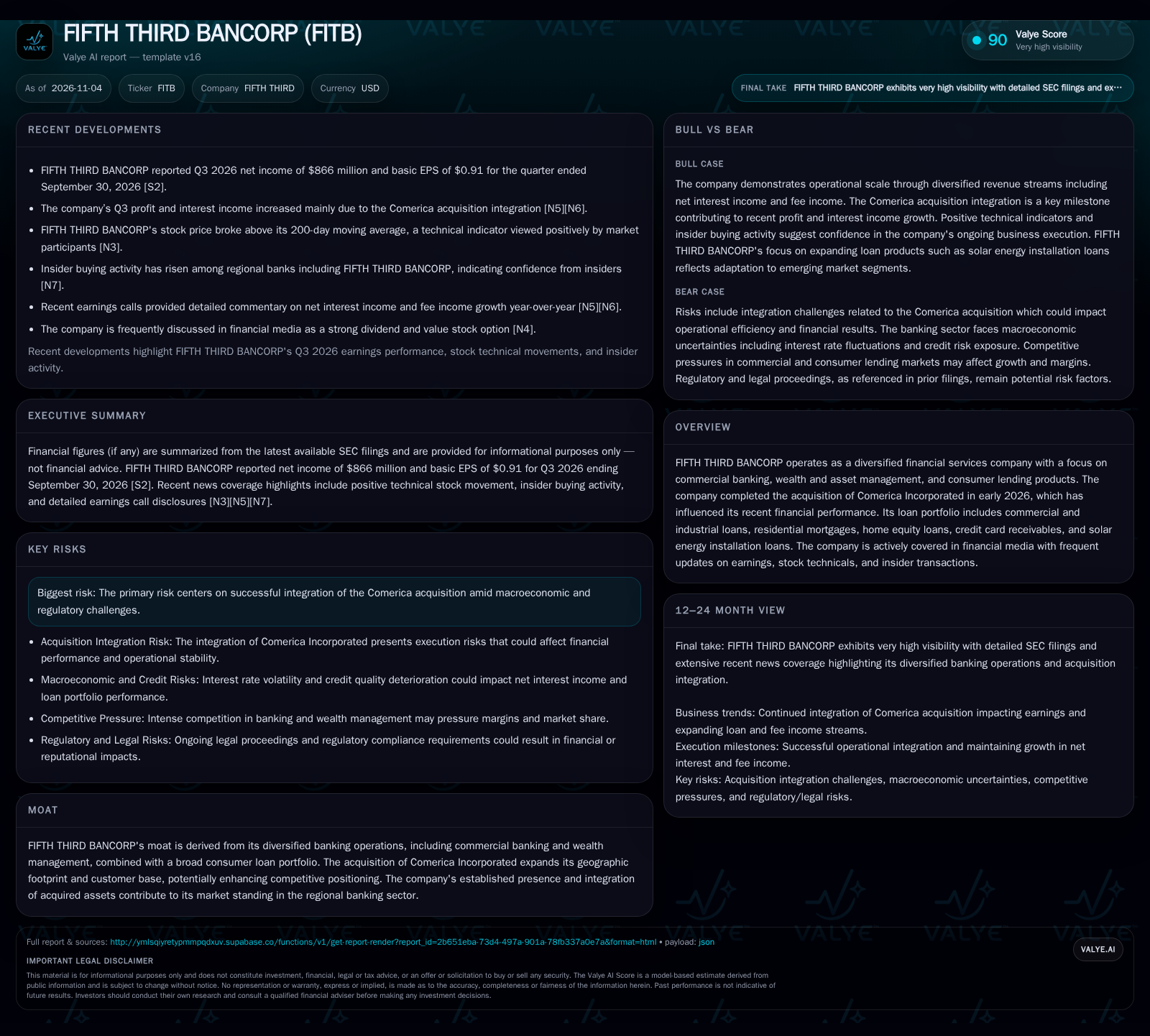
Fifth Third Bancorp posted $866 million in net income for Q3 2026, reflecting the impact of its Comerica acquisition and a diversified lending portfolio. The company’s next phase hinges on successful integration, defending margins in a competitive environment, and realizing growth from new consumer segments such as solar lending. Execution risks and macro headwinds remain material to the investment case. [S2]
Fifth Third Bancorp’s recent quarterly results and the high-profile Comerica acquisition have moved it into a new strategic league among U.S. regional banks. With $866 million in Q3 net income and a loan book that now covers everything from middle-market commercial borrowers to solar energy installations, the company is betting on both scale and diversification to weather a volatile macro environment. The next test will be whether Fifth Third can integrate Comerica cleanly, defend its margins in a competitive industry, and prove that its evolving mix of loans and fee-based services can deliver not just near-term earnings, but durable value through the cycle. [S2]
Comerica Acquisition and Earnings: Defining the New Financial Baseline
Fifth Third Bancorp reported $866 million in net income and $0.91 in basic EPS for Q3 2026, the first full quarter reflecting Comerica Incorporated’s integration. This acquisition is a defining event, materially altering the company’s scale, geographic footprint, and balance sheet composition. The company’s business now includes commercial banking, wealth and asset management, and a consumer lending portfolio spanning residential mortgages, home equity, credit cards, and solar loans. The recent technical breakout above the 200-day moving average may reflect market optimism about these changes, but the real test lies in operational execution and financial delivery post-merger. [S2] [N3]
How Fifth Third’s Revenue Mix and Cost Structure Shape Its Earnings Power
Fifth Third’s earnings model is grounded in the spread between interest earned on loans and interest paid on deposits (net interest income), supplemented by fee income from wealth management, payment services, and consumer lending. The Comerica acquisition increases the scale of both sides of this equation, potentially improving operating leverage if cost synergies are realized. However, the integration also introduces nonrecurring costs and operational risks, especially if technology, compliance, or credit standards are not harmonized quickly.
The loan portfolio’s breadth—from commercial and industrial loans to newer segments like solar energy lending—offers revenue diversification and some insulation from sector-specific shocks. Yet, this mix also exposes the bank to varying credit cycles and regulatory regimes. Capital needs are influenced by both regulatory requirements and the risk-weighting of new loan segments. If Fifth Third can drive deposit growth and maintain pricing power on loans, it could see margin expansion; if competition or credit losses rise, the economics could quickly compress.
Beyond the immediate benefits of scale, the complexity of integrating differing loan underwriting standards and risk assessment models from Comerica could materially influence the risk-adjusted returns on the combined loan portfolio. If the integration process leads to inconsistent credit evaluation or delays in decision-making, this could elevate the risk profile and necessitate higher capital buffers. Conversely, a successful harmonization could enable more granular risk segmentation, allowing Fifth Third to optimize pricing and capital allocation across diverse loan segments. Additionally, the evolving regulatory landscape around emerging loan categories, such as solar energy financing, may impose incremental compliance costs or capital requirements that could affect net interest margins and risk-weighted assets over time.
The cost structure implications extend beyond direct integration expenses to include longer-term investments in technology and process standardization necessary to support a larger, more complex organization. Achieving anticipated operating leverage will likely depend on the bank’s ability to automate routine functions, streamline overlapping back-office operations, and leverage data analytics for credit monitoring and customer segmentation. Failure to realize these efficiencies could result in persistent cost inflation, eroding the margin benefits of scale. Moreover, the balance between investing in growth initiatives and maintaining disciplined expense control will be critical, particularly if macroeconomic conditions tighten or competitive pressures intensify.
Defending Share in a Fragmented, Competitive Regional Banking Arena
Fifth Third competes with a broad array of regional banks, national banks, and nonbank lenders across its commercial and consumer segments. Its competitive advantages rest on operational scale, a diversified loan book, and the ability to cross-sell products such as wealth management to its expanded customer base. The Comerica acquisition increases geographic reach and customer penetration, but also brings new competitors and integration complexity.
Emerging fintechs and specialized lenders are eroding traditional bank moats in areas like unsecured consumer credit and small business lending. Meanwhile, large national banks can outspend on technology and compliance. Fifth Third’s ability to retain and grow customer relationships—especially in newer areas like solar loans—may hinge on superior digital experiences, speed, and risk management. The risk is that larger peers or nimble fintechs capture the most attractive segments, leaving Fifth Third to compete on price or credit risk.
Integration Success and Product Innovation Drive Above-Trend Growth
If Fifth Third executes a smooth Comerica integration—capturing targeted cost synergies, harmonizing cultures, and retaining key clients—the enlarged platform could generate operating leverage, with both net interest and fee income rising faster than expenses. Expansion into solar lending and other emerging segments may attract new customers and diversify revenue, while a robust wealth management offering deepens relationships and increases share of wallet.
Confirmation would come from rising pre-provision net revenue, stable or improving efficiency ratios, and evidence of customer cross-sell and deposit growth. Additional indicators would include successful retention of Comerica’s commercial clients, growth in fee income, and disciplined credit performance in new lending segments. Margin expansion amid stable credit costs would further validate the upside scenario.
Post-Acquisition Integration Brings Mixed Outcomes in a Competitive Market
The most plausible scenario is that Fifth Third delivers moderate earnings growth as it digests the Comerica acquisition, with some cost synergies materializing but also incurring integration expenses and occasional operational friction. Net interest income grows with the expanded loan book, but margin pressure persists due to deposit competition, fluctuating interest rates, and ongoing credit normalization.
Fee income and wealth management help offset cyclical swings in loan demand, but competitive intensity in both commercial and consumer segments keeps pricing power in check. Credit quality remains broadly stable, but isolated pockets of stress emerge in newer or riskier lending categories. Investors see steady, if unspectacular, returns, and future value depends on the company’s ability to keep costs contained while gradually shifting its loan mix toward higher-growth, higher-margin products.
Integration Setbacks and Credit Deterioration Undermine Earnings
If Comerica’s integration runs into major obstacles—such as customer attrition, technology failures, or cultural clashes—Fifth Third could see rising expenses and lost revenue opportunities. Unexpectedly high credit losses in new or legacy loan segments, or a sharp deterioration in macroeconomic conditions, would further pressure earnings.
This scenario is confirmed by rising non-interest expenses, higher-than-expected loan loss provisions, and negative operating leverage. Other warning signs include deposit outflows, declining net interest margin, and regulatory scrutiny or penalties related to integration missteps. A failure to realize targeted cost savings or cross-selling opportunities would increase the risk of subpar returns and potential market underperformance.
Milestones and Metrics That Will Determine Fifth Third’s Post-Merger Value Creation
Progress on Comerica integration cost savings, including specific synergy targets and actual expense trends versus guidance.
Growth rates in net interest income and fee income, especially from newly acquired customer segments and emerging loan categories such as solar lending (if disclosed).
Efficiency ratio trends, as a measure of operating leverage and cost management following the merger.
Credit quality indicators, such as non-performing loan ratios and loan loss provisions, particularly in consumer and new lending verticals.
Deposit growth and retention rates, especially given heightened competition for low-cost funding.
Customer attrition or retention statistics for legacy Comerica commercial relationships (if disclosed).
Regulatory actions, legal proceedings, or compliance issues that could arise from integration or expanded operations.
Market share shifts in key lending and wealth management segments, as a signal of competitive positioning and cross-sell effectiveness (if disclosed).
Disclaimer: This is research-only, informational analysis and not investment advice. It may include AI-generated interpretation and general industry context. Always verify important details using primary sources.

Comments