
First Tracks Biotherapeutics: Advancing Clinical Milestones with a Solid Financial Base in Celiac Disease Therapy
First Tracks Biotherapeutics, Inc. advances its clinical pipeline with positive Phase Ib results for ANB033 in celiac disease, supported by a substantial cash position and new analyst coverage. The company faces the dual challenges of clinical risk and a fiercely competitive landscape, as it seeks to convert scientific momentum into long-term commercial value.
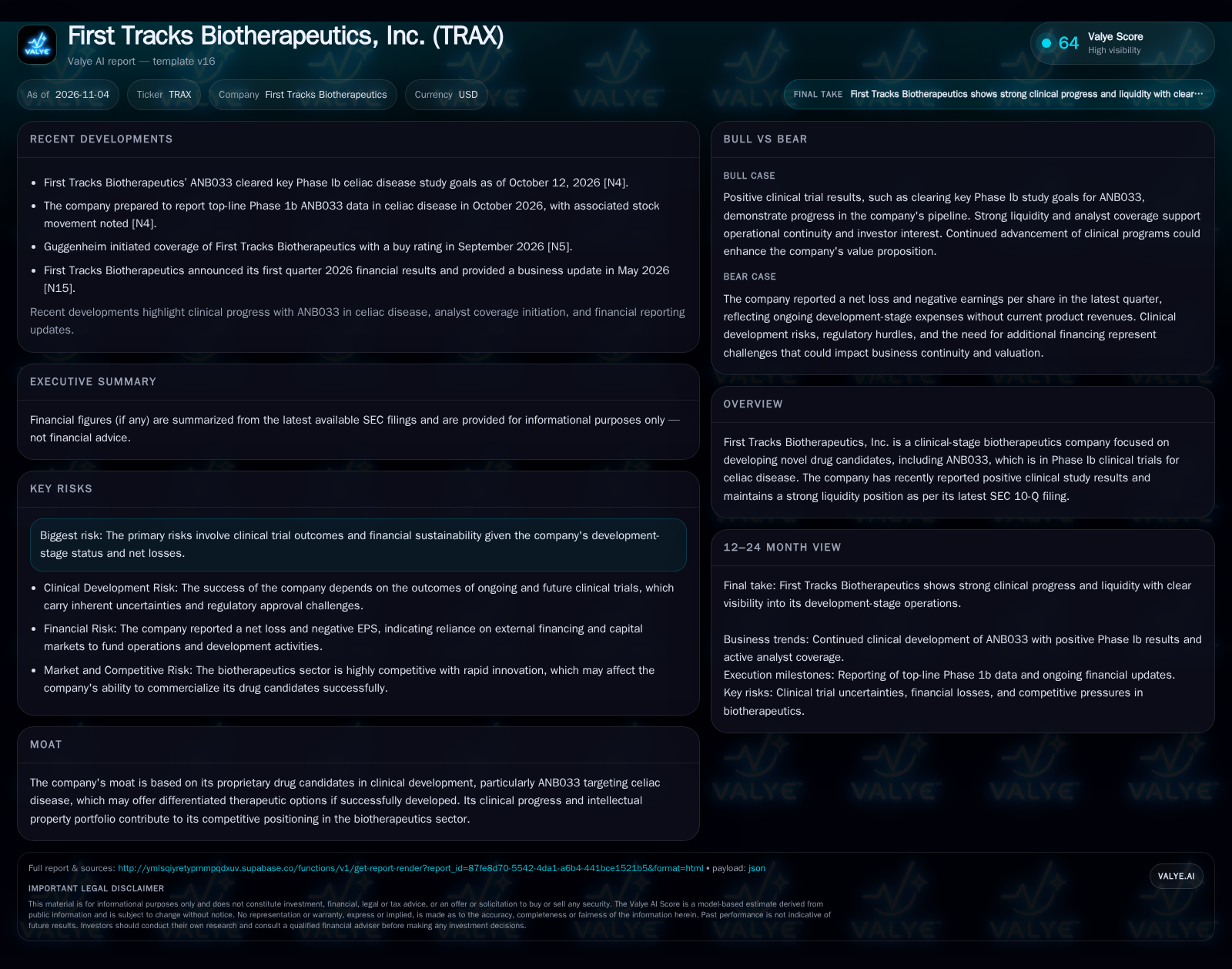
First Tracks Biotherapeutics has reported positive Phase Ib clinical results in celiac disease for ANB033 and maintains a reported cash position of $155.6 million as of September 2026. Guggenheim initiated coverage with a buy rating, reflecting growing external interest. Future value creation hinges on successful late-stage trials and eventual regulatory approval. [S1] [N4] [N5]
First Tracks Biotherapeutics stands out in the biotherapeutics sector as it advances its lead asset, ANB033, through clinical development for celiac disease—a space with no FDA-approved therapies. However, the transition from clinical-stage promise to commercial reality is fraught with risk, from clinical setbacks to the intensifying race among other biopharma players developing competing therapies. The next inflection points will test whether First Tracks can convert its scientific and financial runway into durable competitive advantage. [S1] [N4] [N5]
Clinical Achievements and Financial Strength Provide a Strong Foundation
First Tracks Biotherapeutics recently reported that its lead candidate, ANB033, achieved key goals in a Phase Ib clinical study for celiac disease as of October 2026. This milestone is significant because it demonstrates tangible progress in a high-need therapeutic area with no current FDA-approved treatments. Guggenheim’s initiation of coverage with a buy rating in September 2026 further underscores growing external confidence in the company’s pipeline and prospects. Together, these facts mark a period of clinical and financial momentum, but also set up higher expectations for future trial outcomes and eventual commercialization. [S1] [N4] [N5]
Translating Pipeline Advances into Potential Shareholder Returns
As a clinical-stage biotherapeutics company, First Tracks currently generates no product revenue and relies on external capital to fund R&D, trials, and corporate overhead. The company’s economics are characterized by high upfront costs and negative operating margins, with value realization deferred until successful product approval and commercialization. Should ANB033 or other candidates progress, future revenue streams would likely hinge on pricing power in the absence of direct competitors for celiac disease, subject to payer acceptance and market uptake dynamics.
Cost structure is dominated by variable R&D expenses, with incremental operating leverage possible if a lead candidate advances to approval, given fixed infrastructure. Commercialization would require significant investment in sales, marketing, and potentially manufacturing scale-up, unless partnered with a larger biopharma. If ANB033 demonstrates compelling efficacy and safety in later-stage studies, the company could command premium pricing, especially given the lack of FDA-approved options in celiac disease, though this is tempered by the risk of payer pushback and the need to demonstrate clear differentiation versus emerging competitors.
In addition to the fundamental cost and revenue considerations, the timing of clinical and regulatory milestones critically influences the company's capital efficiency and valuation trajectory. Delays in trial progression or regulatory review can extend the cash runway requirements and increase dilution risk if new financing is needed under less favorable terms. Conversely, accelerated timelines, potentially supported by regulatory designations such as breakthrough therapy status, could compress development cycles and enhance net present value. Moreover, strategic partnerships at various stages—whether for co-development, commercialization, or geographic expansion—could mitigate capital intensity and share execution risks, though they typically involve trade-offs in revenue share and control.
Navigating a Competitive Landscape with Strategic Differentiation
First Tracks operates in a biotherapeutics landscape where scientific innovation is rapid and competitive intensity is high. In celiac disease, ANB033 faces competition from candidates such as FB-102 (argenx SE, post-Forte Biosciences acquisition), GIA632 (Novartis), and TEV-53408 (Teva), all of which are in clinical development targeting similar pathways. The lack of approved therapies creates a significant market opportunity, but it also attracts well-resourced pharmaceutical and biotech incumbents capable of accelerating their own programs or acquiring late-stage assets. [S1]
Beyond celiac, First Tracks’ other candidates, such as rosnilimab and an anti-BDCA2 asset, target indications with entrenched competitors, including established monoclonal antibodies and small molecules from major pharma players. The company’s competitive position will depend on demonstrating clinical superiority, safety, or convenience, as well as speed to regulatory approval. Intellectual property and exclusivity periods offer some protection, but the risk of fast-followers or superior alternatives remains acute in this sector.
Strategic differentiation in this competitive landscape may also hinge on the ability to demonstrate unique mechanisms of action or improved patient-centric outcomes, such as reduced treatment burden or enhanced quality of life, which could justify premium pricing and payer reimbursement. Additionally, the company’s intellectual property portfolio and freedom to operate will be critical in deterring generic or biosimilar entrants post-approval. The evolving regulatory environment for novel celiac disease therapies may also affect competitive dynamics, with potential shifts in approval standards or post-market requirements influencing the relative attractiveness of competing candidates. Maintaining agility in clinical development and regulatory strategy will be essential to navigate these complexities effectively.
Successful Pipeline Outcomes Could Open New Opportunities in Celiac Disease
A favorable outcome would see ANB033 deliver robust efficacy and safety data in subsequent Phase II and III trials, leading to expedited regulatory approval as the first therapy for celiac disease. The absence of FDA-approved treatments could allow First Tracks to establish the drug as the standard of care, capturing significant market share and commanding attractive pricing. Early-mover advantage may enable the company to secure payer coverage and build strong physician adoption, especially if patient outcomes are meaningfully improved over current management via diet alone.
Evidence confirming this scenario would include statistically significant, clinically meaningful results in larger trials, regulatory fast-track or breakthrough designation, and partnership or acquisition interest from larger biopharma companies. Early payer and KOL (key opinion leader) support, as well as signals of rapid market uptake post-launch, would further validate the upside thesis.
Beyond establishing ANB033 as a first-in-class therapy, successful late-stage results could enable First Tracks to explore label expansions into related gluten-sensitive or autoimmune conditions, potentially broadening the addressable market and enhancing long-term revenue streams. Additionally, positive clinical data could facilitate premium pricing negotiations with payers, especially if real-world evidence demonstrates reductions in healthcare resource utilization or improvements in patient adherence compared to dietary management alone. The company might also leverage early commercial success to invest in patient support programs and digital health tools that strengthen brand loyalty and optimize treatment outcomes, thereby creating higher barriers to entry for competitors.
Progress Continues with Financial Prudence Amid Uncertain Conditions
The most plausible path forward is continued clinical progress, with ANB033 advancing through additional studies while First Tracks carefully manages its cash runway. The company may achieve further positive data readouts, but like most biotech firms, will likely face delays, incremental data risks, and the need for additional capital before reaching commercialization. Competition may intensify, with rivals achieving similar or faster progress in parallel celiac disease programs.
Indicators confirming this scenario would include steady burn rates, further clinical milestones achieved on time, and regular updates on trial enrollment and outcomes. Conversely, setbacks such as slower-than-expected enrollment, inconclusive efficacy signals, or rising R&D costs would challenge the base case and could force strategic pivots, including potential partnerships or out-licensing.
Setbacks or Unexpected Competition Could Impact Investment Appeal
The primary risk is that ANB033 or other lead candidates fail to demonstrate sufficient efficacy or safety in mid- or late-stage trials, leading to program discontinuation or major delays. In this scenario, First Tracks’ value would be impaired by the absence of a marketable product, with cash burn eroding the company’s financial cushion and forcing a return to capital markets under less favorable terms. Even if clinical progress continues, a competitor could secure approval first, capturing the first-mover advantage and limiting First Tracks’ commercial opportunity.
Downside confirmation would come from negative or inconclusive clinical results, FDA clinical holds, or evidence that competing therapies have leapfrogged ANB033 in the regulatory process.
Upcoming Milestones Critical to First Tracks’ Future Trajectory
The outcome of upcoming Phase II and III trial readouts for ANB033 in celiac disease—statistical significance, effect size, and safety profile will be decisive.
Updates on enrollment progress, protocol amendments, or regulatory feedback for ongoing and planned trials would help test execution capability.
Cash burn rate and updated guidance on runway duration—would help assess whether further financing will be needed before commercialization.
Evidence of partnership discussions, licensing deals, or acquisition interest from larger biopharma players (if disclosed) could signal external validation.
Payer and physician sentiment toward ANB033 efficacy, safety, and cost-effectiveness, as measured by early market research or advisory board feedback, would help gauge future uptake.
Any regulatory designations (e.g., fast track, breakthrough therapy) for ANB033 may accelerate timelines and bolster the investment case.
Emergence of new clinical data from direct competitors targeting celiac disease, especially any first-in-class approvals, would reshape the competitive landscape.
Disclaimer: This is research-only, informational analysis and not investment advice. It may include AI-generated interpretation and general industry context. Always verify important details using primary sources.

Comments