
Freshworks Advances AI-Enhanced Growth: Profitability, Integration Hurdles, and Enterprise Service Management Evolution
Freshworks’ recent profitability, strategic AI-focused acquisitions, and expanding product suite reflect both opportunity and complexity as the company navigates the competitive enterprise software market. The integration of Torii and emphasis on AI-driven simplicity create new levers for growth, but execution risks and market pressures remain central to the investment thesis.
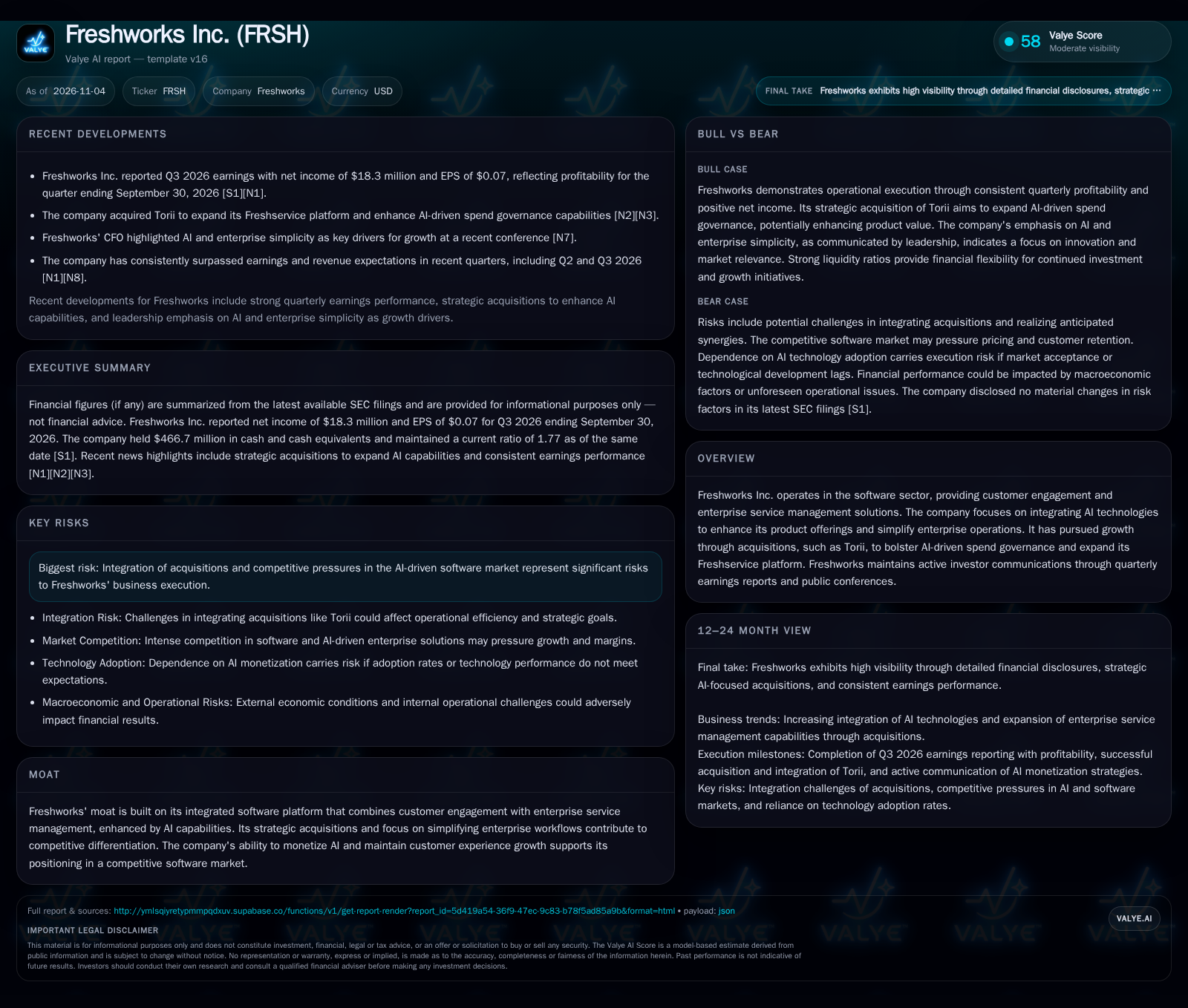
Freshworks reported Q3 2026 profitability, highlighted its AI-centric strategy, and expanded its Freshservice platform with the Torii acquisition. [S1] [N1] [N2] [N3] [N7] [N8]
Freshworks is entering a new phase of maturity in the enterprise software landscape, marked by consistent profitability, a reported cash position, and a strategic pivot toward AI-driven solutions. The recent acquisition of Torii expands its Freshservice platform into spend governance, reflecting a bid to deepen product stickiness and address evolving customer needs. However, the company’s ability to integrate acquisitions and translate AI investments into lasting revenue streams will be pivotal in determining whether it can outpace formidable competition and justify its current growth narrative.
Freshworks’ 2026 Outlook: Profitability, Expansion, and AI’s Strategic Impact
Freshworks posted net income of $18.3 million and EPS of $0.07 for Q3 2026, reflecting ongoing profitability at a time when many SaaS peers face margin pressures. As of September 30, 2026, the company reported $466.7 million in cash and cash equivalents, with a current ratio of 1.77 and a cash ratio of 2.51, indicating a reported liquidity position. This financial strength underpins Freshworks’ ability to pursue growth initiatives without immediate external funding needs. The acquisition of Torii, aimed at expanding the Freshservice product suite and introducing AI-driven spend governance, signals a strategic commitment to platform breadth and deeper enterprise integration. Management’s public emphasis on AI and enterprise simplicity as growth levers further positions Freshworks as a contender in the next wave of enterprise software innovation. [S1] [N1] [N2] [N3] [N7] [N8]
Recurring Revenue, Product Growth, and AI’s Role in Freshworks’ Economic Model
Freshworks’ business model is rooted in software-as-a-service (SaaS) economics, where recurring subscription revenue dominates and customer retention is paramount. The company’s expansion into AI-driven spend governance (via Torii) and broader enterprise service management suggests an intent to increase average contract value (ACV) and deepen account penetration. In SaaS, revenue growth is typically driven by a combination of new customer acquisition, upsell/cross-sell to existing clients, and expansion into adjacent workflows. The integration of AI may allow Freshworks to command premium pricing or reduce churn, but this is not yet established as a current fact.
Operating leverage is a key factor: as Freshworks grows, its ability to spread R&D and sales costs across a larger revenue base could drive margin expansion—provided it can contain customer acquisition costs and maintain high retention. However, the economics of integrating acquired technologies (like Torii) can be complex, involving upfront integration costs and the risk of delayed synergy realization. If AI features can be effectively monetized, they could shift the revenue mix toward higher-margin products, but the timing and magnitude of such benefits remain to be proven.
How Freshworks Stands Out in a Saturated SaaS and AI Service Management Landscape
Freshworks operates in a highly competitive landscape, facing established enterprise software providers as well as newer SaaS entrants targeting customer engagement and IT service management. Its competitive position is shaped by its integrated platform approach, combining customer support, ITSM, and now spend governance with a growing AI toolkit. The moat hypothesis rests on product breadth, ease of use, and the ability to deliver tangible workflow simplification—attributes that could reduce switching costs and increase stickiness if proven effective.
However, barriers to entry in SaaS are relatively low, and software buyers frequently re-evaluate vendors. The addition of AI features is rapidly becoming table stakes, with both large incumbents and specialist startups investing aggressively. Freshworks’ ability to differentiate on simplicity and rapid deployment may appeal to mid-market and upper-SMB segments, but price competition and the challenge of demonstrating superior ROI remain persistent counterforces. The success of the Torii integration will be a key test of whether Freshworks can genuinely extend its platform advantage and not merely match the feature set of larger rivals.
Growth Potential from AI Monetization and Platform Development
A favorable scenario emerges if Freshworks rapidly and successfully integrates Torii, enabling it to cross-sell AI-driven spend governance to its existing customer base and attract new enterprise accounts. If AI features demonstrably reduce customer costs or improve operational efficiency, Freshworks could justify higher pricing tiers or expand wallet share within accounts. This would likely result in above-peer revenue growth, margin expansion from operating leverage, and improved customer retention as the platform becomes more central to business operations.
Evidence confirming this scenario would include a material increase in net dollar retention rates, disclosed customer wins attributable to new AI-driven modules, and a trend of accelerating ACV growth. Public case studies or management commentary tying revenue outperformance directly to AI and Torii integration would further validate this thesis.
Operational Stability Coupled with Steady AI Adoption
The most plausible path forward is one where Freshworks continues to deliver steady revenue and earnings growth, benefiting incrementally from AI adoption and expanded product breadth. Integration of Torii proceeds without major disruption but does not produce immediate step-change results. AI features are adopted by a subset of customers, supporting modest improvements in retention and upsell rates, while the broader market remains price-sensitive and competitive.
Confirmation of this scenario would come from continued quarterly profitability, stable or modestly improving margins, and management guidance that emphasizes gradual progress in AI monetization rather than breakout acceleration. Evidence against this path would include either a sudden jump in churn (suggesting integration or product issues) or rapid margin expansion (which would point to a more bullish scenario).
Risks from Integration Challenges and Intensifying Competition
In a downside scenario, Freshworks encounters significant challenges integrating Torii, resulting in product delays, customer confusion, or operational inefficiencies. If the broader market perceives Freshworks’ AI features as undifferentiated or struggles to realize ROI, pricing pressure could intensify, and customer churn may increase. Larger incumbents or aggressive startups could accelerate feature parity, eroding any first-mover or simplicity advantage.
Signs that this scenario is unfolding would include missed revenue or margin targets, disclosures of integration-related setbacks or elevated churn, and management commentary shifting toward remediation and cost control rather than expansion. Public customer losses or negative feedback about the Torii integration and AI features would further support the bear case.
Freshworks’ Progress Benchmarks for AI-Driven Expansion
Net dollar retention rate trends, especially if management attributes improvements to AI or spend governance modules.
Disclosed customer wins or case studies explicitly tied to the Torii integration or new AI-driven features.
Quarterly updates on the pace and breadth of AI feature adoption within the customer base, if disclosed.
Gross margin and operating margin progression, indicating whether operating leverage is being realized as revenue grows.
Churn rates or customer retention metrics, particularly in the wake of major platform integrations or pricing changes.
Management’s qualitative commentary on the success of cross-selling Torii capabilities to existing Freshservice customers.
Any reported product delays, integration costs, or operational disruptions linked to recent acquisitions.
Competitive responses—such as accelerated feature launches or aggressive pricing—by major SaaS and ITSM vendors.
Disclaimer: This is research-only, informational analysis and not investment advice. It may include AI-generated interpretation and general industry context. Always verify important details using primary sources.

Comments