
XPLR Infrastructure: Distribution Suspension, Asset Mix, and the Challenge of Sustainable Cash Flow in Clean Energy Infrastructure
XPLR Infrastructure’s recent net profitability and asset reshuffling highlight both the resilience and the structural pressures facing clean energy partnerships. The suspension of common unitholder distributions, significant goodwill impairments, and shifting project economics reveal a business model at a crossroads between steady contracted revenue and the volatility of resource-dependent returns.
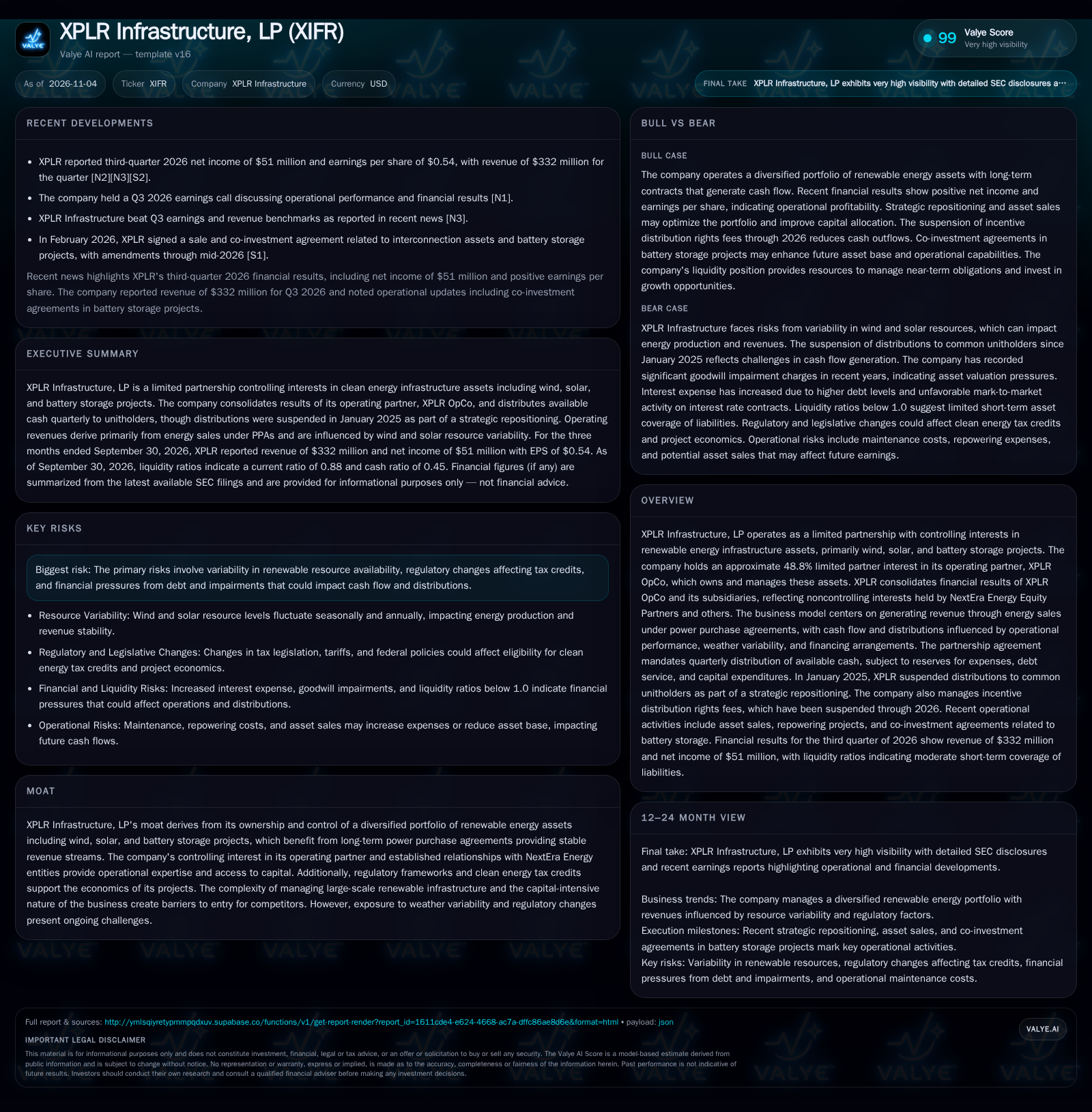
XPLR Infrastructure reported Q3 2026 net income of $51 million and revenue of $332 million, but continues to suspend distributions to common unitholders amid strategic repositioning and asset sales. Despite stable revenue from long-term power purchase agreements, the business faces persistent headwinds from resource variability, increased debt service, and significant goodwill impairments—raising questions about the sustainability of cash flows and the long-term value proposition for equity holders. [S2] [N2] [N3]
XPLR Infrastructure, LP stands at a pivotal junction as a major owner and operator of renewable energy assets. While the company’s Q3 2026 results showed a return to net profitability and revenues above expectations, its ongoing suspension of distributions to common unitholders and recurring asset impairments highlight the underlying challenges of the clean energy infrastructure model. The partnership’s cash flows remain tied to a complex mix of long-term contracts, resource availability, and evolving capital structures—posing fundamental questions about the durability of returns and the balance between growth, risk, and distribution.
Recent Profitability Masks Distribution Pause and Asset Revaluation
XPLR Infrastructure reported $332 million in revenue and $51 million in net income for Q3 2026, outperforming analyst expectations and marking a period of operational profitability. However, this quarterly strength is juxtaposed against a continued suspension of distributions to common unitholders—a policy in place since January 2025 as part of a broader strategic repositioning. This signals a focus on liquidity and capital preservation rather than immediate returns to equity holders. The company has also recorded substantial non-cash goodwill impairment charges—$253 million in 2025 and $575 million in 2024—indicating pressure on the carrying value of certain assets, which may reflect changing market conditions or expectations for future cash flows. As of September 30, 2026, XPLR reported $505 million in cash and equivalents, a current ratio of 0.88, and a cash ratio of 0.45, underscoring limited short-term coverage of liabilities. [S1] [S2] [N2] [N3]
How XPLR’s Revenue Model Balances Fixed Contracts and Variable Resource Risk
XPLR Infrastructure’s core economics are anchored by long-term power purchase agreements (PPAs) for its wind, solar, and battery storage assets, providing a contracted revenue base that can offer predictability versus merchant energy sales. This structure in theory supports leverage and capital recycling. However, actual cash generation is sensitive to wind and solar resource variability, operational uptime, and the performance of repowered or newly acquired assets. While O&M expenses can be partially offset by vendor credits or operational efficiencies, depreciation and amortization are rising due to ongoing repowering investments—highlighting the capital-intensive, long-lived nature of the asset base. Interest expense has increased, influenced by both higher average debt and adverse mark-to-market movements on interest rate contracts, further pressuring distributable cash. The business’s funding model depends on a mix of asset-level non-recourse debt and partnership-level cash flows, with quarterly distribution requirements suspended in response to recent financial headwinds. [S1]
The interplay between fixed-price PPAs and the inherent variability of renewable energy generation creates a nuanced risk profile for XPLR Infrastructure. While PPAs provide a floor for revenue, the timing and predictability of cash inflows depend heavily on actual energy production, which is subject to weather patterns and equipment performance. This intermittency necessitates sophisticated forecasting and risk management strategies, including hedging through derivatives or contractual arrangements with off-takers. Moreover, the capital-intensive nature of repowering projects—required to maintain or enhance asset output over multi-decade horizons—introduces additional layers of capital allocation risk. The balance between deploying capital for maintenance versus growth investments directly influences distributable cash flow and the partnership’s ability to meet its debt service obligations without resorting to equity dilution or asset sales.
Interest expense dynamics further complicate the cash flow picture. XPLR’s reliance on a combination of asset-level non-recourse debt and partnership-level financing exposes it to refinancing risks and interest rate volatility. In a rising rate environment, mark-to-market losses on interest rate swaps or other hedging instruments can create non-cash but recurring earnings pressure, potentially obscuring operational performance. Additionally, the structure of debt covenants and amortization schedules may constrain flexibility in capital deployment or distributions. Monitoring the maturity profile of debt and the availability of refinancing options becomes critical, especially if asset performance or regulatory conditions deteriorate. The company’s ability to optimize its capital structure while preserving liquidity will be a key determinant of sustainable cash flow generation.
Contracted Clean Energy: Barriers, Peers, and the Threat of Substitution
XPLR’s competitive stance is shaped by its diversified asset base, access to operational expertise via NextEra affiliates, and the scale to pursue large wind, solar, and battery storage projects. Long-term PPAs provide a degree of revenue insulation, and the complexity of project development, capital access, and regulatory navigation creates entry barriers. However, these advantages are increasingly challenged by a maturing renewables market: new entrants, utility-scale developers, and infrastructure funds are expanding their presence, often with more flexible cost structures or different risk appetites. The company remains exposed to substitution risk from emerging energy storage technologies and evolving grid solutions, which could compress margins or require further repowering investment. Regulatory changes affecting tax credits or interconnection rules could also reshape competitive dynamics. While the suspension of Incentive Distribution Rights (IDRs) through 2026 reduces cash outflows, it may also signal a need to preserve capital amid uncertain returns.
If Asset Mix Optimization and Storage Expansion Translate to Cash Flow Restoration
A favorable trajectory for XPLR would involve the successful repositioning of its asset portfolio—shedding underperforming or impaired assets while reinvesting in higher-yielding battery storage and next-generation renewables. If resource availability normalizes and new PPAs are signed at attractive rates, operating leverage could improve, restoring distributable cash flow and enabling the reinstatement of quarterly distributions. Enhanced grid integration or regulatory tailwinds (such as expanded tax credits) could further boost project economics. Concrete signs of this scenario would include sustained positive net income, a return to common unitholder distributions, a reversal or stabilization of impairment charges, and improved liquidity ratios. Accelerating growth in co-investment storage deals or asset sale gains would also support this thesis.
If XPLR successfully leverages advancements in battery storage technology and grid integration, the partnership could unlock new revenue streams beyond traditional energy sales. Enhanced storage capacity allows for better arbitrage opportunities, frequency regulation, and participation in ancillary service markets, potentially increasing asset utilization and margins. Moreover, integrating storage with renewable generation assets can mitigate resource variability, thereby stabilizing cash flows and improving the predictability of distributions. This strategic shift would require disciplined capital allocation and operational excellence to avoid margin compression from increased complexity or maintenance costs. Nonetheless, favorable regulatory developments that incentivize storage deployment could accelerate this transition and improve the overall risk-return profile of the asset base.
Maintaining Stability Amid Resource and Financing Headwinds
The most plausible near-term outcome for XPLR is continued operational stability with moderate revenue growth, but persistent pressure on distributable cash due to resource variability, elevated interest expense, and ongoing capital needs for asset repowering or maintenance. The company may continue to prioritize liquidity, keeping distributions to common unitholders suspended while gradually repositioning its portfolio in line with market conditions. Margins may remain compressed, with incremental improvements tied to vendor negotiations or selective asset sales. Confirmation of this scenario would come from quarterly revenue and net income figures that track recent trends, ongoing but reduced impairment charges, and liquidity ratios that remain below 1.0 absent a material change in capital structure or asset performance.
Prolonged Distribution Suspension and Asset Impairments Erode Equity Value
A negative outcome would see XPLR facing continued or worsening resource underperformance, further regulatory headwinds, or capital market constraints that limit the company’s ability to refinance or recycle assets. Additional impairment charges could signal persistent overvaluation of legacy projects, while higher debt service costs and rising O&M or repowering expenses erode cash flow. If distribution suspensions persist and asset sales fail to generate sufficient proceeds or strategic repositioning stalls, the partnership’s equity value could come under sustained pressure. Evidence for this scenario would include further net losses, rising impairment or interest expense, a deteriorating current ratio, and no indication of a timeline for reinstating distributions.
In a prolonged adverse environment, XPLR could face a compounding cycle of asset impairments and constrained liquidity that undermines its potential financial flexibility. Continued underperformance of renewable resources due to climatic shifts or equipment degradation would reduce revenue below PPA expectations, triggering potential covenant breaches or forced asset disposals at unfavorable valuations. Simultaneously, rising interest expenses and limited access to capital markets may increase refinancing risk, elevating the cost of capital and pressuring distributable cash flow further. This scenario could necessitate more aggressive cost-cutting measures or restructuring efforts, which might impair long-term operational capabilities and investor confidence. Without clear pathways to restore distributions or stabilize asset values, the partnership’s equity holders could experience sustained value erosion.
What Could Confirm or Challenge XPLR’s Long-Term Value Proposition
Quarterly distributable cash flow and actual distributions to common unitholders—if disclosed—would help gauge the effectiveness of repositioning and cash generation.
Trends in goodwill and asset impairment charges: a stabilization or reversal would suggest improved asset quality or better market conditions.
Execution and returns on new battery storage and co-investment agreements: project-level details and outcomes would clarify future growth prospects.
Interest expense trends and mark-to-market impacts on interest rate contracts, as these directly affect distributable cash and debt sustainability.
Operational metrics such as capacity factors, outage rates, and realized PPA prices—if reported—would clarify the linkage between resource variability and financial outcomes.
Regulatory developments regarding clean energy tax credits or interconnection rules, which could materially alter project economics or competitive dynamics.
Any announced timeline or management commentary on the resumption of distributions, which would be a key signal for equity value recovery.
Disclaimer: This is research-only, informational analysis and not investment advice. It may include AI-generated interpretation and general industry context. Always verify important details using primary sources.

Comments