
Alight’s Strategic Shift Post-Divestiture: AI Integration, Recurring Revenue Dynamics, and Execution Risks
Alight, Inc. has sharpened its focus on integrated employee benefits administration after a major divestiture, betting on AI-driven personalization and a recurring revenue model. The company’s post-divestiture margin path, ability to deliver differentiated outcomes, and resilience against larger competitors will determine whether this strategic refocus yields durable value.
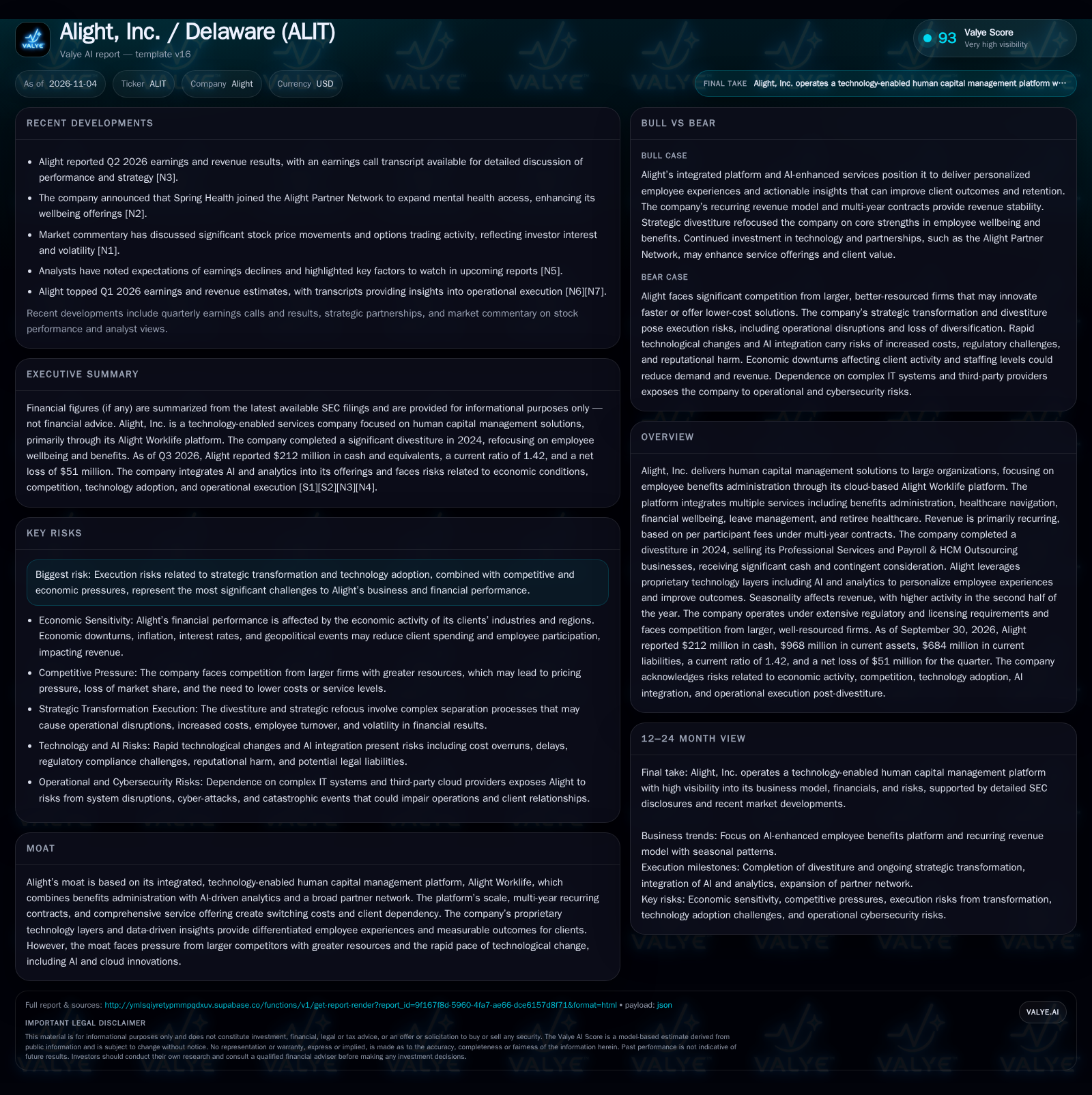
Alight, Inc. has exited its Professional Services and Payroll & HCM Outsourcing businesses, receiving $1 billion in cash and contingent notes, and is now centered on its Alight Worklife platform for employee benefits administration. The company’s revenue is largely recurring, supported by multi-year contracts, but recent results show a net loss and modest current liquidity. Future value creation will hinge on successful AI integration, operational execution post-divestiture, and the company’s ability to fend off larger, well-resourced competitors in a rapidly evolving human capital management market. [S2]
Alight, Inc. has emerged from a significant strategic transformation, having divested its Professional Services and Payroll & HCM Outsourcing businesses in 2024 to refocus on its core strength: technology-enabled employee benefits administration. Now operating primarily through its Alight Worklife platform, the company is betting on AI and analytics to drive both client retention and market differentiation. However, recent financials highlight the pressure to translate this focus into sustainable profitability, as Alight faces stiff competition from larger players and must prove that its renewed strategy can deliver both operating leverage and resilience through economic cycles. [S2]
Post-Divestiture Reality: Platform Focus and Continuing Losses Shape Alight’s Trajectory
Alight, Inc. completed a major divestiture in July 2024, selling its Professional Services segment and Payroll & HCM Outsourcing business for $1 billion in cash and contingent notes. This transaction has left the company with a sharper focus on its Alight Worklife platform, which now anchors its Employer Solutions segment. The company’s revenue remains largely recurring, driven by per-participant fees under contracts typically lasting three to five years. As of September 30, 2026, Alight reported $212 million in cash, a current ratio of 1.42, and a net loss of $51 million for the quarter, with diluted EPS of -$1.93. These facts highlight both the influx of cash from the divestiture and the ongoing challenge of achieving profitability in its streamlined business model. [S2]
Evaluating Alight’s Recurring Revenue Model for Potential Operating Leverage
Alight’s economics fundamentally hinge on recurring, per-participant fees under multi-year contracts—creating a predictable revenue base that is less exposed to project-based volatility but is sensitive to client headcount and employment trends. The company’s post-divestiture focus means less revenue diversification, which increases exposure to the core benefit administration cycle and seasonality (notably, higher revenues in the second half due to annual enrollment).
Operating leverage could emerge as Alight increases participant counts or cross-sells new AI-driven modules without a commensurate rise in fixed costs. However, the platform business is capital-intensive in terms of technology investments, particularly around AI, analytics, and cybersecurity. The company’s ability to achieve margin expansion will depend on controlling technology costs and extracting more value from its existing client base, while managing the risk that larger competitors could erode pricing or force increased investment to maintain parity.
The recent net loss signals that, despite the recurring revenue base, margin improvement is not automatic post-divestiture. If Alight can scale its AI and analytics offerings efficiently, it may be able to drive higher revenue per participant or reduce service delivery costs, but this remains to be proven in the post-divestiture structure. [S2]
Alight’s Integrated Platform and AI Edge Confront Scale Challenges and Competitive Pressures
Alight’s competitive position is built on its integrated Alight Worklife platform, which combines benefits administration, healthcare navigation, and financial wellbeing tools. The company aims to differentiate through AI-enhanced personalization and a broad partner network, but faces intense competition from larger, better-resourced human capital management and benefits administration providers. These competitors may have greater ability to invest in AI, undercut pricing, or bundle services.
Switching costs in benefits administration can be significant due to data complexity, regulatory compliance, and integration with HR systems, but are not insurmountable—especially if competitors offer superior technology or lower pricing. Alight’s multi-year contracts provide some protection, but renewal risk is real if clients perceive less innovation or value relative to alternatives.
The company’s moat is further challenged by the rapid evolution of AI and cloud technologies, which can quickly erode legacy advantages. Alight’s reliance on third-party cloud providers and complex IT systems introduces operational risk and may limit its ability to control the pace of innovation compared to vertically integrated rivals. [S2]
Margin Expansion and Retention Improvements Possible with Successful AI-Driven Personalization
The favorable scenario for Alight is one where its investments in AI and analytics yield tangible improvements in client employee outcomes—such as higher benefits utilization, better health and financial wellbeing, and reduced administrative burdens. These differentiated outcomes could drive higher client retention, justify premium pricing, and create opportunities to upsell additional modules or services.
Operating leverage could materialize if technology investments flatten while revenue per participant rises, either through organic growth or successful cross-selling. Evidence that would confirm this scenario includes: a sustained trend of revenue per participant increasing, margin expansion in quarterly filings, and client case studies or renewals explicitly citing AI-driven value.
The scenario could be falsified if margin improvement stalls, if technology costs continue to outpace revenue gains, or if client churn rises due to dissatisfaction or competitive displacement. Independent analyst commentary or customer wins/losses attributed to technology differentiation would be important confirming or falsifying signals.
Expectations of Platform Stability Amid Competitive Renewal and Gradual Margin Improvement
The most plausible path is that Alight maintains its core client base due to the inertia and complexity of switching benefits administration providers, but faces ongoing renewal and pricing pressure from larger competitors investing aggressively in AI and platform capabilities. Revenue continues to be stable and recurring, but any margin expansion is gradual and may be offset by the need for sustained investment in technology and compliance.
This scenario would be confirmed by stable revenue and participant counts, moderate improvement in operating margins (if disclosed), and a renewal rate that remains in line with historical averages. It would be challenged by evidence of margin compression, rising technology or compliance costs, or a spike in client churn—particularly among larger enterprise clients.
Profitability and Client Loyalty at Risk from Execution Challenges and Slow AI Uptake
In the adverse scenario, Alight struggles to execute its post-divestiture strategy: technology investments fail to deliver differentiated outcomes, AI integration is costly or delayed, and clients perceive insufficient value versus larger, more innovative competitors. This could result in higher churn at contract renewal, pricing concessions to retain business, or the need for further restructuring.
Financially, this would manifest as persistent net losses, declining margins, or a reduction in recurring revenue base. Contributing factors could include regulatory setbacks, cybersecurity incidents, or operational disruptions stemming from the company’s reliance on third-party cloud infrastructure.
The scenario would be confirmed by repeated quarterly losses, negative analyst commentary on competitive positioning, or news of major client defections. It would be partially falsified by evidence of successful new client wins, improved profitability, or publicized AI-driven product launches that gain market traction.
Alight’s Progress Monitored Through Value Creation and Competitive Strength Metrics
Revenue per participant: If disclosed, this would indicate whether AI-driven cross-selling or premium offerings are gaining traction.
Operating margin trends: Quarterly improvement would support the thesis that technology investments are producing leverage post-divestiture.
Client renewal and churn rates: A useful metric would be the proportion of contracts renewed at equal or higher value, versus lost to competitors.
Case studies or client testimonials citing AI-enabled outcomes: Public disclosures or analyst commentary would help test whether differentiation is real or marketing-driven.
Technology expense as a percentage of revenue: Monitoring this would reveal whether investments are becoming more efficient or are outpacing growth.
Major client wins or losses, especially for large enterprise accounts: These events would signal market confidence in Alight’s platform versus larger competitors.
Incidents of operational disruption or cybersecurity events: Any reported outage or breach would test the company’s resilience given its reliance on complex IT and third-party cloud providers.
Regulatory or legal developments related to AI and employee data: New compliance requirements or litigation could impact cost structure and innovation pace.
Disclaimer: This is research-only, informational analysis and not investment advice. It may include AI-generated interpretation and general industry context. Always verify important details using primary sources.

Comments