
EverQuote’s AI Ambitions, Customer Concentration, and the Next Phase of Insurance Marketplace Economics
EverQuote’s accelerating revenue and profitability underscore the leverage in its digital insurance marketplace model, but a heavy reliance on a few auto insurance carriers and rising operating expenses shape both opportunity and risk. The company’s AI-driven platform investments may enhance traffic quality and referral value, yet industry cyclicality and customer concentration remain critical variables for long-term resilience.
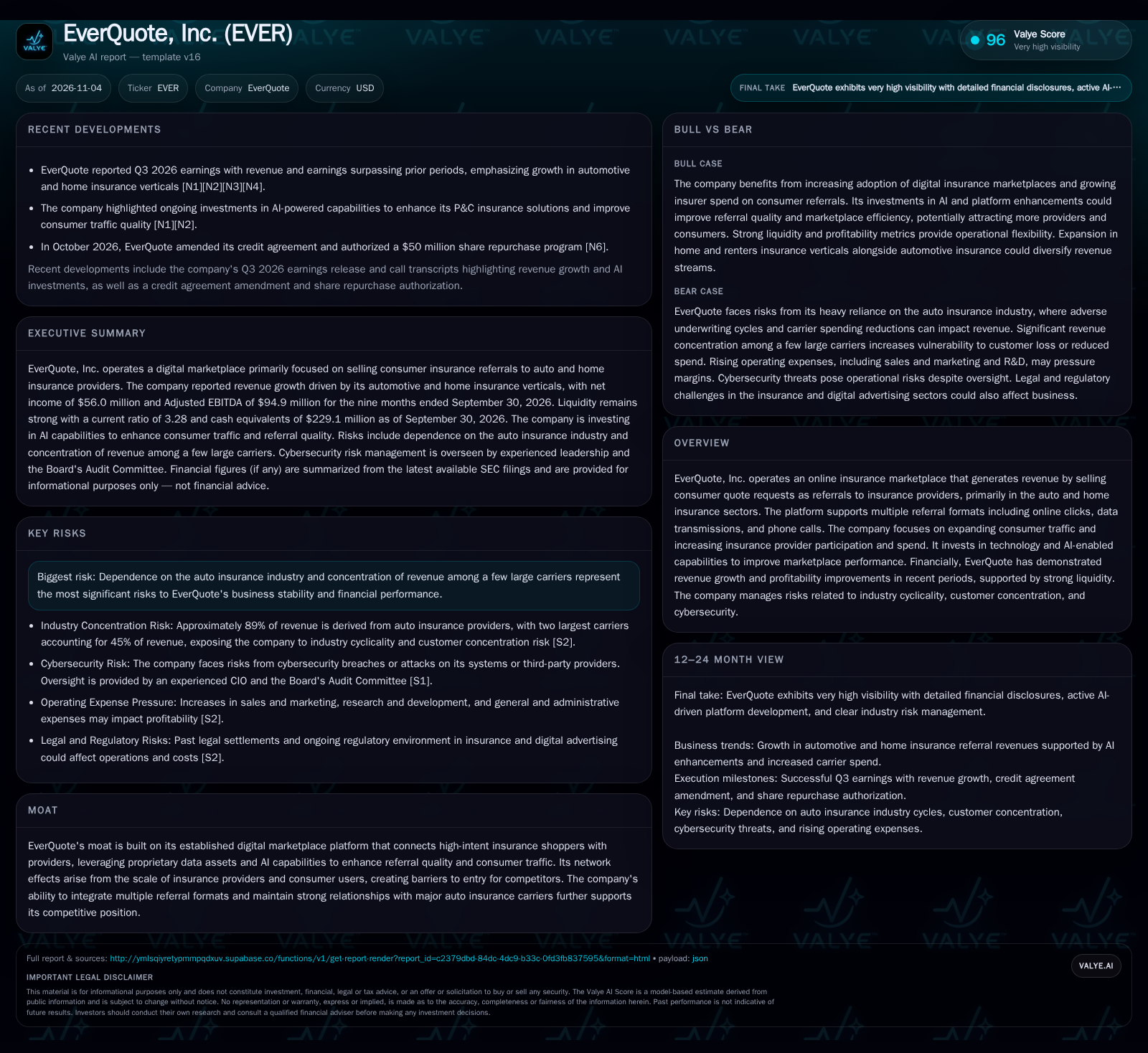
EverQuote reported substantial revenue and earnings growth for the first nine months of 2026, driven by its auto and home insurance referral markets. However, 89% of revenue comes from auto providers, with two carriers representing 45% of total revenue, exposing the company to industry cycles and customer concentration risk. Investments in AI-enabled capabilities aim to improve platform performance, but rising operating expenses and industry cyclicality could pressure margins.
EverQuote’s latest financials highlight the power—and fragility—of its digital insurance marketplace model. The company is delivering robust growth and margin expansion, fueled by auto and home insurance referrals and underpinned by its reported liquidity position. Yet, with nearly nine-tenths of revenue tied to auto insurance providers and two carriers making up close to half of total revenue, EverQuote’s fortunes remain closely linked to industry cycles and the spending decisions of a concentrated customer base. As investments in AI and platform enhancements accelerate, the company’s ability to diversify revenue streams and manage rising costs will determine whether it can sustain its momentum or succumb to the familiar pitfalls of concentration and cyclicality.
Recent Financial Performance and Strategic Moves Set the Stage
EverQuote reported revenue of $604.0 million for the nine months ended September 30, 2026, up from $497.2 million for the same period in 2025, reflecting growth in both the automotive and home insurance verticals. Net income rose to $56.0 million, and Adjusted EBITDA reached $94.9 million, indicating significant improvement in operating leverage and profitability [S2]. As of September 30, 2026, EverQuote reported $229.1 million in cash and equivalents, a current ratio of 3.28, and a cash ratio of 2.36 [S2]. In October 2026, EverQuote amended its credit agreement and authorized a $50 million share repurchase program [N6].
However, 89% of revenue still derives from auto insurance providers, and the top two carrier customers account for a combined 45% of revenue, underscoring the company’s ongoing exposure to customer concentration and industry cyclicality [S2]. At the same time, EverQuote is investing in AI-enabled capabilities designed to improve the quality and quantity of consumer traffic, particularly within its P&C insurance solutions [N1] [N2] [N3] [N4].
Marketplace Model Economics and the Challenge of Scale
EverQuote’s revenue model is built around selling consumer referrals—generated through its online marketplace—to insurance providers. Revenue is recognized at the point of referral delivery, supporting three primary formats: clicks (online-to-online), data (online-to-offline), and calls (both online- and offline-to-offline) [S1]. This transaction-based approach means revenue is closely linked to consumer inquiry volumes, provider demand, and the platform’s ability to match high-intent shoppers to relevant carriers.
The model benefits from inherent operating leverage: incremental referral volumes can be monetized with relatively modest increases in variable cost, while fixed costs (notably in technology and platform maintenance) are spread across a larger revenue base. This dynamic is reflected in the expanding Adjusted EBITDA margin as revenue has grown [S2]. However, EverQuote’s cost structure is sensitive to two key areas: sales and marketing, which increased in 2026 as the company competed for consumer attention and carrier spend; and research and development, which grew as EverQuote invested in AI and platform enhancements [S2]. If these investments successfully drive higher-quality traffic and conversion rates, they may ultimately improve margins by attracting more providers and increasing their willingness to pay for leads. However, if consumer acquisition costs outpace referral monetization, profitability could be pressured.
EverQuote’s capital requirements are relatively modest for a digital marketplace, but ongoing investment in technology and traffic acquisition remains critical. The recent share repurchase program and amended credit agreement may provide additional potential financial flexibility, though the company’s long-term economics will hinge on its ability to drive volume and pricing power while managing customer acquisition and retention costs.
Network Effects, AI Differentiation, and Competitive Pressures
EverQuote’s primary advantage lies in its established two-sided marketplace, which connects a large base of insurance shoppers with providers, generating network effects as more participants on each side increase the platform’s value. The company’s proprietary data and AI-driven referral matching aim to differentiate its offerings by improving lead quality and conversion rates for carriers, which may justify higher referral prices or deeper carrier engagement [N1] [N2] [N3] [N4].
However, the digital insurance lead generation space is highly competitive, with alternative channels including other digital marketplaces, direct-to-carrier acquisition, and traditional agency networks. Larger insurance carriers increasingly invest in their own digital acquisition infrastructure, potentially reducing reliance on third-party platforms like EverQuote. At the same time, customer switching frictions are relatively low—carriers can shift marketing budgets rapidly in response to perceived lead quality or cost-effectiveness.
EverQuote’s integration of multiple referral formats (clicks, calls, data) and focus on high-intent consumers may help maintain a competitive edge, but sustained differentiation will require continuous platform innovation and demonstrable improvements in traffic quality. The company’s heavy revenue concentration among a few large carriers heightens vulnerability to competitive moves or strategic shifts by those partners.
AI-Driven Enhancements Unlock Platform Scale and Diversification
If EverQuote’s investments in AI-enabled capabilities deliver substantial improvements in traffic quality, referral conversion rates, and provider ROI, the company could attract increased spend from both existing and new insurance carriers. Enhanced platform performance may allow EverQuote to command higher prices per referral and expand its share of carrier marketing budgets—especially if carriers perceive EverQuote as a more efficient customer acquisition channel than alternatives.
A successful expansion into home and renters insurance verticals could meaningfully diversify the revenue base, reducing dependence on auto insurance cycles and top carrier customers. Over time, network effects may strengthen as more providers and consumers join the platform, further increasing marketplace liquidity and reinforcing EverQuote’s moat.
Confirmation of this scenario would come from a declining share of revenue from the top two auto carriers, rising referral yields, increased carrier participation, and sustained margin expansion even as operating expenses rise. Additional evidence would include continued double-digit revenue growth in non-auto verticals and positive commentary from carriers regarding referral quality and ROI.
Sustaining Growth Amid Industry Cyclicality and Cost Inflation
The most plausible trajectory is that EverQuote continues to deliver moderate revenue and earnings growth, primarily driven by its core auto insurance vertical, with incremental gains in home and renters insurance. AI and platform investments yield gradual improvements in referral quality, supporting stable or slightly higher carrier spend, but do not fundamentally transform the economics or competitive landscape.
Operating expenses—particularly sales, marketing, and R&D—remain elevated as EverQuote competes for consumer attention and carrier engagement, resulting in modest margin expansion or stability rather than dramatic improvement. Revenue concentration among the top auto carriers persists, leaving the company exposed to industry cycles and customer budget shifts.
Evidence supporting this scenario would include continued high (but not increasing) revenue concentration, steady (rather than accelerating) growth in non-auto verticals, and relatively flat referral yields. Margins would improve in line with revenue growth, but not at a rate suggesting step-change efficiency or diversification.
Carrier Budget Cuts and Industry Cycles Erode Demand
In an adverse scenario, weakness in the auto insurance sector or unfavorable underwriting cycles prompt major carriers to cut marketing spend, resulting in a sharp reduction in EverQuote’s referral volumes and revenue. If one or both of the top carrier customers materially reduce their participation or exit the platform, the impact on top-line results and profitability could be severe given their combined 45% share of revenue [S2].
Rising sales and marketing costs, combined with stagnant or declining referral volumes, could compress margins and undermine the value proposition for both providers and consumers. If AI and platform investments fail to yield measurable improvements in traffic quality, carriers may shift budgets to alternative acquisition channels perceived as more efficient.
This scenario would be confirmed by declining revenue or negative growth rates, a significant drop in spend from the top two carriers, deteriorating EBITDA margins, and negative commentary from carriers regarding lead quality or ROI. Additional warning signs would include rising customer acquisition costs and stagnant or shrinking participation in non-auto verticals.
Benchmarks for Testing EverQuote’s Marketplace Resilience and Growth Ambitions
The percentage of revenue derived from auto insurance providers versus home and renters insurance verticals—declining auto concentration would indicate successful diversification.
The combined revenue share of the top two carrier customers—if disclosed, a reduction would reduce concentration risk and signal broader platform adoption.
Referral yield metrics (average revenue per referral or per inquiry)—if disclosed, would help test the impact of AI-enabled enhancements and pricing power.
Sales and marketing expense as a percentage of revenue—rising ratios may signal intensifying competition for consumer traffic or diminishing marketing efficiency.
Carrier retention and churn rates—if disclosed, would clarify the stability of provider relationships and EverQuote's vulnerability to customer loss.
Growth rates in home and renters insurance revenue—sustained double-digit growth would support the diversification thesis.
EBITDA margin trends—expansion would validate operating leverage and efficiency gains from platform investments.
Commentary or disclosures on carrier satisfaction and ROI from referrals—would help assess EverQuote's value proposition relative to alternative acquisition channels.
Disclaimer: This is research-only, informational analysis and not investment advice. It may include AI-generated interpretation and general industry context. Always verify important details using primary sources.

Comments