
California Resources Corp: Portfolio Reshaping, Operational Constraints, and the Search for Sustainable Margins
Can the company’s evolving asset mix and infrastructure investments shift the economics, or will structural headwinds keep returns elusive?
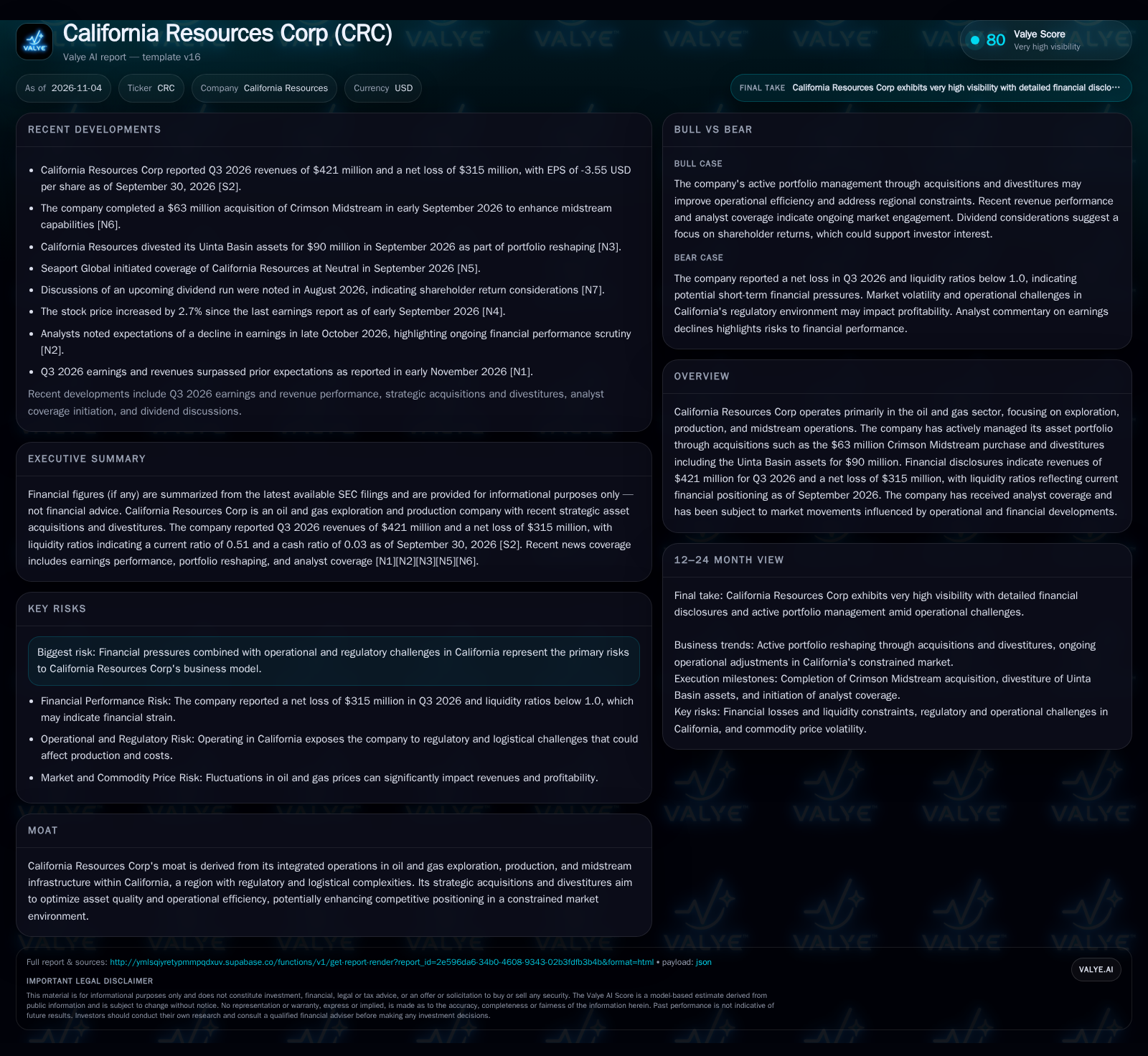
California Resources Corp is actively reshaping its portfolio—acquiring midstream assets and divesting non-core production—to offset financial pressures and regulatory constraints in California. Despite Q3 2026 revenues of $421 million, the company posted a significant net loss and faces tight liquidity. The central question: Will these strategic moves improve cash flow and margins, or are structural challenges too entrenched to overcome in the near term? [S2] [N3] [N6]
California Resources Corp is at a strategic crossroads, navigating California’s uniquely challenging regulatory landscape with a mix of asset divestitures and infrastructure acquisitions. The recent purchase of Crimson Midstream and the sale of Uinta Basin assets suggest a deliberate shift toward higher control over logistics and a more focused production footprint. However, Q3 2026 results reveal persistent losses and liquidity pressures, raising the stakes for CRC’s portfolio realignment efforts. The coming quarters will test whether these moves can materially improve margins and cash flow in a market where environmental and political headwinds remain formidable.
Recent Portfolio Changes and Q3 Performance: Signals and Stakes
California Resources Corp’s Q3 2026 report reveals a company in transition: $421 million in revenue was overshadowed by a net loss of $315 million and basic/diluted EPS of -$3.55 per share [S2]. The acquisition of Crimson Midstream for $63 million in September 2026 expands CRC’s midstream infrastructure, potentially enhancing operational control and reducing third-party transportation costs [N6]. Simultaneously, the $90 million divestiture of Uinta Basin assets reflects an effort to streamline the portfolio and concentrate resources on core California operations [N3]. The company reported cash and liquidity metrics for the period; these figures do not by themselves establish operating runway, investment capacity, financial flexibility, or financing capacity. [S2] These facts underscore a business model under pressure but actively seeking structural improvement through asset rotation.
How Asset Mix and Infrastructure Shape CRC’s Cash Flow Potential
CRC’s revenue model is anchored in oil and gas production, with earnings highly sensitive to commodity prices, production volumes, and realized differentials. The recent midstream acquisition could reduce reliance on third-party pipelines, potentially lowering transportation costs and capturing a greater share of value per barrel—if the company can achieve sufficient throughput and operational efficiency. However, California’s regulatory environment often results in elevated compliance and permitting costs, compressing margins relative to operators in less restrictive regions.
The divestiture of the Uinta Basin assets may reduce operating complexity and capital outlays outside the company’s core geography, but it also eliminates production diversity that could offset region-specific risks. CRC’s fixed-cost base—particularly for legacy environmental remediation and well retirement obligations—creates high operating leverage: incremental production or price improvements can rapidly boost cash flow, but downturns magnify losses. [S2]
The interplay between midstream ownership and production economics is critical in CRC’s context. Owning midstream assets can transform cost structures from variable third-party fees to more fixed or semi-fixed costs, which may improve predictability but also increases operational leverage. This dynamic means that throughput volumes must reach certain thresholds to realize cost advantages; underutilization could conversely exacerbate per-unit costs. Furthermore, midstream integration can enable CRC to capture margin components typically lost to external providers, such as fee-based transport and storage premiums, but only if contractual and operational synergies are effectively managed. Given California’s infrastructure constraints and regulatory complexities, the timing and scale of these benefits will depend heavily on CRC’s ability to optimize asset deployment amid fluctuating production profiles.
California Constraints: Competitive Edges and Enduring Disadvantages
CRC’s competitive position is defined by its deep operational footprint and infrastructure in California—a market with high barriers to entry but also significant regulatory and environmental headwinds. The recent Crimson Midstream acquisition may give CRC a relative logistical advantage over regional peers by integrating transport and storage, reducing exposure to bottlenecks and third-party tariffs [N6]. However, all California operators face stringent emissions standards, permitting delays, and political scrutiny that can disrupt drilling schedules and inflate costs.
On the carbon management front, CRC’s Carbon TerraVault segment is positioned to participate in California’s carbon capture and storage (CCS) initiatives, which could become a differentiated revenue stream if policy incentives and customer demand materialize. Still, the core oil and gas business competes with both in-state independents and out-of-state producers with lower cost structures, as well as renewables providers eroding long-term fossil demand. The company’s asset optimization strategy may help defend its share, but enduring cost and regulatory disadvantages limit pricing power and margin expansion potential.
California’s regulatory environment not only imposes direct costs but also introduces uncertainty that complicates capital allocation and operational planning. This uncertainty can dampen investment appetite and delay project execution, limiting the ability to scale production or infrastructure efficiently. While CRC’s integrated footprint offers some insulation by internalizing logistics, the company remains exposed to systemic risks such as sudden policy shifts or community opposition, which can impose stop-work orders or require costly modifications. Competitively, this environment may favor operators with diversified geographic exposure or those able to leverage lower-cost basins, constraining CRC’s pricing flexibility. Hence, the company’s strategic focus on California assets must be balanced against these enduring disadvantages, with adaptive operational models and proactive stakeholder engagement critical to maintaining competitive positioning.
Infrastructure Integration Unlocks Margin Expansion
If CRC can leverage its expanded midstream footprint to materially reduce per-barrel transport costs and improve throughput reliability, the resulting margin gains could meaningfully improve cash flow and earnings. Successful execution would require not only operational synergies from the Crimson acquisition but also stable or rising commodity prices and regulatory stability in California.
Confirmation of this scenario would include sequential improvement in operating margins, positive free cash flow, and evidence of increased utilization of midstream assets. Additional upside could come from growth in the Carbon TerraVault CCS business if California’s policy environment accelerates decarbonization mandates, providing new high-margin service opportunities.
Operational Adjustments Buffer, But Do Not Eliminate, Structural Pressures
The most likely outcome is that CRC’s portfolio reshaping—while incrementally beneficial—only partially offsets California’s persistent regulatory, cost, and market headwinds. Revenues may remain volatile, with narrow operating margins unless oil prices rise or compliance costs fall.
Supporting evidence would include continued modest losses or break-even results, ongoing asset sales or swaps to manage cash needs, and muted capital spending. Absence of significant improvements in operating metrics or balance sheet strength would indicate that structural constraints remain the dominant force.
Liquidity Pressures Escalate Amid Regulatory and Price Shocks
Should oil prices decline or California impose new production or emissions restrictions, CRC’s already thin margins could evaporate, leading to deeper losses and acute liquidity stress. The company’s low current and cash ratios would limit its ability to absorb shocks, fund operations, or maintain shareholder distributions without asset sales or dilutive financing.
Downside confirmation would come from further deterioration in cash balances, rising payables, covenant breaches, or a halt to dividend payments. Additional asset divestitures under duress or signals of regulatory clampdowns would reinforce the risk of a negative feedback loop.
Thesis-Testing Developments for California Resources: What Could Move the Needle
Sequential changes in operating margins and per-barrel transportation costs post-Crimson acquisition—if disclosed—would clarify the value of midstream integration.
Updates on regulatory or permitting timelines in California, especially any new restrictions or compliance cost increases, would materially affect forward economics.
Quarterly free cash flow trends, not just net income, would be a critical indicator of potential financial flexibility and potential for dividend sustainability.
Utilization rates and revenue contributions from the Carbon TerraVault CCS segment—if disclosed—would help gauge the potential for non-traditional revenue growth.
Progress or setbacks in further asset sales, portfolio optimization, or capital allocation decisions could signal management’s confidence and cash needs.
Changes in analyst coverage stance or material revisions to forward earnings estimates would reflect evolving market expectations regarding CRC’s restructuring outcomes.
Disclaimer: This is research-only, informational analysis and not investment advice. It may include AI-generated interpretation and general industry context. Always verify important details using primary sources.

Comments