
PennyMac Mortgage Investment Trust: Navigating Interest Rate Volatility and Funding Constraints in a Shifting Mortgage Market
PennyMac Mortgage Investment Trust (PMT) reported a Q3 2026 net loss and negative EPS, increased its share repurchase authorization to $630 million, and carries significant secured debt.
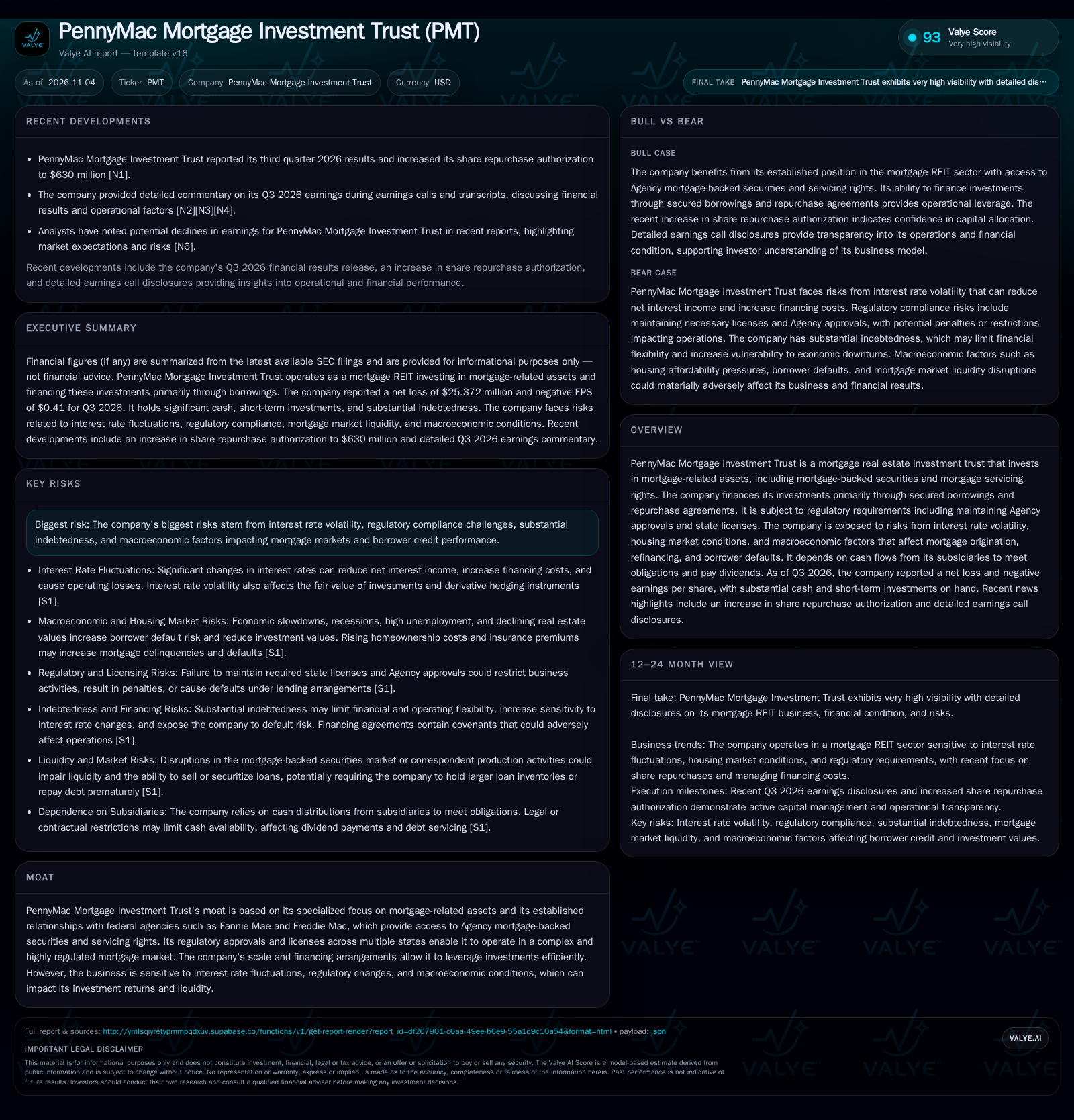
PennyMac Mortgage Investment Trust (PMT) reported a Q3 2026 net loss and negative EPS, increased its share repurchase authorization to $630 million, and carries significant secured debt. The company’s economics remain highly exposed to interest rate shifts, mortgage market liquidity, and regulatory complexity. The next phase will test the sustainability of current capital allocation moves and the resilience of its funding model amid tightening macro conditions and earnings pressure. [S2] [N1] [N6]
PennyMac Mortgage Investment Trust (PMT), a major player in the mortgage REIT sector, is at a pivotal juncture. While management’s decision to increase the share repurchase authorization signals a willingness to deploy capital, PMT’s substantial secured indebtedness and dependence on subsidiary cash flows amplify the stakes. The next twelve to twenty-four months will test whether the company’s capital management strategy and operational scale can offset the structural headwinds facing the mortgage investment sector.
Recent Losses, Expanded Buybacks, and Debt Load: The 2026 Operating Backdrop
As of Q3 2026, PennyMac Mortgage Investment Trust reported a net loss of $25.372 million, translating to basic and diluted EPS of -$0.41. This marks continued earnings pressure amid challenging sector dynamics. The company increased its share repurchase authorization to $630 million in early November 2026, suggesting a tactical response to share price weakness or perceived undervaluation. On the balance sheet, PMT carried $19.1 billion in outstanding debt as of December 2025, predominantly secured, and held $148.63 million in short-term investments as of September 2026. Analyst coverage anticipates further earnings declines, reflecting persistent macro and sector headwinds. [S2] [N1] [N6]
Interest Income, Funding Costs, and Leverage: The Mechanics of Mortgage REIT Profitability
PMT’s core economics are built on the spread between interest earned on mortgage-related assets (including mortgage-backed securities and servicing rights) and the cost of borrowings, primarily via repurchase agreements and secured financing. In a benign rate environment, leverage amplifies returns, as fixed-rate assets are financed at lower short-term rates. However, this model leaves PMT highly sensitive to interest rate increases, which can compress net interest margins, raise funding costs, and erode asset values. The company’s substantial secured indebtedness magnifies these effects, especially if market liquidity tightens or repo counterparties become more restrictive. Capital needs are ongoing: refinancing risk is pronounced given the short-term nature of much repo funding, and regulatory requirements for Agency approvals and state licenses require continuous compliance investment. Operating leverage can swing both ways, with margin expansion possible in stable or falling rate regimes, but sharp downside exposure if rates rise or mortgage spreads widen unexpectedly.
The interplay between asset duration and funding tenor also critically influences PMT’s profitability dynamics. When mortgage assets have longer durations relative to the typically short-term repo funding, the firm faces reinvestment risk if rates rise, potentially forcing reinvestment at higher yields but also increasing funding costs. Conversely, if rates fall, the cost of funding may decrease more quickly than asset yields, enhancing net interest margins. Additionally, the embedded optionality in mortgage-backed securities, such as prepayment risk, complicates duration management and can lead to unpredictable cash flows. Effective hedging strategies and dynamic asset-liability management become essential to mitigate these risks, though they introduce complexity and potential basis risk that can erode returns if not precisely executed.
Navigating a Crowded Mortgage Asset Landscape: Scale, Regulatory Barriers, and Substitution Threats
PMT’s primary competitive advantages lie in its established relationships with federal agencies (such as Fannie Mae and Freddie Mac), regulatory approvals, and the scale to access and manage large pools of mortgage assets. The company’s breadth in servicing rights and mortgage-backed securities, combined with multi-state licensing, offers operational depth in a highly regulated sector. However, barriers to entry are not absolute: other large mortgage REITs, specialty finance firms, and institutional investors compete aggressively for similar assets, often with comparable funding models. The risk of substitution remains real—if alternative investment vehicles, fintech platforms, or direct lending channels gain share, PMT could face yield compression or asset scarcity. Regulatory shifts, such as changes to Agency eligibility or capital rules, could also alter the playing field, raising compliance costs or restricting access to key markets.
Margin Recovery and Capital Deployment: How a Favorable Macro Turn Could Unlock Value
A constructive scenario for PMT would see a stabilization or decline in interest rates, which could restore or widen net interest spreads and support asset values. Improved market liquidity would ease refinancing risks and potentially lower funding costs, while a rebound in mortgage originations or servicing volumes could enhance fee income. The increased share repurchase authorization might signal management’s confidence and, if executed at depressed valuations, could amplify per-share value creation. Evidence confirming this scenario would include sequential improvement in net interest income, narrowing or reversal of recent net losses, and commentary indicating successful deployment of repurchase capital. A stabilization in regulatory environment and sustained Agency approvals would further reinforce the upside, as would signs of improved housing market affordability or lower borrower default rates.
Managing Through Volatility: A Plausible Path of Earnings Pressure and Tactical Adjustments
The most plausible near-term outlook is continued earnings pressure as PMT navigates elevated funding costs, volatile mortgage spreads, and choppy housing market conditions. The company may prioritize capital preservation, tactical asset rotation, and measured buyback activity rather than aggressive expansion. Net interest margins could remain compressed, and periodic losses may persist, but the company’s operational scale and regulatory standing may allow it to weather the environment without existential threat. Confirmation of this scenario would include ongoing but moderate net losses, cautious commentary on capital allocation, and maintenance of regulatory approvals. Falsification would come from a sharp inflection in either direction—either a rapid swing to profitability or a material deterioration in funding access, asset quality, or compliance status.
Funding Constraints, Regulatory Shocks, and Asset Impairments: What Could Accelerate Adverse Outcomes
A negative scenario could unfold if interest rates rise further, market liquidity deteriorates, or mortgage delinquencies spike. In this case, PMT could face margin compression, forced asset sales, or mark-to-market losses on its portfolio. If repo markets tighten, refinancing risk could materialize, leading to higher borrowing costs or even forced deleveraging. Regulatory setbacks—such as loss of Agency approvals or state licenses—could restrict business lines or trigger covenant breaches. Failure of subsidiaries to upstream sufficient cash could jeopardize dividend payments or debt servicing. Evidence confirming this scenario would include a sharp increase in realized credit losses, adverse regulatory actions, or disclosures of funding stress, while stabilization in these areas would help falsify the thesis of imminent downside.
Testing the PMT Thesis: Operational, Regulatory, and Funding Milestones to Scrutinize
Sequential trends in net interest income and net interest margin—improvement would suggest stabilization, while further compression would reinforce margin risk.
Execution pace and scale of share repurchases under the expanded authorization—actual buyback activity versus authorized capacity would clarify management’s capital allocation stance.
Updates on Agency approvals and state licensing status—any regulatory lapses or warnings would materially increase operational risk.
Disclosure of refinancing activity, repo funding terms, and counterparty diversification—a concentration of maturities or reliance on few lenders would elevate refinancing risk.
Asset quality metrics, including delinquency and default rates on underlying mortgage assets—rising levels would signal mounting credit pressures.
Commentary or filings on subsidiary cash flows and distribution constraints—limitations here would affect dividend continuity and debt servicing ability.
Housing market indicators, such as affordability, transaction volumes, and home price trends—deterioration would impact both asset values and origination/servicing dynamics.
Any disclosed changes in regulatory capital requirements or Agency eligibility criteria—shifts could alter the company's operating model or cost base.
Disclaimer: This is research-only, informational analysis and not investment advice. It may include AI-generated interpretation and general industry context. Always verify important details using primary sources.

Comments