
Atlantic Union Bankshares: Profitability, Credit Dynamics, and the Evolution of Regional Banking Economics
Atlantic Union Bankshares delivered rising Q3 2026 earnings and outlined medium-term targets, but its performance will hinge on credit quality management and navigating interest rate volatility in a competitive regional landscape.
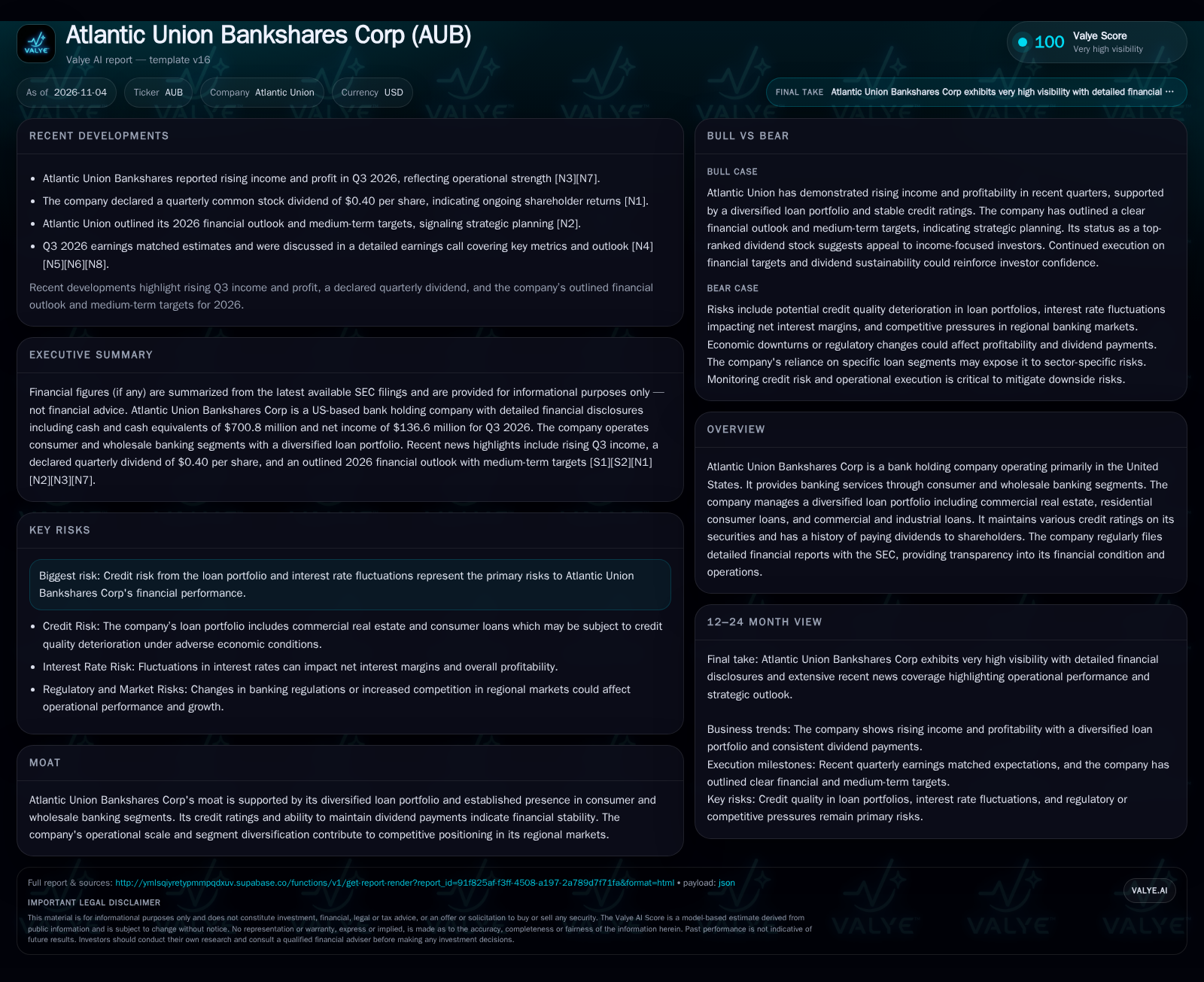
Atlantic Union Bankshares posted net income of $136.6 million in Q3 2026 and holds $700.8 million in cash and equivalents. The company’s diversified loan portfolio and stable credit ratings underpin its current financial strength, but ongoing profitability will depend on effective credit risk management and adapting to changing interest rate and regulatory environments. Strategic execution against its 2026 outlook will be key to sustaining growth and dividend capacity. [S2] [N2] [N3] [N7]
Atlantic Union Bankshares Corp enters late 2026 with a strengthened earnings profile and a clear set of medium-term strategic targets. Recent results show net income and profitability growth, supported by a diversified loan book and stable credit ratings. However, the true test for Atlantic Union will be its ability to steer through credit cycle volatility and margin pressures as the interest rate environment and competitive dynamics shift for regional banks. The company’s financial outlook and execution on risk management will determine whether it can sustain its current trajectory and deliver on shareholder value.
Recent Performance Highlights and Strategic Positioning
Atlantic Union Bankshares reported net income of $136.6 million for Q3 2026, with basic earnings per share of $0.95 and diluted EPS of $0.94, reflecting operational strength during the period. The company reported cash and liquidity metrics for the period; these figures do not by themselves establish operating runway, investment capacity, financial flexibility, or financing capacity. Management has also outlined a 2026 financial outlook and medium-term targets, providing a framework for strategic execution and investor expectations. These facts underscore the company’s current financial stability and its intent to maintain momentum through careful planning and risk management. [S2] [N2] [N3] [N7]
How Atlantic Union Converts Loan Growth and Deposits into Earnings
Atlantic Union Bankshares generates revenue mainly from net interest income, derived from the spread between interest earned on its loan portfolio and interest paid on deposits and other funding sources. The company’s diversified loan book—spanning commercial real estate, residential 1-4 family, and commercial and industrial lending—enables it to balance risk and return across different credit cycles. The mix of fixed and variable-rate loans, alongside its deposit franchise, can influence net interest margin (NIM) sensitivity to rate changes.
Profitability is also shaped by non-interest income streams, such as fees and service charges, although these are typically a smaller proportion of total revenue for regional banks. Operating leverage arises primarily from scaling loan volumes and deposits over a relatively fixed branch and back-office cost base. However, this leverage can be offset by rising credit costs or regulatory compliance expenses in periods of stress.
Capital needs are ongoing, as regulatory requirements dictate minimum capital ratios, and growth in the loan book must be matched by retained earnings or external capital. The cited source reports dividend-related activity; that disclosure alone does not establish dividend-policy continuity, management confidence, or a material constraint on capital flexibility.
Regional Dynamics: Where Atlantic Union Stands Against Local and National Rivals
Atlantic Union’s competitive position is anchored in its established presence in consumer and wholesale banking within its regional footprint. Its diversified lending strategy reduces exposure to any single sector but does not fully insulate it from regional economic downturns or sector-specific shocks—especially in commercial real estate or small business lending.
Peer competition includes other regional and super-regional banks, credit unions, and increasingly, digital-first financial institutions that can undercut legacy banks on cost or convenience. While Atlantic Union benefits from customer relationships and local knowledge, these advantages can be eroded if fintech entrants or larger banks deploy superior technology or aggressive pricing.
The company’s credit ratings (ranging from Aaa to Bbb/B on different securities) suggest a generally stable risk profile relative to peers, but any downgrade could raise funding costs or constrain growth. The ability to maintain deposit growth and defend net interest margins will be critical as competitors vie for both customers and market share in a shifting regulatory and rate environment.
What a Favorable Credit Cycle and Strategic Execution Could Unlock
If Atlantic Union’s credit quality remains robust and the broader economy avoids a downturn, the company could see continued loan growth and stable or expanding net interest margins.
Confirmation of this scenario would come from sustained low net charge-offs, benign delinquency trends, and a stable or improving efficiency ratio. Additionally, if management can successfully execute on its outlined 2026 financial targets—delivering on revenue growth, margin goals, and disciplined expense management—market perception of Atlantic Union’s operational resilience would be strengthened.
Further upside could be realized if Atlantic Union leverages technology to lower costs or expand product offerings, thereby improving customer retention and wallet share relative to less agile regional peers.
Banking Through the Cycle: Earnings Stability with Margin Pressures
The most plausible scenario sees Atlantic Union maintaining solid, but not accelerating, profitability as it manages through a moderately volatile credit and interest rate environment. Loan growth may slow as competition for high-quality borrowers intensifies and credit underwriting standards remain cautious. Net interest margins could compress if funding costs rise faster than loan yields, especially if the yield curve flattens or inverts.
Operational efficiency gains may be incremental, with cost discipline offsetting only part of the pressure from regulatory compliance and technology investment needs. This scenario would be confirmed by relatively stable quarterly EPS, modest changes in loan loss provisions, and no significant changes in credit ratings.
A reversal in regional economic conditions or a gradual increase in nonperforming assets would challenge this base case, as would aggressive pricing moves by competitors or a shift in regulatory requirements that increases compliance costs.
Credit Deterioration and Margin Squeeze: How the Bear Case Plays Out
A negative turn could be triggered by a regional economic downturn or sector-specific stress—particularly in commercial real estate or small business lending—leading to rising delinquencies and charge-offs. If credit losses accelerate, Atlantic Union could be forced to increase loan loss provisions, which would directly erode profitability and potentially threaten dividend capacity.
Simultaneously, if interest rates become more volatile or the funding environment tightens, net interest margins could be compressed further, especially if deposit competition intensifies or wholesale funding becomes more expensive. In such a scenario, credit rating downgrades may follow, raising borrowing costs and constraining access to capital at attractive rates.
Evidence for the downside case would include a marked uptick in nonperforming loans, higher provision expenses, downward revisions of earnings guidance, and any reduction or suspension of the dividend. Heightened regulatory scrutiny or adverse policy changes could further amplify these pressures.
Milestones That Will Shape Atlantic Union’s Value Proposition
Quarterly trends in loan loss provisions and net charge-offs—if disclosed—will provide an early signal of underlying credit quality shifts.
Net interest margin (NIM) movements, especially relative to peers, would help test the impact of rate and funding dynamics on core earnings.
Sustained growth or decline in the commercial real estate and commercial & industrial loan books would indicate risk appetite and sector exposure.
Updates on efficiency ratio and operating expense trends—if broken out—would clarify the company’s ability to generate operating leverage.
Moody’s or other credit rating agency actions on Atlantic Union’s securities could affect funding costs and market perception.
Deposit growth rates and composition (core vs. time deposits) would help gauge franchise strength and funding stability.
Management commentary on competitive pressure from digital banks or fintech entrants, if discussed in future communications, would shed light on evolving threats to the regional banking model.
Disclaimer: This is research-only, informational analysis and not investment advice. It may include AI-generated interpretation and general industry context. Always verify important details using primary sources.

Comments