
Hamilton Lane’s Strategic Expansion: Evergreen Funds, Technology Leverage, and the Next Phase of Private Markets Access
Hamilton Lane’s scale in private markets, broadening client reach, and deepening technology investments underpin its growth, yet the firm must navigate fee variability, governance concentration, and a rapidly evolving landscape for alternative investments.
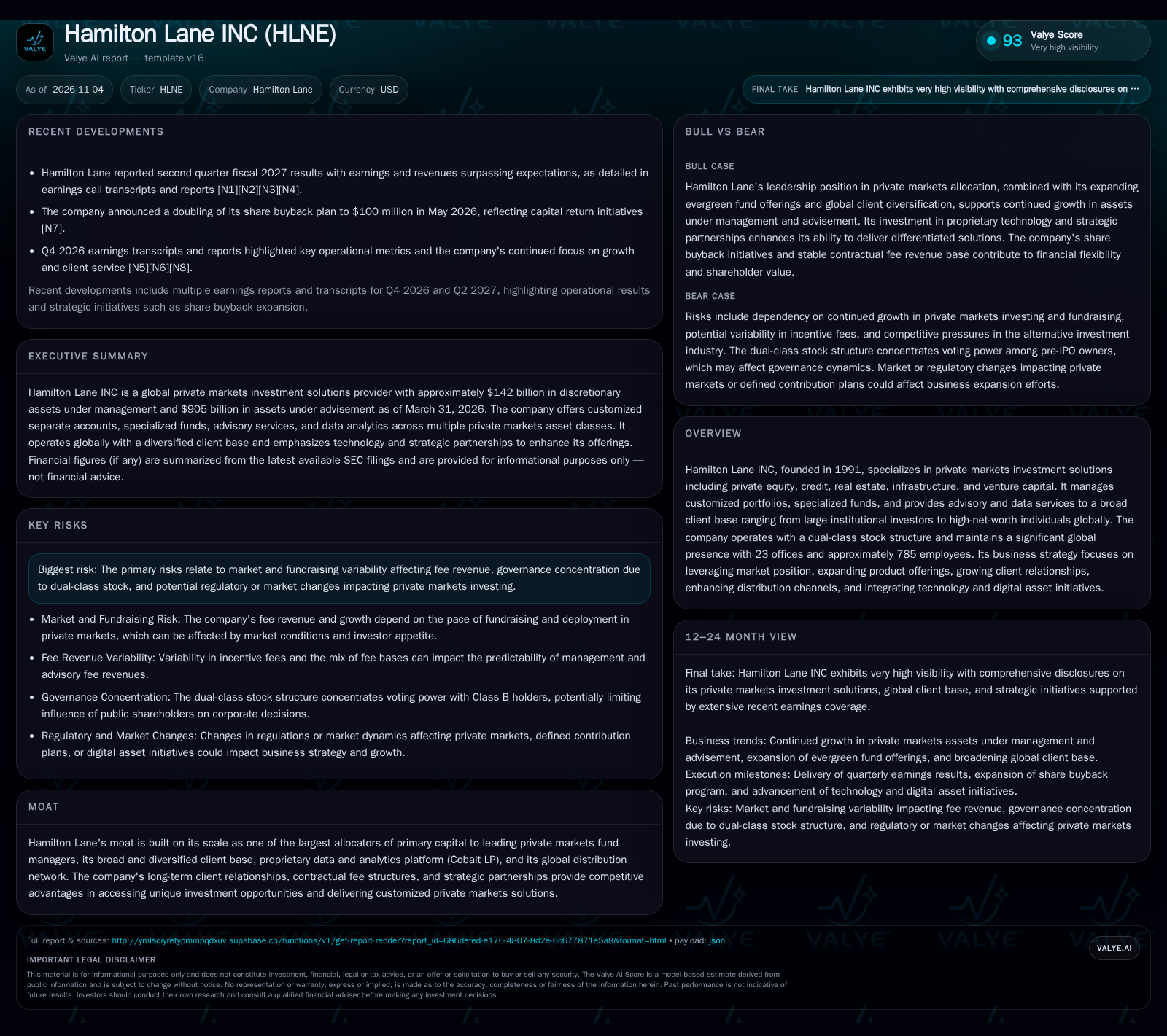
Hamilton Lane’s $142 billion in discretionary AUM and $905 billion in assets under advisement reflect its global leadership in private markets solutions. Recent outperformance in earnings, a doubling of its share buyback plan, and expansion of evergreen fund offerings highlight proactive capital management and product innovation. The company’s moat rests on scale, long-term client relationships, and proprietary data platforms, but future growth will hinge on successfully translating institutional expertise to new client segments and maintaining fee stability amid changing market dynamics. [S2] [N1] [N7]
Hamilton Lane Inc. sits at the crossroads of global capital flows and the expanding universe of private markets, managing over $1 trillion in client assets across discretionary and advisory mandates. The company continues to outpace expectations, as evidenced by strong recent earnings and a doubling of its share buyback program. Yet, as Hamilton Lane seeks to scale its technology, broaden evergreen offerings, and access new client segments, the durability of its fee-driven economics and the implications of governance concentration remain central to the investment debate. The next phase will test whether its data, relationships, and product innovation can sustain leadership as private markets become more accessible and competitive.
Recent Performance and Strategic Moves Shape the Current Landscape
Hamilton Lane reported $142 billion in discretionary assets under management (AUM) and $905 billion in non-discretionary assets under advisement (AUA) as of March 31, 2026, reinforcing its status among the largest private markets allocators globally. Recent earnings exceeded expectations in both Q4 2026 and Q2 2027, pointing to operational resilience and robust demand for its solutions. In May 2026, the company doubled its share buyback authorization to $100 million, reflecting a willingness to return capital to shareholders amid strong financial performance. The company’s expansion of evergreen fund offerings—vehicles that allow periodic subscriptions and redemptions—signals a strategic push to reach new investor segments, including retail and defined contribution pools. These moves collectively support both near-term visibility and the long-term thesis of scalable growth.[S2] [N1] [N7]
How Hamilton Lane Monetizes Private Markets Expertise
Hamilton Lane’s core economics stem from a blend of management, advisory, and performance-based incentive fees tied to its AUM and AUA. Customized separate accounts (about $92 billion AUM) and specialized funds (about $50 billion AUM) generate recurring management fees, typically structured as a percentage of committed or invested capital. Long-dated fund structures and multi-year advisory mandates provide revenue visibility, especially with no single client representing more than 2% of fee revenue as of March 2026, which helps diversify concentration risk.[S2]
Variable elements—particularly incentive fees—can drive earnings volatility, as these depend on investment performance and realization events. The expansion of evergreen funds may introduce new fee structures, potentially with lower headline rates but higher asset stability and more predictable inflows than closed-end funds. Advisory services, covering $905 billion in AUA, typically produce lower margins but reinforce Hamilton Lane’s market intelligence and client relationships.
Operating leverage is plausible as the firm expands AUM/AUA faster than headcount and core infrastructure costs, especially via technology investments like the Cobalt LP analytics platform. However, scaling technology and distribution to reach retail and defined contribution clients may require upfront investments and could compress margins if the average account size drops or distribution costs rise. Capital needs are moderate, with buybacks and technology spend funded from operating cash flows, but significant acquisition or platform bets could alter this balance.
Assessing Hamilton Lane’s Defenses in a Crowded Alternatives Market
Hamilton Lane’s competitive advantages center on scale, its deep relationships with leading fund managers, and its proprietary data and analytics capabilities. As one of the world’s largest private markets allocators, it can access preferred investment opportunities and negotiate favorable terms—a benefit that smaller peers or new entrants may struggle to match. Its Cobalt LP platform, integrating data and analytics, supports client transparency and portfolio construction, potentially creating stickier relationships and higher switching costs.
However, the competitive field is intensifying. Large asset managers, specialist private equity and credit funds, and fintech platforms are all vying to serve institutional and increasingly retail investors. Technology-driven platforms may compress fees or offer new access models, eroding traditional economics. Hamilton Lane’s diversification across asset classes, geographies, and client types mitigates some risk, but the question is whether its scale and technology edge will remain sufficient as the industry democratizes access and fee pressures mount.
Another structural factor is the dual-class share structure, which concentrates voting power with pre-IPO owners. While this can support long-term strategic vision, it may deter some public market investors and limits influence over governance decisions.
Pathways to Outperformance: Retail Penetration and Technology-Driven Fee Expansion
A favorable scenario for Hamilton Lane would see sustained growth in private markets allocations, with the firm accelerating AUM and AUA expansion through its evergreen fund offerings and digital distribution partnerships. Success in entering defined contribution and retail channels could unlock a vast new pool of capital, driving both management fees and inflows even if average account sizes are smaller. Effective deployment of Cobalt LP and tokenization initiatives could help the firm differentiate its value proposition, supporting pricing power and client retention even as competition intensifies.
Confirmation of this scenario would come from rapid growth in evergreen AUM, new distribution agreements with major intermediaries, and recurring evidence of technology adoption (e.g., client wins citing analytics capabilities or successful tokenized fund pilots). Evidence against this scenario would include stalled AUM growth in new channels, client attrition, or a visible decline in fee rates as retail distribution ramps.
Private Markets Growth Continues, With Fee Mix and Margin Pressures Emerging
The most plausible trajectory is continued moderate growth in both AUM and AUA, powered by Hamilton Lane’s core institutional client base and incremental success with evergreen products and international expansion. Management and advisory fees remain the primary revenue drivers, but the mix gradually shifts toward lower-fee, higher-volume vehicles as retail and defined contribution channels expand. Operating leverage is maintained but offset by higher distribution and technology costs, resulting in stable or modestly compressed margins.
This scenario would be confirmed by steady quarterly AUM growth, a rising share of evergreen and retail-oriented assets, and margin trends that remain within historical ranges. A falsification would be a sharp drop in incentive fees, persistent margin compression, or a slowdown in net inflows—suggesting either market saturation or competitive displacement.
Adverse Conditions: Market Disruption, Fee Compression, and Governance Friction
The principal risk chain involves a significant slowdown in private markets fundraising or asset deployment, triggered by macroeconomic shocks, regulatory hurdles, or waning investor appetite for alternatives. In this environment, both management and incentive fees could fall, with weak performance fees compounding the impact of lower AUM growth. Competitive pressures from low-cost or technology-driven entrants may force Hamilton Lane to cut fees or increase client acquisition costs, further compressing margins.
Governance risks could also become salient if public shareholders push back against the dual-class structure, particularly in a period of underperformance. Evidence for this scenario would include declining fee revenue, net outflows, margin deterioration, or public agitation for governance reforms. Falsification would require resilience in fee rates, continued inflows, and no material client or shareholder defections despite industry headwinds.
What Will Determine Hamilton Lane’s Next Phase of Growth and Resilience?
Quarterly growth in AUM and AUA, with a breakout of flows into evergreen and retail-oriented products, if disclosed.
Trends in management and incentive fee rates as a percentage of AUM/AUA, especially as product mix shifts.
Operating margin stability or compression as technology and distribution costs evolve.
Client concentration metrics and evidence of retention or attrition among top institutional or wealth clients.
Adoption rates and commercial impact of the Cobalt LP platform and tokenization or digital asset initiatives, if disclosed.
New distribution or sub-advisory partnerships targeting defined contribution and retail channels.
Shareholder sentiment and any developments relating to the dual-class governance structure.
Evidence of regulatory changes affecting private markets access, distribution, or product structuring.
Disclaimer: This is research-only, informational analysis and not investment advice. It may include AI-generated interpretation and general industry context. Always verify important details using primary sources.

Comments