
Lindblad Expeditions: Premium Adventure Travel, Brand Leverage, and the Test of Liquidity Constraints
Lindblad Expeditions blends a premium, niche travel product with a powerful brand partnership and diversified land-based offerings.
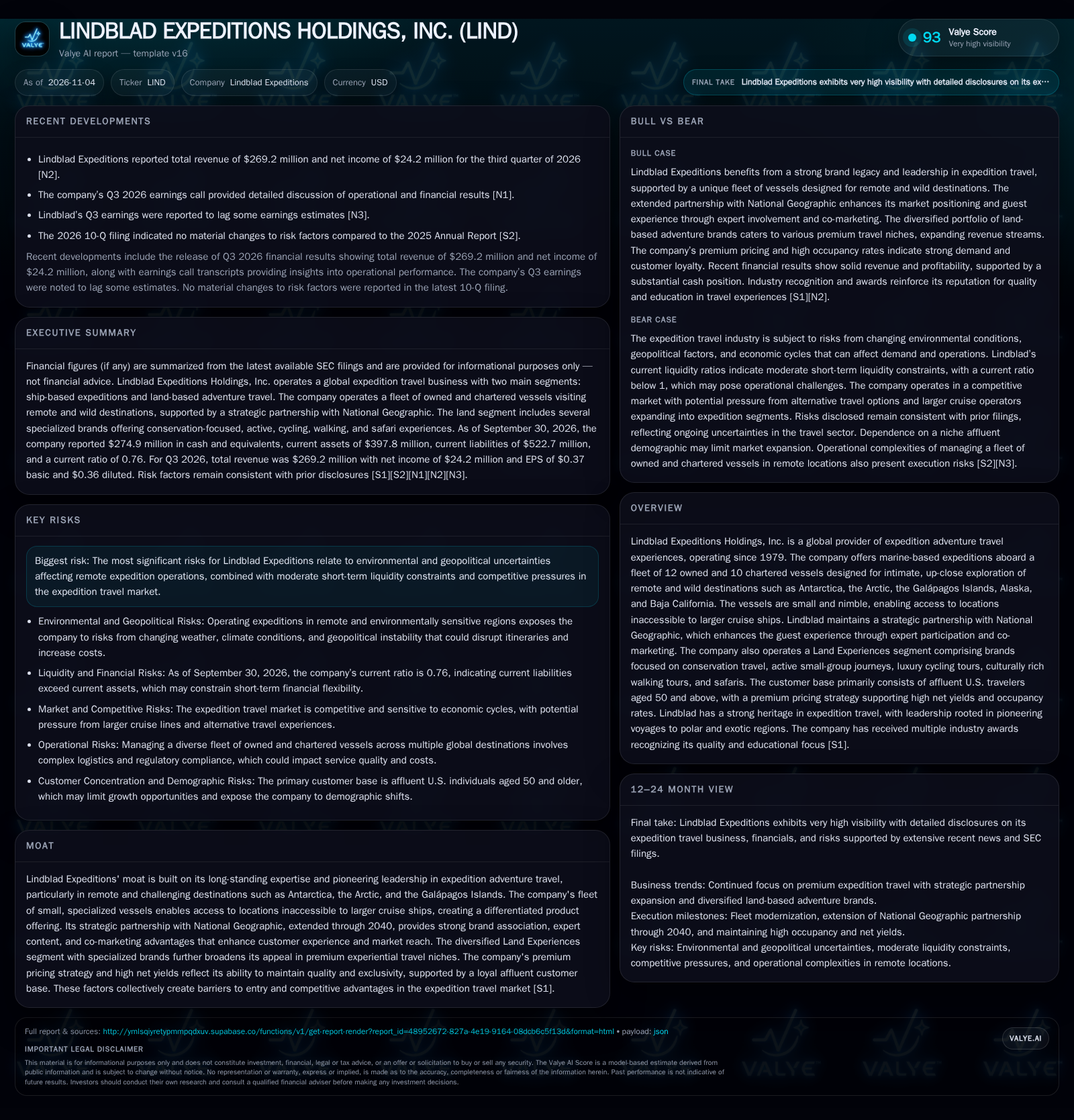
Lindblad Expeditions reported Q3 2026 revenues of $269.2M and net income of $24.2M, reflecting robust demand for high-end adventure travel. Its extended National Geographic partnership and diversified land brands support differentiation. The company’s ability to sustain premium pricing, occupancy, and operational reliability will determine whether it can extend its leadership or face margin and growth pressures as the market evolves. [S2] [N2]
Lindblad Expeditions operates at the intersection of luxury travel and adventure, offering affluent customers small-ship and land-based journeys to some of the world’s most remote and compelling destinations. The next phase will test whether Lindblad’s premium positioning and operational capabilities are sufficient to offset these financial and executional constraints.
Recent Performance and the Liquidity Challenge
Lindblad Expeditions reported Q3 2026 revenues of $269.2 million and net income of $24.2 million, confirming that premium expedition travel continues to attract demand and support profitability. The company’s cash and equivalents stood at $274.9 million as of September 30, 2026, but its current liabilities of $522.7 million resulted in a current ratio of 0.76 and a cash ratio of 0.53. These metrics indicate that Lindblad’s near-term obligations outpace its liquid resources, posing a moderate short-term liquidity constraint. The company’s risk disclosures remain unchanged from prior filings, suggesting a stable but ongoing risk environment. [S2] [N2]
Beyond the surface-level liquidity ratios, a deeper analysis of Lindblad's cash flow generation and working capital management is critical to understanding its near-term financial resilience. If the company can convert receivables efficiently and manage payables strategically, it may mitigate some pressure from the apparent liquidity shortfall. However, reliance on short-term financing or asset sales to bridge gaps could increase financial risk, especially if market conditions tighten or credit availability diminishes.
How Premium Pricing and Asset Intensity Shape Lindblad’s Economics
Lindblad’s business model is anchored in premium pricing, targeting affluent, experience-seeking travelers—primarily aged 50 and above—who are less price-sensitive and value exclusivity, education, and access. The company’s small-ship fleet, customized for remote destinations, enables high yields per guest but also drives high fixed costs through asset ownership, maintenance, and regulatory compliance.
Revenue is diversified between the marine-based Lindblad Segment and the Land Experiences segment, each leveraging distinctive brands. While the marine business benefits from strong occupancy and pricing power, it is capital-intensive, requiring continual investment in fleet modernization and compliance. The land segment, while less asset-heavy, still relies on bespoke service delivery and operational coordination across global geographies.
Operating leverage can be significant: high occupancy and premium pricing magnify margins, but underutilization or disruptions (weather, geopolitical, mechanical) can rapidly erode profitability due to fixed cost structure.
The capital intensity inherent in Lindblad’s model also introduces a nuanced trade-off between fleet ownership and potential chartering or partnership arrangements. While owning vessels ensures control over quality and itinerary customization, exploring hybrid asset strategies could alleviate capital burdens and improve return on invested capital. Additionally, the company’s ability to innovate in cost management—such as leveraging technology for operational efficiencies or optimizing itinerary scheduling to maximize vessel utilization—could materially influence margin sustainability. Given the fixed-cost base, even marginal improvements in operational efficiency or guest yield can disproportionately enhance profitability, underscoring the importance of continuous refinement in both service delivery and asset deployment.
Brand, Access, and the Threat from Larger Travel Players
Lindblad’s enduring competitive advantages stem from its heritage in expedition travel, its fleet’s unique access to remote locations, and its exclusive partnership with National Geographic, which provides both branding and experiential differentiation. This partnership, renewed through 2040, supports co-marketing and content integration that are difficult for new entrants to replicate.
However, the broader travel landscape is evolving. Large cruise operators and luxury travel conglomerates are increasingly targeting the expedition segment, leveraging scale, loyalty programs, and broader distribution. These players may not match Lindblad’s deep expertise or intimacy of experience but can compete on price, amenities, and global reach, potentially pressuring Lindblad’s yields or occupancy if market growth slows.
Substitution risk is also rising as affluent travelers seek alternative adventure or eco-tourism experiences, including bespoke land-based offerings, luxury safaris, and sustainable travel brands. Lindblad’s diversified land segment partially addresses this, but the question is whether it can maintain pricing power and differentiation as competition intensifies.
What a Virtuous Cycle of Demand, Pricing, and Brand Leverage Would Look Like
A favorable scenario for Lindblad would see continued robust demand from its affluent core demographic, allowing it to sustain or even increase premium pricing across both marine and land segments.
Evidence for this scenario would include rising booking volumes (particularly for longer and more remote itineraries), stable or improving average revenue per guest, high repeat-customer rates, and positive guest satisfaction metrics. Additional confirmation would come from successful cross-selling between marine and land brands, as well as industry awards and recognition reinforcing Lindblad’s reputation for quality and educational content.
Falsification would occur if premium pricing faces resistance, occupancy falls, or if larger competitors erode Lindblad’s market share in core destinations.
Sustaining Premium Niche Leadership Amid Capital and Operational Hurdles
The most plausible outlook is that Lindblad maintains its leadership in the premium expedition niche, but must carefully manage capital and liquidity constraints. Demand is likely to remain resilient among affluent travelers, but growth could moderate as competition intensifies and economic volatility persists.
In this scenario, Lindblad’s ability to sustain premium pricing and high occupancy supports positive cash flow, but fleet investments and debt servicing absorb much of the generated cash. The company may prioritize operational reliability, guest experience, and steady fleet upgrades over aggressive expansion. The extended National Geographic partnership continues to anchor differentiation.
Confirmation would come from continued profitability, stable or modestly growing revenues, and effective cost management.
When Liquidity and Disruption Undermine the Premium Model
A negative scenario would be triggered if Lindblad’s liquidity position deteriorates further, forcing the company to defer maintenance, delay fleet investments, or curtail marketing—thereby eroding service quality and guest experience. Simultaneous shocks such as weather events, geopolitical instability, or mechanical failures could amplify fixed-cost pressures and reduce occupancy, rapidly compressing margins.
Competitive encroachment by larger cruise operators or alternative travel platforms could intensify pricing pressure, forcing discounts or incentives that weaken net yields. Should affluent travelers shift preferences or delay bookings due to external shocks, Lindblad may struggle to fill itineraries at profitable rates.
Evidence for this scenario would be declining occupancy, falling average revenue per guest, negative cash flow, or news of deferred investment and service cutbacks. Falsification would require stabilization or improvement in the company’s liquidity metrics and operational continuity despite shocks.
What Will Determine Lindblad’s Next Phase of Premium Travel Economics?
Booking momentum and forward occupancy rates—especially for high-yield, long-duration itineraries—would clarify demand resilience.
Average revenue per guest and net yield trends, if disclosed, would indicate pricing power and customer willingness to pay.
Repeat passenger rates and cross-segment (marine to land) conversion would signal brand loyalty and successful portfolio integration.
Updates on fleet modernization, maintenance deferrals, or new vessel launches would reveal the company’s ability to invest amid capital constraints.
Trends in current ratio and cash flow from operations would help test the sustainability of Lindblad’s liquidity position.
Any changes in the scope, exclusivity, or effectiveness of the National Geographic partnership would directly affect competitive differentiation.
Evidence of competitive encroachment—such as new expedition offerings from major cruise operators or pricing pressure in core markets—would be a leading indicator of future margin risk.
Operational disruptions (weather, geopolitical, or regulatory) and their impact on itinerary completion rates would highlight the company’s execution risk profile.
Disclaimer: This is research-only, informational analysis and not investment advice. It may include AI-generated interpretation and general industry context. Always verify important details using primary sources.

Comments