
Rhythm Pharmaceuticals: Precision Medicine in Rare Obesity Disorders and Strategies for Market Expansion
With IMCIVREE now commercialized across multiple major markets and a reinforced $750 million financing, Rhythm Pharmaceuticals faces the pivotal challenge of scaling rare disease innovation into a sustainable, differentiated business—amid clinical, regulatory, and competitive uncertainty.
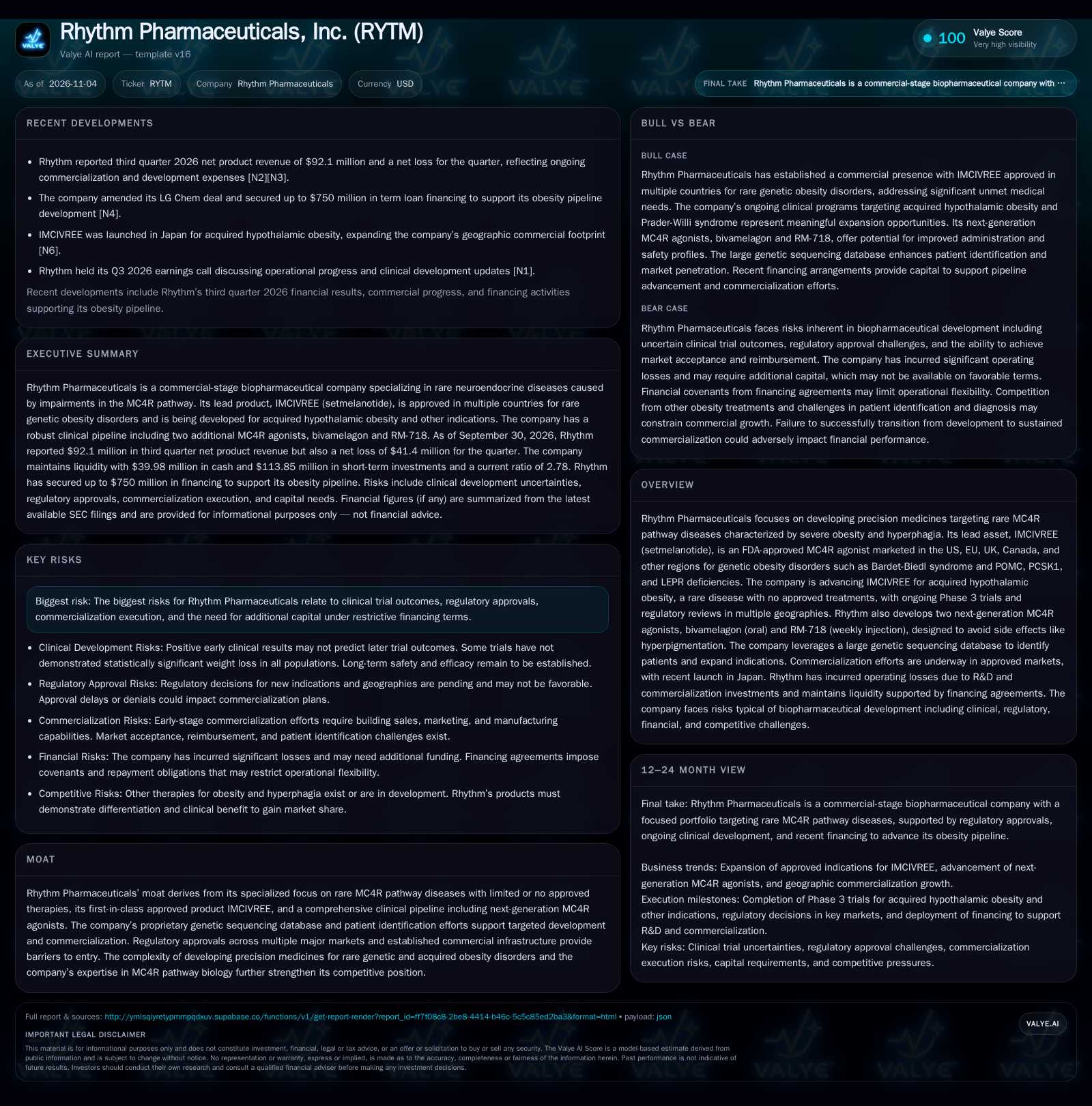
Rhythm Pharmaceuticals has advanced IMCIVREE, its MC4R agonist, into commercial launches across the US, EU, and Japan, targeting rare genetic and acquired obesity disorders. Q3 2026 revenue reached $92.1 million, but the company remains unprofitable and reliant on recently secured $750 million in financing to fund R&D and commercial expansion. The thesis now hinges on Rhythm’s ability to expand IMCIVREE’s label, drive adoption in new geographies and indications, and manage the risks of capital intensity, regulatory hurdles, and emerging obesity competitors. Execution on next-generation MC4R assets and patient identification via genetic screening will be critical to future value creation and differentiation. [N2] [N4] [S2]
Rhythm Pharmaceuticals stands at a commercial and strategic crossroads. With IMCIVREE now approved and launched for multiple rare genetic and acquired obesity indications—including a recent entry into Japan—Rhythm has established a global footprint in diseases with high unmet need and no approved alternatives. Yet the company remains loss-making, dependent on substantial new financing, and exposed to the formidable risks of scaling rare-disease innovation into a sustainable business. The core question is whether Rhythm can translate its first-mover advantage and specialized genetic focus into durable growth as it pursues both label expansion for IMCIVREE and pipeline progress on next-generation MC4R agonists, all while navigating the capital and competitive gauntlet of the evolving obesity landscape. [S1] [S2] [N2] [N4] [N6]
IMCIVREE’s Global Rollout and Liquidity Strategies for Expanding Patient Access
Rhythm Pharmaceuticals reported $92.1 million in net product revenue for the third quarter of 2026, reflecting early-stage commercialization of IMCIVREE for rare MC4R pathway diseases in the US, EU, UK, Canada, and a recent launch in Japan for acquired hypothalamic obesity—a rare disease with no approved alternatives. Despite these launches, the company posted a net loss of $41.37 million in the same quarter, underlining the capital intensity of ongoing R&D and market expansion efforts. Rhythm’s liquidity position as of September 30, 2026, included $39.98 million in cash and $113.85 million in short-term investments, supported by a current ratio of 2.78 and a cash ratio of 1.02. Importantly, the company recently amended its LG Chem deal and secured up to $750 million in term loan financing earmarked for advancing its obesity pipeline. These developments mark a pivotal phase: Rhythm is now leveraging new capital to drive both commercial expansion and clinical development, but must also manage the associated financial covenants and repayment obligations that may constrain future flexibility. [N2] [N4] [N6] [S2]
Economics of Targeted Rare Diseases: Pricing, Patient Identification, and Growth Constraints
Rhythm’s core business model centers on high-value, low-volume rare disease therapeutics. IMCIVREE, as an MC4R agonist for genetically defined obesity disorders, likely commands premium pricing—consistent with orphan drug economics—due to significant unmet need and lack of direct competitors in its approved indications. The company’s use of a proprietary genetic sequencing database (~120,000 samples) supports precision patient identification, which is crucial for market penetration but also inherently limits addressable volume. While high per-patient pricing can drive strong gross margins, the economics remain heavily dependent on expanding the eligible patient pool through new indications (such as acquired hypothalamic obesity) and successful navigation of reimbursement and market access dynamics in each geography.
The capital requirements for this model are substantial: continued R&D for label expansion, commercial infrastructure buildout, and post-marketing commitments all demand sustained investment. The newly secured $750 million financing provides runway but introduces leverage and covenant risk. Operating leverage may improve if Rhythm can broaden IMCIVREE’s label or achieve meaningful uptake in new regions, but fixed costs and commercial investments will remain high relative to the rare-disease volume unless the company can unlock larger patient populations through label expansion or next-generation assets.
Standing Out Amidst Obesity Treatments: Genetic Precision and Regulatory Advantages
Rhythm’s competitive edge lies in its specialized focus on MC4R pathway disorders—a segment with few approved therapies and high barriers to entry due to the complexity of genetic diagnosis and the need for tailored clinical development. IMCIVREE’s regulatory approvals across the US, EU, and Japan, along with established commercial infrastructure, create a first-mover advantage and some degree of switching friction for rare disease specialists. The company’s proprietary sequencing database further differentiates its patient identification and market access approach.
However, competitive pressures are mounting. Large pharmaceutical companies and biotechnology entrants are aggressively developing obesity and metabolic disorder treatments, some with broader mechanisms that could encroach on rare disease segments if label expansions are pursued. Additionally, generic or biosimilar competition, while less imminent in rare diseases, could eventually erode pricing power if exclusivity windows narrow. Rhythm’s next-generation MC4R agonists (bivamelagon and RM-718) are designed to improve safety (e.g., avoiding hyperpigmentation) and administration (oral/weekly dosing), potentially reinforcing the company’s clinical and commercial differentiation if efficacy and tolerability are confirmed.
Potential Impact of Expanding Indications and Next-Generation Therapies on Rhythm’s Growth
The most compelling upside scenario for Rhythm Pharmaceuticals is driven by successful label expansion of IMCIVREE into larger rare disease populations—such as acquired hypothalamic obesity (AHO) and Prader-Willi syndrome (PWS)—combined with robust uptake in newly launched geographies like Japan. If ongoing Phase 3 trials for AHO and other indications yield positive results and regulatory approvals follow in the US, EU, and Japan, Rhythm could substantially increase its addressable market and leverage its existing commercial infrastructure. The next-generation MC4R agonists, bivamelagon (oral) and RM-718 (weekly subcutaneous), offer additional upside if they demonstrate superior efficacy, safety, or convenience, enabling penetration into new patient segments or improving adherence.
Upside would be confirmed by: regulatory approvals for AHO and PWS; strong launch trajectories in new geographies; evidence of commercial traction beyond ultra-rare populations; and positive pivotal data for next-gen assets leading to pipeline advancement or partnership opportunities.
Maintaining Leadership in Rare Diseases Amid Capital and Execution Challenges
The most plausible near-term scenario is that Rhythm continues to build on its rare disease franchise, growing IMCIVREE sales in currently approved indications and geographies while pursuing incremental label expansions. Revenue growth is likely to remain driven by small, high-value patient populations, with gradual uptake in new markets such as Japan for AHO. The company will continue to invest heavily in R&D, commercialization, and patient identification, resulting in ongoing operating losses offset by the recently secured financing.
This scenario would be confirmed if: IMCIVREE sales show steady, though not exponential, growth; regulatory progress for new indications is mixed or delayed; next-generation MC4R programs advance but without near-term transformative impact; and operating expenses remain high relative to revenue, keeping the company reliant on external capital or future partnership infusions.
Financial Risks from Unfavorable Clinical or Regulatory Developments
The primary risk to Rhythm’s business is a combination of clinical or regulatory setbacks—such as failed or inconclusive Phase 3 trials for AHO or other pipeline indications—or slower-than-expected commercial uptake in new or existing markets. If IMCIVREE’s label cannot be expanded or reimbursement is constrained, the company could struggle to grow revenue beyond current rare disease niches, leaving high fixed costs unsupported and eroding investor confidence.
Downside would be confirmed by: negative or ambiguous clinical trial data; regulatory rejections or delays for key label expansions (notably AHO or PWS); weak launch performance in new territories; or evidence that financing covenants restrict operational flexibility or necessitate dilutive capital raises.
Key Milestones Shaping Rhythm’s Growth Prospects and Financial Health
Quarterly net product revenue growth in existing and newly approved markets, especially from Japan’s launch of IMCIVREE for acquired hypothalamic obesity [N6].
Regulatory decisions and clinical trial readouts for IMCIVREE in acquired hypothalamic obesity (AHO) and Prader-Willi syndrome (PWS), which would directly impact market size and growth trajectory.
Enrollment rates, top-line data, and progression of next-generation MC4R agonist programs (bivamelagon and RM-718), as these assets represent potential future growth and competitive differentiation.
Patient identification and diagnostic rates from the genetic sequencing database—if disclosed, this would clarify Rhythm’s ability to expand its commercial funnel and addressable market.
Updates on reimbursement access and payer coverage in key geographies, especially for new indications, as orphan drug pricing can face pushback or delays.
Covenant compliance and any changes in liquidity position, especially in light of the $750 million financing and related operational constraints.
Any partnerships, licensing deals, or co-commercialization agreements that could accelerate pipeline development or extend commercial reach.
Disclaimer: This is research-only, informational analysis and not investment advice. It may include AI-generated interpretation and general industry context. Always verify important details using primary sources.

Comments