
Corebridge Financial’s Strategic Merger: Scale, Integration, and the Future Shape of Insurance Economics
Corebridge Financial’s robust Q3 2026 profitability and board-approved merger with Equitable Holdings mark a pivotal moment for the insurer. The combined entity could reshape competitive dynamics, but success will hinge on integration execution, risk management, and the ability to unlock genuine cost and revenue synergies.
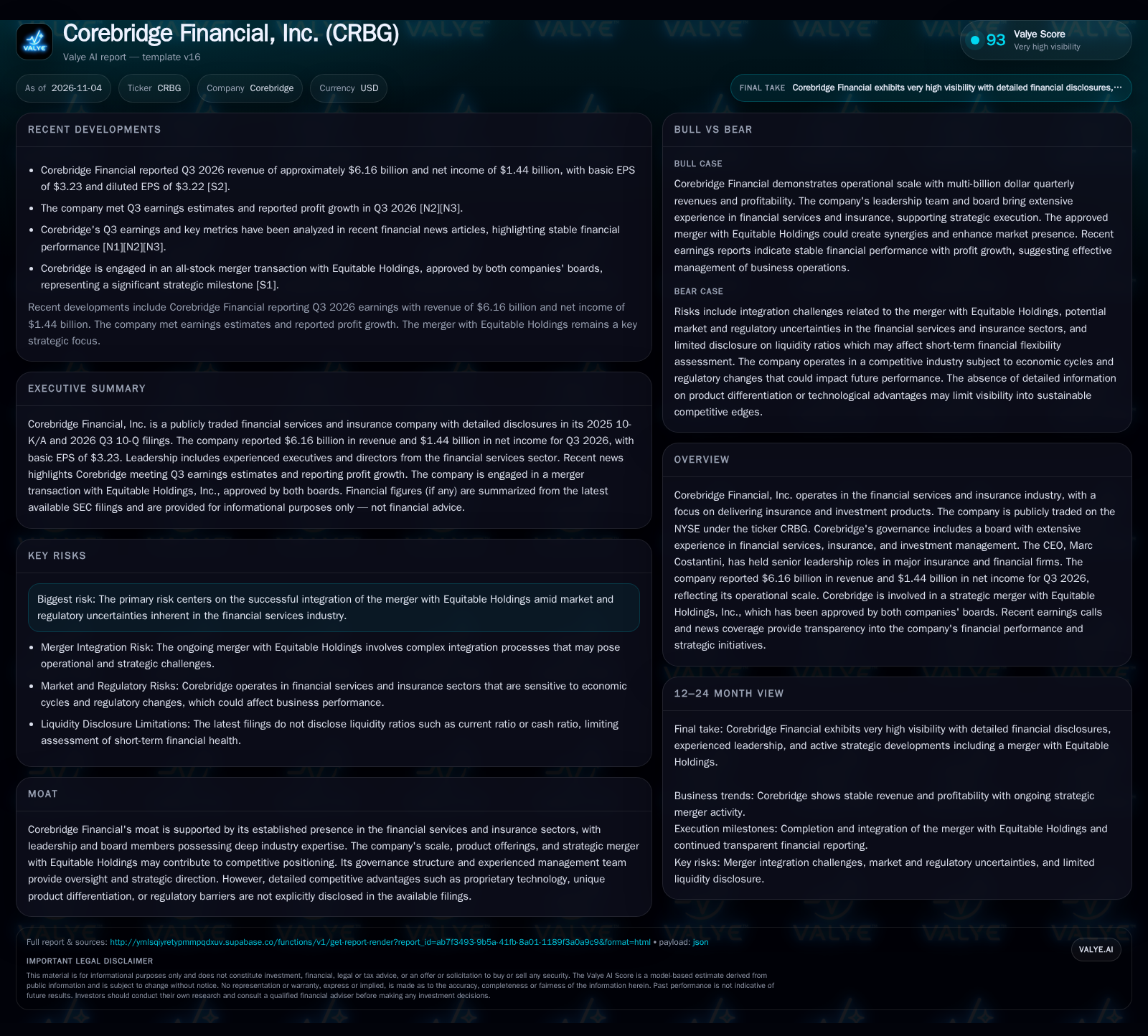
Corebridge Financial reported $6.16 billion in Q3 2026 revenue and $1.44 billion in net income, maintaining profitability while preparing for a transformative all-stock merger with Equitable Holdings. The merger, approved by both boards, could deliver scale benefits but raises integration and execution risks in a highly regulated, competitive sector. Success will depend on realizing operational synergies, managing legacy exposures, and navigating economic and regulatory headwinds.
Corebridge Financial’s Q3 2026 performance highlights its scale and stable profitability, but the board-approved merger with Equitable Holdings is the true inflection point for the company’s future. While the combination promises increased market presence and potential cost or revenue synergies, it also brings a complex set of integration, execution, and regulatory challenges. The next phase for Corebridge will be defined by its ability to unlock merger benefits while navigating the inherent risks of scale, legacy exposure, and a shifting insurance landscape.
Recent Earnings and Merger Milestone Define the Strategic Landscape
Corebridge Financial reported $6.16 billion in revenue and $1.44 billion in net income for the quarter ended September 30, 2026, translating to basic EPS of $3.23 [S2]. This performance met Q3 earnings estimates and demonstrated profit growth, as reflected in coverage from primary financial news sources [N1] [N2] [N3]. The most consequential development, however, is the board-approved all-stock merger with Equitable Holdings, Inc., which represents a significant strategic shift and positions Corebridge at the center of industry consolidation [S1]. The merger could reshape Corebridge’s market positioning, cost structure, and long-term growth trajectory.
How Scale and Product Mix Could Reshape Corebridge’s Profitability
Corebridge’s business model is anchored in the economics of insurance and financial services: collecting premiums or assets under management, investing float, and managing risk exposures. The reported $1.44 billion in Q3 net income on $6.16 billion in revenue implies a robust margin for the quarter [S2]. In insurance, fixed costs are substantial—spanning regulatory compliance, technology infrastructure, and actuarial staff—while variable costs relate to claims, commissions, and asset management fees. Operating leverage is often high: incremental growth in premiums or assets, if not offset by proportional increases in claims or expenses, can drive meaningful margin expansion.
The pending merger with Equitable Holdings could meaningfully alter Corebridge’s economics. If the integration succeeds, the combined entity may benefit from broader distribution, cross-selling potential, operational cost rationalization, and enhanced investment scale. However, these gains are not automatic; realizing them requires disciplined integration, harmonization of product portfolios, and effective risk management. The company reported cash and liquidity metrics for the period; these figures do not by themselves establish operating runway, investment capacity, financial flexibility, or financing capacity. [S2]
A nuanced understanding of Corebridge’s profitability also requires examining how changes in product mix could influence risk-adjusted returns. For instance, a shift toward higher-margin but more volatile insurance products may increase earnings variability, necessitating more sophisticated risk management frameworks. Conversely, expanding asset management operations could provide steadier fee income but expose the firm to market fluctuations and performance pressures. Balancing these dynamics post-merger will be critical, as the combined entity must optimize its portfolio to sustain margins while maintaining capital efficiency and regulatory compliance.
Industry Consolidation and the Challenge of Sustainable Differentiation
Corebridge operates in a highly competitive and regulated sector where scale, brand trust, and distribution reach are critical. The merger with Equitable Holdings could propel Corebridge into the upper echelon of U.S. insurance and retirement solutions providers by assets and premiums. Larger scale can confer tangible advantages: improved negotiating leverage with distribution partners, better asset management economics, and enhanced ability to invest in technology and data analytics.
However, the sector is crowded with well-capitalized peers—from legacy mutuals to large financial conglomerates and specialist asset managers. Switching costs for customers can be moderate, especially in commoditized insurance lines, and product innovation cycles are often slow. Without explicit evidence of proprietary technology, unique product features, or regulatory barriers, Corebridge’s sustainable differentiation may hinge on its ability to execute at scale, manage risk more effectively, and leverage its expanded distribution and investment platform post-merger.
In addition to scale and distribution, Corebridge’s ability to leverage data analytics and digital platforms could become a decisive competitive factor. If the merger enables investment in advanced underwriting models, customer segmentation, and personalized product offerings, the company might enhance customer retention and acquisition. However, the insurance industry’s legacy systems and regulatory constraints often slow digital transformation, so the realization of these benefits depends on effective change management and technology integration. Without clear differentiation in these areas, the merged firm risks competing primarily on price in commoditized segments, which could pressure long-term profitability.
Unlocking Merger Synergies and Outperforming Through Integration
The most favorable scenario for Corebridge is one in which the merger with Equitable Holdings delivers both cost and revenue synergies above market expectations. This would require seamless integration of operations, successful harmonization of technology and distribution channels, and retention of key talent from both organizations. If achieved, the combined entity could realize lower per-unit operating costs, improved investment returns from a larger asset base, and expanded product cross-sell opportunities.
Evidence supporting this scenario would include: sustained or accelerating profit margins post-merger; clear disclosures of realized cost savings and revenue synergies; stable or improving retention of large client accounts; and positive credit or financial strength ratings from external agencies. Disclosures around integration progress, combined product uptake, and early wins in distribution would further confirm this upside.
Another dimension to potential synergy realization lies in capital allocation efficiency. The merged entity could redeploy excess capital from lower-return segments to higher-growth or higher-return initiatives, enhancing overall shareholder value. Additionally, a larger asset base might provide access to alternative investment opportunities or improved negotiating terms with asset managers, thereby boosting investment income. However, these benefits will materialize only if the combined management team can establish clear capital priorities and governance structures that balance growth ambitions with prudent risk controls, especially given the complexity of integrating diverse business lines and regulatory regimes.
Managing Integration While Sustaining Core Profitability
The most plausible trajectory is that Corebridge, following merger completion, experiences a period of operational disruption offset by ongoing profitability from its established core business. Integration costs—system harmonization, restructuring, and culture alignment—may dampen near-term earnings, but the underlying insurance and asset management franchises continue to generate stable cash flows.
Confirmation of this scenario would come from quarterly results showing continued revenue scale, stable (if not improved) net income, and management commentary emphasizing disciplined integration. Early evidence of cost containment and customer retention, even in the absence of immediate synergies, would support the view that the combined entity can weather the integration phase without material erosion of its competitive position.
Integration Friction, Market Headwinds, and Erosion of Value
The adverse scenario features material integration difficulties—delays in system or process alignment, talent attrition, or customer disruption—leading to higher-than-expected costs and lost business momentum. In parallel, adverse market factors (such as credit events, unfavorable interest rate movements, or regulatory shocks) could compound the challenge, particularly if the combined entity’s risk profile is not well managed.
Evidence for this downside would include: sequential margin compression; negative surprises in quarterly earnings tied to integration or restructuring expenses; loss of key distribution relationships; or downgrades in credit and insurer financial strength ratings. Unanticipated legacy exposures or legal liabilities from either party could further exacerbate downside risk.
Milestones and Metrics That Will Define Corebridge’s Post-Merger Trajectory
Quarterly disclosures of integration costs and realized synergies would help investors gauge whether the merger is delivering anticipated benefits or facing friction.
Trends in net income and operating margins, particularly post-merger, will indicate whether scale advantages are being captured or offset by integration drag.
Retention rates of key customers and distributors—if disclosed—will signal whether business momentum and relationships are being preserved during integration.
Updates on credit ratings and insurer financial strength ratings will reflect external validation of risk management and capital adequacy post-merger.
Management commentary or disclosures on technology platform integration and operational harmonization would provide insight into execution risk.
Any emergence of unforeseen legal, regulatory, or legacy liability exposures in quarterly or annual filings would be critical to monitor.
Board and executive turnover, or publicized cultural clashes, could serve as early warning signals for deeper integration challenges.
Disclaimer: This is research-only, informational analysis and not investment advice. It may include AI-generated interpretation and general industry context. Always verify important details using primary sources.

Comments