
Tarsus Pharmaceuticals: Commercial Inflection, Pipeline Ambitions, and the Test of Single-Product Leverage
Tarsus Pharmaceuticals’ launch of XDEMVY establishes first-mover advantage in Demodex blepharitis, but the company’s future hinges on successful pipeline expansion, operational scaling, and the ability to convert initial commercial momentum into a sustainable multi-asset business.
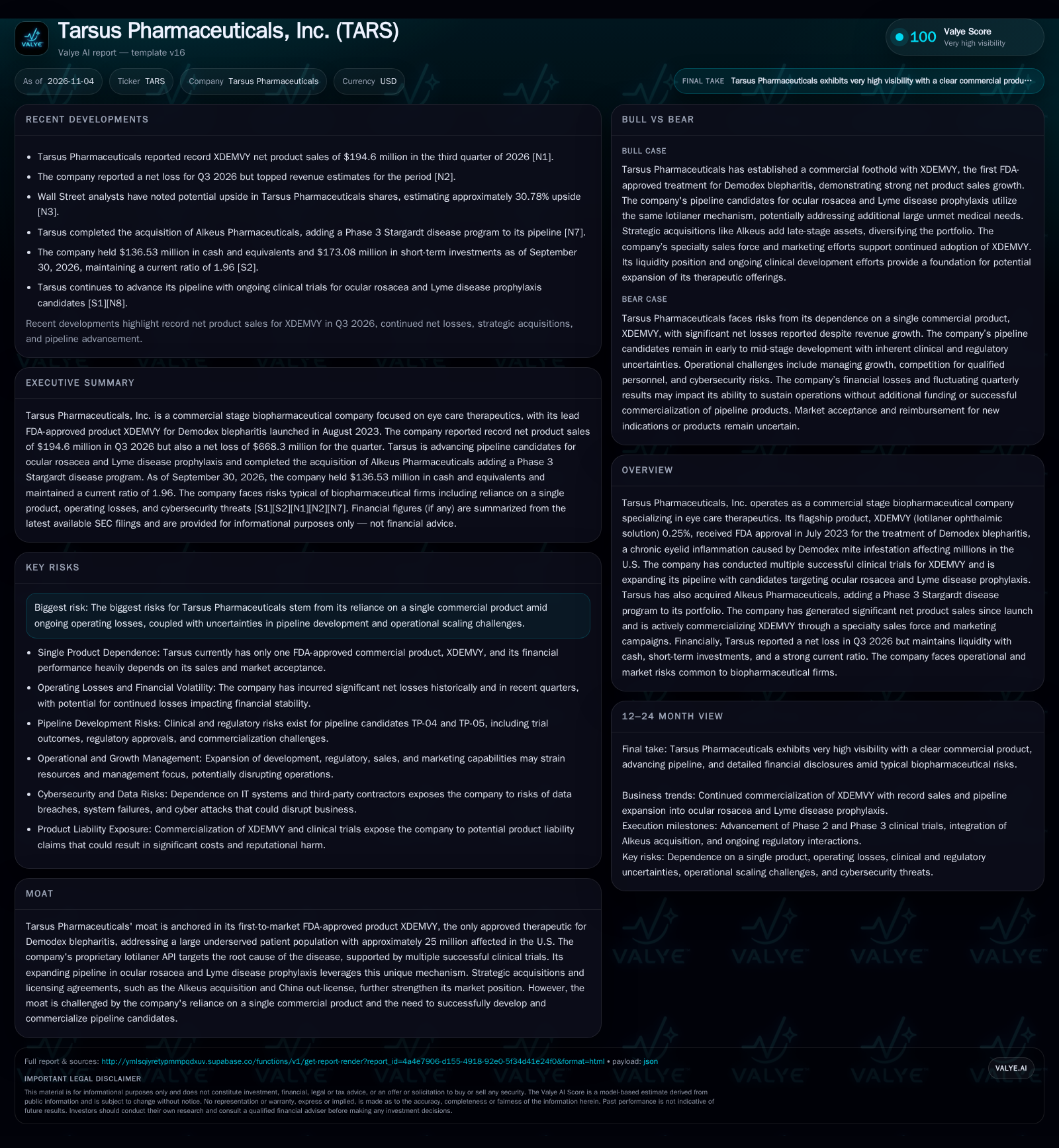
Tarsus Pharmaceuticals’ XDEMVY is the only FDA-approved treatment for Demodex blepharitis and achieved $194.6 million in Q3 2026 net product sales, though the company posted a significant net loss. Pipeline assets targeting ocular rosacea and Lyme disease prophylaxis, as well as the Alkeus acquisition for Stargardt disease, represent potential future growth drivers. The company’s challenge is to transform strong initial sales into a durable, diversified revenue base while managing operational and financial risks tied to reliance on a single marketed product. [S1] [S2] [N1] [N7]
Tarsus Pharmaceuticals has quickly established commercial leadership in a previously unaddressed ophthalmic disease segment with XDEMVY, the first and only FDA-approved treatment for Demodex blepharitis. This first-mover advantage has translated into rapid sales ramp-up, but the company’s future trajectory now depends on two fronts: sustaining and expanding XDEMVY adoption amid competitive and market-education challenges, and successfully advancing a pipeline that targets additional high-unmet-need indications in both ophthalmology and infectious disease. With a recent net loss, despite strong revenue growth, and ongoing investment in R&D and commercial infrastructure, Tarsus faces the classic biopharma test—can it parlay a single-asset launch into a resilient, multi-asset business?
Commercial Milestone: XDEMVY’s Sales Surge and Pipeline Momentum
Tarsus Pharmaceuticals’ most material recent development is the commercial traction of XDEMVY, which generated $194.6 million in net product sales in Q3 2026, bringing launch-to-date net product sales to over $646 million. This rapid ramp confirms significant market demand in the previously undertreated Demodex blepharitis segment, where XDEMVY remains the only FDA-approved therapy. However, alongside this sales achievement, Tarsus reported a substantial net loss of $668.3 million for the quarter, reflecting ongoing investment in commercialization, R&D, and operational scaling. [S1] [N1] [S2]
Pipeline expansion is underway: TP-04 entered Phase 2 trials for ocular rosacea in December 2025, with topline results expected in the first half of 2027, while TP-05, targeting Lyme disease prophylaxis, is preparing for Phase 2 after positive early-stage data. The recent acquisition of Alkeus Pharmaceuticals augments the pipeline with a Phase 3 asset for Stargardt disease, further broadening Tarsus’s late-stage opportunities. [S1] [N7]
The company reported cash and liquidity metrics for the period; these figures do not by themselves establish operating runway, investment capacity, financial flexibility, or financing capacity. [S2]
How XDEMVY’s Economics Shape Tarsus’s Growth Trajectory
Tarsus’s near-term economics are dominated by XDEMVY, which benefits from first-mover pricing flexibility as the only approved therapy for Demodex blepharitis. The lack of direct competitors and the product’s unique mechanism—paralyzing and eradicating Demodex mites—enable premium positioning, likely translating to favorable gross margins typical of specialty ophthalmic drugs. However, the cost structure is currently weighted toward high SG&A and R&D as the company invests in field force expansion, physician education, and pipeline advancement.
Variable costs for XDEMVY, such as production and distribution, are likely modest relative to the high price point, suggesting positive unit economics at scale. Fixed costs remain high due to ongoing R&D, regulatory activities, and the cost of scaling commercial infrastructure. As XDEMVY adoption grows, operating leverage could improve if revenue outpaces expense growth. However, the company’s continued net losses indicate that current revenue does not yet fully offset the aggregate expense base.
Capital requirements remain significant. Despite recent positive cash flows from operations, Tarsus’s ongoing clinical trials, commercialization efforts, and integration of new pipeline assets (like Alkeus) require sustained investment, implying that external financing may be needed if pipeline assets are to be advanced aggressively and commercial reach extended. [S2]
First-Mover Advantage and the Race to Broaden the Moat
Tarsus’s competitive position is anchored by XDEMVY’s status as the only FDA-approved therapy for Demodex blepharitis, a prevalent but historically undertreated condition. This first-mover advantage is reinforced by robust clinical data and a unique mechanism of action, creating significant barriers for would-be entrants who must demonstrate both safety and efficacy in a large, chronic population. The company’s specialty sales force and targeted marketing to ophthalmologists and optometrists aim to entrench prescribing habits before competitors can launch rival therapies.
However, the moat is currently narrow: XDEMVY’s position is vulnerable to new entrants (branded or generic), physician inertia, or alternative management strategies should they emerge. Broader competitive threats include established ophthalmology companies with deeper commercial infrastructure and pipeline assets. Tarsus’s pipeline, if successfully commercialized, could extend its competitive advantage into ocular rosacea—where no FDA-approved therapies exist—and infectious disease prophylaxis, but these markets have different competitive dynamics and regulatory hurdles.
Strategic moves like the Alkeus acquisition and regional licensing agreements (e.g., for TP-03 in China) represent attempts to diversify both the pipeline and geographic footprint, but the benefit will depend on successful integration, regulatory progress, and market acceptance.
Unlocking Multi-Asset Growth: When Pipeline Execution Compounds XDEMVY Momentum
The most compelling upside for Tarsus is a scenario in which XDEMVY continues to penetrate the large U.S. Demodex blepharitis market, achieving broader adoption among eye care professionals and strong formulary access, while the pipeline delivers additional FDA approvals. In this case, TP-04 for ocular rosacea and TP-05 for Lyme disease prophylaxis would reach the market, diversifying revenue and leveraging the commercial infrastructure built for XDEMVY.
If TP-04 demonstrates robust efficacy and safety in Phase 2 and 3 trials, Tarsus could establish a second first-to-market asset in ocular rosacea, potentially commanding premium pricing in another large, unmet-need indication. Similarly, if TP-05’s oral formulation proves effective for Lyme disease prophylaxis, the company could access a broader, possibly primary care-driven market.
The Alkeus Stargardt program’s success would further validate Tarsus’s ability to integrate and advance external assets, potentially attracting additional business development opportunities.
Confirming evidence would include: accelerating XDEMVY prescription growth, successful completion and positive topline results from TP-04 and TP-05 trials, FDA approvals for new indications, improved operating leverage (declining SG&A as a percentage of sales), and continued strong formulary/access wins.
Building a Sustainable Franchise Amid Commercial and R&D Uncertainties
The most plausible trajectory is that XDEMVY continues to grow, but at a moderating pace as initial adoption tapers and market penetration slows without additional indications or international expansion. Physician education and patient awareness efforts drive incremental uptake, but competitive threats and payer pushback may begin to emerge as the market matures.
Pipeline progress is mixed: TP-04 and TP-05 advance through clinical stages, but regulatory timelines and trial results are subject to the typical uncertainties of mid-stage development. The integration of Alkeus and its Stargardt program proceeds, but commercialization is further out and contingent on successful Phase 3 data.
Financially, Tarsus manages near-term liquidity through a combination of XDEMVY cash flows and prudent expense management but may seek additional funding to accelerate pipeline programs or withstand unforeseen setbacks.
This scenario would be confirmed by steady, but not accelerating, XDEMVY sales, continued net operating losses (though narrowing over time), and incremental pipeline progress (e.g., positive but not transformational data). Falsification would come from stagnating sales, clinical trial failures, or unexpected regulatory setbacks.
When Single-Product Dependence and Pipeline Delays Threaten the Investment Case
The bear case for Tarsus materializes if XDEMVY adoption falls short of expectations—due to lower-than-anticipated patient or physician uptake, reimbursement challenges, or the emergence of alternative management strategies. In this scenario, Tarsus’s heavy investment in commercial infrastructure becomes a financial drag, exacerbating net losses.
Pipeline setbacks compound the risk: if TP-04 or TP-05 fail to demonstrate efficacy or encounter safety/regulatory issues, Tarsus remains a single-product company in a niche market. The Alkeus Stargardt asset, while promising, is years from commercialization and carries its own clinical development risks.
Under this scenario, liquidity becomes a pressing concern as cash burn accelerates. The company may be forced to raise dilutive capital or scale back R&D and commercial investments, further reducing its ability to recover momentum.
Evidence for this scenario would include plateauing or declining XDEMVY sales, negative pivotal trial results, delays in regulatory filings, and widening net losses or accelerated cash burn.
Milestones That Will Define Tarsus’s Transition from Single-Asset to Multi-Asset Value
Quarterly XDEMVY prescription growth and market share among U.S. eye care professionals—would signal ongoing adoption and competitive entrenchment.
Gross-to-net realization for XDEMVY and trends in formulary coverage and reimbursement rates—if disclosed, this would clarify pricing power and payer acceptance.
Progression of TP-04 (ocular rosacea) through Phase 2 and, subsequently, Phase 3 clinical trials—topline data and regulatory updates will be critical inflection points.
Initiation and results of TP-05 Phase 2 trials for Lyme disease prophylaxis—key for pipeline diversification.
Integration milestones and clinical progress for the Alkeus Stargardt program—updates on Phase 3 timelines or interim results would help test the value of this acquisition.
SG&A expense trends relative to XDEMVY revenue—operating leverage improvement would demonstrate scalability of the commercial model.
Cash burn rate and any new financing activity—would clarify runway and the need for future capital raises.
Emergence of competitor products or generic threats—regulatory filings or trial readouts from competitors would test the durability of XDEMVY’s market exclusivity.
Disclaimer: This is research-only, informational analysis and not investment advice. It may include AI-generated interpretation and general industry context. Always verify important details using primary sources.

Comments