
AES CORP: Renewable Growth, Utility Expansion, and the Strategic Implications of the Horizon Merger
AES leverages a diversified generation portfolio and a robust renewable energy backlog while advancing a major merger that could reshape its capital structure and growth trajectory.
AES CORP is executing on large-scale renewable project backlogs and utility rate base expansion, while progressing through a transformative merger with infrastructure investors. The merger’s finalization could materially alter AES’s potential financial flexibility and strategic direction [S1] [S2] [N1].
AES CORP stands at a strategic crossroads: with over half its generation capacity now renewable and a significant pipeline of contracted clean energy projects, the company is positioned as a key enabler of corporate decarbonization. At the same time, its regulated utilities are set for continued rate base expansion, and a transformative merger with major infrastructure investors nears completion. The next phase for AES hinges on its ability to deliver on backlog, manage regulatory and financial headwinds, and realize the promised synergies of its pending merger.
AES’s Dual Engines: Renewable Backlog and Merger Progress Drive the Narrative
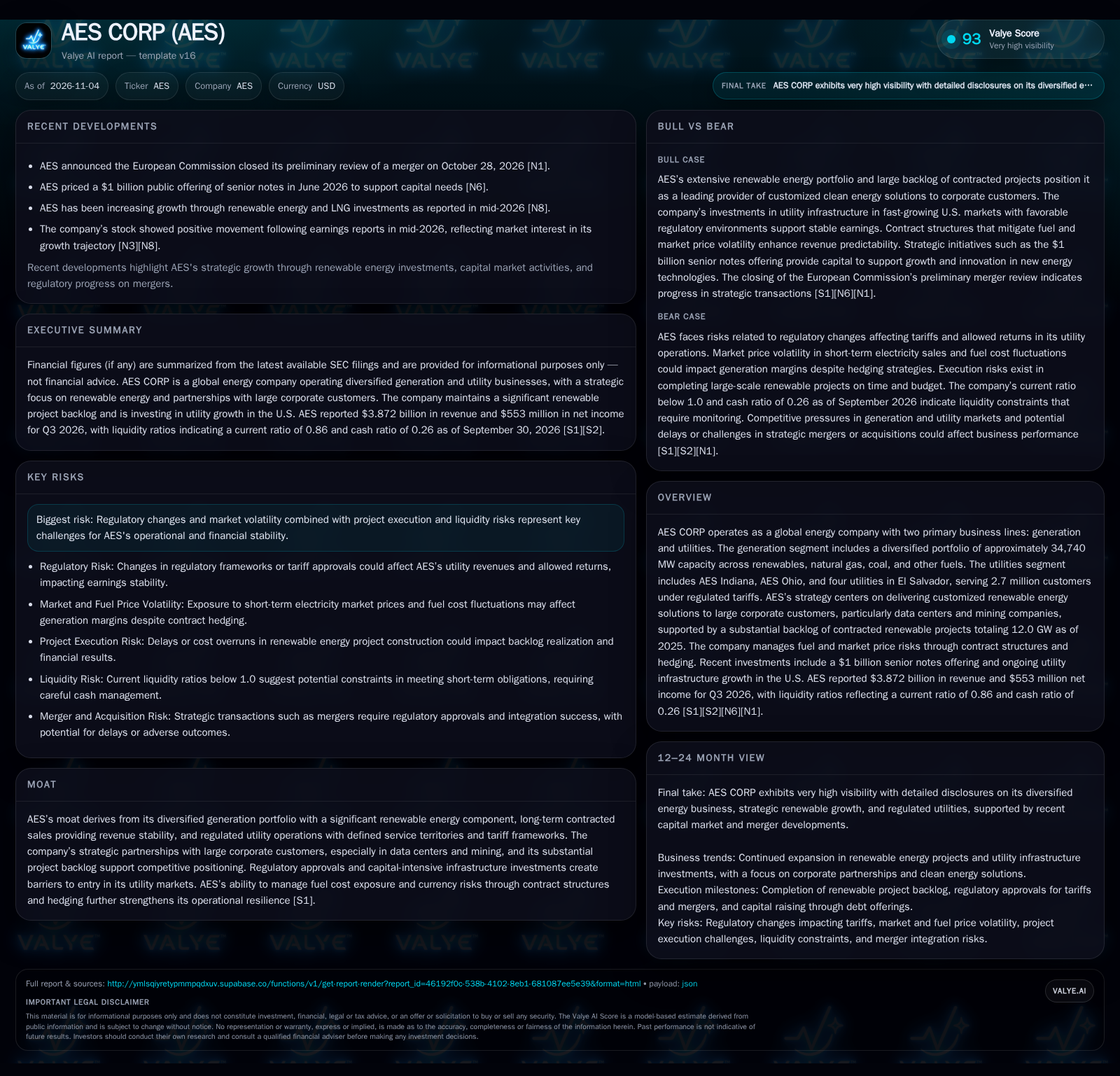
AES reported $3.872 billion in revenue and $553 million in net income for Q3 2026, reflecting the contribution of both its regulated utilities and a diversified generation portfolio where renewables now account for 54% of capacity [S2] [S1]. This shift is reinforced by a 12.0 GW backlog of contracted renewable projects, with 5.7 GW under construction, supporting forward revenue visibility and growth [S1].
The company has advanced a transformative merger with infrastructure funds managed by Global Infrastructure Management, LLC and EQT Infrastructure VI. As of late October 2026, the deal has cleared major regulatory approvals, including those from the European Commission and U.S. authorities, but final closing conditions and integration steps remain [S2] [N1].
On the financial side, AES’s current ratio stands at 0.86 and its cash ratio at 0.26 as of September 30, 2026, which, while not unusual for a capital-intensive utility, highlight the importance of disciplined cash management as the company pursues growth and integration [S2].
How AES Monetizes Renewables and Utilities: Contract Structures, Rate Bases, and Capital Cycles
AES’s economics are anchored in two distinct but complementary models: long-term contracted generation (especially renewables) and regulated utility operations. The renewables segment monetizes through medium- and long-term power purchase agreements (PPAs), capacity payments, and renewable energy credit (REC) sales. These contracts typically provide predictable revenues and limit exposure to spot electricity and fuel price volatility, especially as many renewable assets (solar, wind, storage) have minimal variable costs [S1].
On the utility side, AES operates under regulated tariffs and rate-of-return frameworks, particularly in its U.S. businesses (AES Indiana, AES Ohio), which are experiencing double-digit rate base growth through 2027. This allows for a relatively stable earnings stream but requires continual capital investment to expand and upgrade infrastructure—fueling both growth and the need for external funding [S1].
Capital intensity remains high, especially as AES builds out 5.7 GW of renewable projects currently under construction. The company recently completed a $1 billion senior notes offering, illustrating reliance on debt markets to fund expansion [N6]. The company reported cash and liquidity metrics for the period; these figures do not by themselves establish operating runway, investment capacity, financial flexibility, or financing capacity. [S2]
Competitive Edge and Counterforces: Corporate Partnerships, Regulatory Shields, and Market Dynamics
AES’s competitive position is built on scale, diversification, and the ability to deliver customized renewable solutions to large corporate buyers—especially data centers and mining companies. These customers increasingly demand clean energy with long-term price certainty, and AES’s backlog of contracted projects positions it as a preferred partner for such off-takers [S1].
The company’s regulated utility operations in the U.S. and El Salvador provide geographic and business model diversification, with defined service territories and tariff protections acting as moats against new entrants. However, this comes with the risk of regulatory intervention, as evidenced by recent motions for additional credit protections in Ohio, highlighting the ongoing negotiation between utility regulators and asset owners [S2].
Competition is intensifying on several fronts: from independent power producers, vertically integrated utilities, and new entrants deploying capital into renewables. Technology substitution risk (e.g., distributed generation, battery storage, and virtual power plants) could erode traditional utility economics over time, especially if regulatory frameworks lag market evolution. AES’s ability to maintain customer relationships and regulatory goodwill will be critical to defending its position.
Unlocking Value: If Backlog Execution and Merger Synergies Materialize
The most favorable outcome for AES would see timely delivery of the 12.0 GW renewable backlog, on-budget and with minimal regulatory or supply chain delays, translating into expanded contracted cash flows and further de-risked earnings. Successful integration of new projects, alongside continued double-digit rate base growth in AES Indiana and AES Ohio, would reinforce stable, growing utility earnings [S1].
If the Horizon merger closes smoothly, AES could gain access to additional capital, operational expertise, and strategic alignment with infrastructure investors—potentially lowering its cost of capital and accelerating investment in new technologies or markets. Confirmation would come from evidence of project completions feeding into revenue growth, margin expansion from scale, and debt refinancing or credit upgrades following merger closing.
Falsification would look like persistent delays in bringing new projects online, regulatory pushback on utility rate increases, or integration challenges that erode the anticipated synergies and potential financial flexibility.
A Balancing Act: Steady Growth Amid Execution and Regulatory Complexity
The most plausible trajectory is that AES continues to convert its renewable backlog into operating assets at a moderate pace, with some projects facing typical construction or permitting delays, but the bulk eventually entering service and contributing to contracted revenue. Regulated utilities maintain growth, but ongoing regulatory scrutiny—such as credit ring-fencing requests in Ohio—introduces periodic friction and potential for incremental compliance costs [S2].
The merger with Horizon Parent likely closes after final regulatory and procedural steps, but integration is gradual and may involve transitional costs. Liquidity remains tight but manageable through ongoing access to capital markets, refinancing, and disciplined capital allocation. AES’s revenue mix remains anchored in long-term contracts and regulated tariffs, with incremental contributions from new energy technologies as pilot programs scale.
Evidence supporting this scenario would include steady project completions, stable or improving credit metrics post-merger, and utility rate base growth tracking guidance. Falsification would be signaled by significant project delays, regulatory reversals, or an inability to refinance maturing obligations on favorable terms.
Where Momentum Stalls: Execution, Liquidity, or Regulatory Shocks Derail Progress
An adverse scenario would see a confluence of delays or cost overruns in renewable project construction, eroding the value of AES’s backlog and undermining growth expectations. If regulatory bodies impose additional credit or ring-fencing requirements—especially in Ohio or other U.S. jurisdictions—AES could face higher financing costs or constrained access to utility cash flows [S2].
Should liquidity tighten further (e.g., due to underperforming asset sales, refinancing at higher rates, or project cost inflation), AES might be forced to slow its capital program, defer growth investments, or raise equity at unattractive terms. In the extreme, failed merger integration or reversal of regulatory approvals could trigger a strategic reset, asset divestitures, or a loss of investor confidence.
Downside confirmation would include public disclosures of major project delays, negative credit actions, regulatory orders imposing new constraints, or missed financial targets tied to project delivery or utility earnings.
Testing the AES Thesis: Project Delivery, Merger Completion, and Regulatory Outcomes
The pace and cost of converting the 12.0 GW renewable backlog into operating assets—quarterly project completion disclosures will be critical [S1].
Progress and final closing of the Horizon merger, including any new capital structure or strategic changes announced post-closing [S2] [N1].
Utility rate base growth in AES Indiana and AES Ohio, and any material regulatory orders affecting allowed returns or credit protections [S1] [S2].
Quarterly cash flow from operations and any changes in liquidity metrics, including refinancing of near-term debt maturities [S2].
Evidence of margin stability or expansion in both generation and utility segments, particularly as new projects come online (if disclosed).
Regulatory filings or news regarding potential ring-fencing, credit rating requirements, or new compliance costs in key jurisdictions [S2].
Any changes in the scale or composition of the renewable project backlog—including cancellations, new awards, or shifts in customer demand [S1].
Updates on capital allocation priorities post-merger, including dividends, buybacks, or strategic investments (if disclosed).
Disclaimer: This is research-only, informational analysis and not investment advice. It may include AI-generated interpretation and general industry context. Always verify important details using primary sources.

Comments