
HNI Corporation: Integration Ambitions Meet Margin Pressures After Steelcase Acquisition
HNI’s $1.9 billion purchase of Steelcase has reshaped the company’s scale and strategy, driving double-digit sales growth but compressing margins as integration, restructuring, and financing costs weigh on net income. The company’s ability to realize operational synergies, defend share in a changing workplace market, and manage housing-driven volatility in its residential segment will determine whether value creation follows headline expansion.
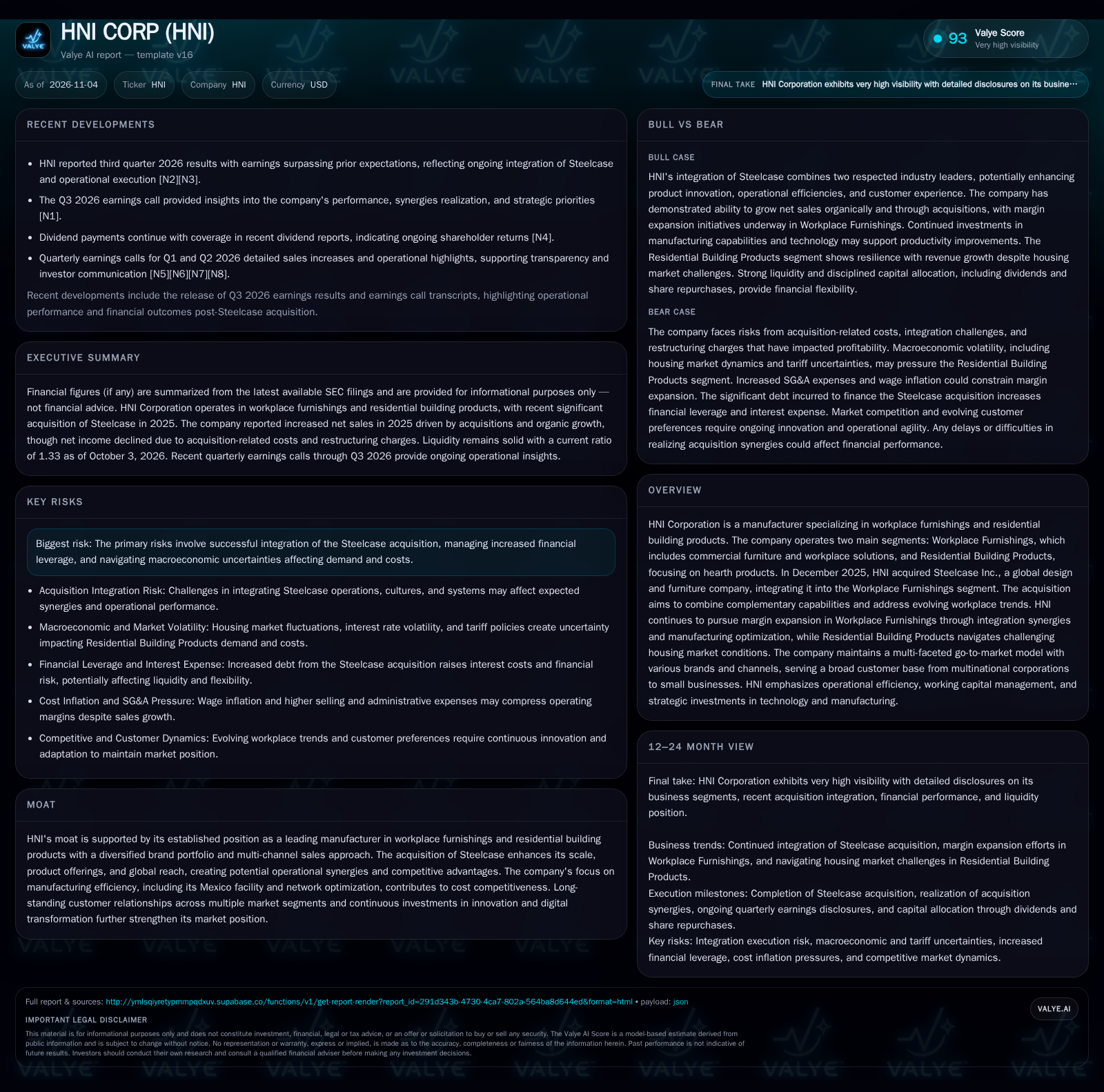
HNI Corporation’s acquisition of Steelcase in late 2025 produced a step-change in scale, with 2025 sales up 12.4% and Workplace Furnishings leading growth. However, acquisition-related costs and restructuring have sharply reduced net income and compressed margins. The company’s thesis now hinges on integration execution, synergy realization, and navigating macroeconomic volatility in both commercial and residential end markets. Leverage from the Steelcase deal raises risk but also creates operating leverage potential if execution is strong. Watch for evidence of sustained margin recovery, successful integration, and resilience in the face of housing and workplace demand swings. [S2] [N2]
HNI Corporation’s $1.9 billion acquisition of Steelcase has repositioned it as a leading force in workplace furnishings, creating both new opportunities for scale-driven efficiency and acute challenges in profitability and integration. While the deal pushed 2025 sales to $2.839 billion, net income dropped sharply as acquisition and restructuring costs, as well as higher interest expense, weighed on results. With the Workplace Furnishings segment now encompassing both legacy HNI and Steelcase, and Residential Building Products navigating persistent housing market uncertainty, the company’s next phase depends on extracting promised synergies, restoring margins, and proving that bigger can also mean better returns. [S2] [N2]
Steelcase Acquisition: Scale Gains and Margin Compression Shape the Current Picture
The most material development for HNI is the December 2025 acquisition of Steelcase Inc. for $1.9 billion in cash and stock, immediately expanding HNI’s Workplace Furnishings segment and adding $187.5 million in post-acquisition 2025 sales. This deal drove consolidated net sales up 12.4% to $2.839 billion, with Workplace Furnishings growing 14.6% and Residential Building Products up 5.7%. However, the integration came at a steep cost: net income fell to $54.2 million in 2025 from $139.5 million in 2024 as acquisition-related charges, restructuring, higher interest expense, and divestiture losses weighed on results. Operating income margin declined by 380 basis points year-over-year, reflecting these transition costs. [S2]
Recent quarterly results (Q3 2026) show earnings surpassing expectations, suggesting some operational improvement post-acquisition. Still, the company faces significant execution risk as it works to integrate Steelcase, realize synergy targets, and manage heightened leverage. The focus on cost savings, digital transformation, and manufacturing optimization—especially leveraging the Mexico facility—remains central to the current strategy. [N2] [N3]
How HNI Makes—and Could Lose—Money After the Steelcase Deal
HNI’s economic engine is now more heavily weighted toward the commercial workplace segment, with Residential Building Products (primarily hearth products) as a smaller but still meaningful contributor. Workplace Furnishings is typically characterized by a mix of project-driven and recurring contract revenue, with pricing power varying by brand, customer scale, and the complexity of solutions. The Steelcase acquisition expands product breadth, global reach, and channel presence, potentially enhancing cross-selling and broadening the customer base.
The company’s revenue growth is now partly acquisition-driven, but future profit improvement depends on realizing cost synergies (e.g., supply chain consolidation, manufacturing rationalization) and operating leverage from increased scale. The integration of Steelcase introduces significant fixed costs, including amortization and financing expense, but also creates an opportunity to spread overhead across a larger revenue base if volumes are sustained. The challenge is that margin expansion is not automatic: 2025 saw a 380 basis point decline in operating margin despite sales growth, as one-time integration and restructuring costs, plus ongoing SG&A and wage inflation, more than offset early synergy benefits. [S2]
Capital needs remain substantial, with $67.8 million in 2025 capex focused on machinery, equipment, and technology. The company’s use of debt to fund the Steelcase acquisition increases financial risk and interest burden, making cost discipline and working capital management even more critical. While dividends and share repurchases continue, the payout ratio has averaged 58% of prior-year earnings, a level that may become harder to sustain if free cash flow does not recover post-integration.
Defending Share in a Shifting Workplace and Residential Landscape
HNI competes in fragmented but competitive markets. In commercial furnishings, competition comes from other diversified manufacturers, niche design firms, and low-cost importers, while in residential building products, regional and specialty brands vie for share amid cyclical demand. The Steelcase acquisition consolidates two established brands, theoretically strengthening HNI’s hand with larger customers, designers, and channel partners who value breadth, reliability, and integrated solutions.
Potential sources of advantage include scale-driven purchasing power, a broadened product and brand portfolio, and the ability to invest in digital tools and customer experience. However, the risk is that legacy integration issues—IT systems, salesforce alignment, and culture—could dilute these advantages, at least in the near term. Furthermore, the move to hybrid work and evolving workplace needs could blunt traditional demand for office furniture, requiring HNI to adapt its offering and go-to-market approach. In Residential Building Products, the company faces macro-driven swings in housing starts and remodeling, with tariffs and commodity inflation as ongoing wildcards.
If Synergies Flow and Demand Recovers, Margin Expansion Could Outpace Expectations
The most favorable scenario for HNI sees the company successfully integrating Steelcase, quickly realizing targeted cost and operational synergies, and leveraging its expanded product and channel footprint to win incremental share. As one-time acquisition and restructuring charges fade, operating margins could rebound, aided by higher inventory turns and a more efficient manufacturing footprint—especially if Mexico facility ramp-up delivers as planned. The company’s ability to cross-sell between legacy HNI and Steelcase customer bases and win large, multi-location corporate projects could further lift topline and profitability.
Confirmation would come from sequential improvements in gross and operating margins, higher free cash flow conversion, and evidence of sustained sales growth in both Workplace Furnishings and Residential Building Products. Analyst and management commentary citing successful integration milestones, above-expectation synergy realization, and improved customer retention or win rates would support the upside. Conversely, delays in synergy capture, persistent margin compression, or stalled topline growth would falsify this scenario.
Integration Grind and Mixed End-Market Trends Dominate the Next Phase
The most plausible medium-term outcome is a gradual normalization of profitability as HNI absorbs the integration costs and operational disruptions from the Steelcase deal. Sales growth moderates as the initial acquisition bump annualizes out, with Workplace Furnishings benefiting from a partial recovery in office demand, while Residential Building Products remains exposed to housing market volatility. Margin recovery is incremental rather than dramatic, as synergy realization is partially offset by persistent wage and SG&A inflation.
Evidence in support of this scenario would include modest but steady improvements in operating margins, continued focus on working capital efficiency, and capital allocation discipline. Management updates emphasizing sequential progress in integration and operational KPIs—such as inventory turns and receivable collections—would confirm the base case. Should integration stall, restructuring drag persist, or macro headwinds intensify, the scenario could tip negative.
If Integration Falters or Markets Weaken, Leverage Could Exacerbate Losses
The most adverse scenario would see HNI struggling to integrate Steelcase, with synergy targets missed and cultural or operational friction undermining both revenue and cost-side assumptions. Prolonged restructuring or unexpected impairment charges could further erode profitability, while higher interest expense from acquisition debt amplifies the impact of any earnings shortfall. In this case, operating margin stagnates or declines further, and cash flow comes under pressure—raising questions about the sustainability of dividends and repurchases.
External market shocks—such as a sharp downturn in office demand, a deeper housing recession, or additional tariff/commodity price spikes—could compound these problems, especially given the increased financial leverage. Confirmation would include missed synergy milestones, negative operating leverage, unexpected asset write-downs, or guidance cuts. Early warning signs might include persistent margin compression, rising working capital needs, or management signaling delays in integration objectives.
Milestones and Metrics That Will Determine HNI’s Post-Acquisition Trajectory
Quarterly gross and operating margin trends—sequential improvement would confirm synergy capture and cost control.
Progress updates on Steelcase integration milestones, including system harmonization, salesforce alignment, and manufacturing consolidation.
Net debt and interest coverage ratios—will indicate whether leverage is being managed as integration proceeds.
Free cash flow generation and payout ratios—sustained improvement would support continued dividends and repurchases.
Workplace Furnishings segment sales growth relative to office demand trends; a useful metric would be order backlog or large project wins, if disclosed.
Residential Building Products segment performance versus housing starts and remodeling activity; monitoring sensitivity to macro shocks.
Inventory turns and working capital metrics—ongoing improvement would suggest operational discipline is holding.
Management commentary on customer retention, cross-selling success, and digital transformation progress.
Disclaimer: This is research-only, informational analysis and not investment advice. It may include AI-generated interpretation and general industry context. Always verify important details using primary sources.

Comments