
Mercury General’s Regulatory Reset: Rate Approvals, Catastrophe Exposure, and the Long Game in California Insurance
Mercury General’s 2026 results reflect the duality of regulatory-driven pricing power and persistent catastrophe risk. With California’s new rate regime and catastrophe modeling integration, the insurer has levers for premium adequacy—but profitability remains elusive amid loss reserving uncertainties and wildfire fallout.
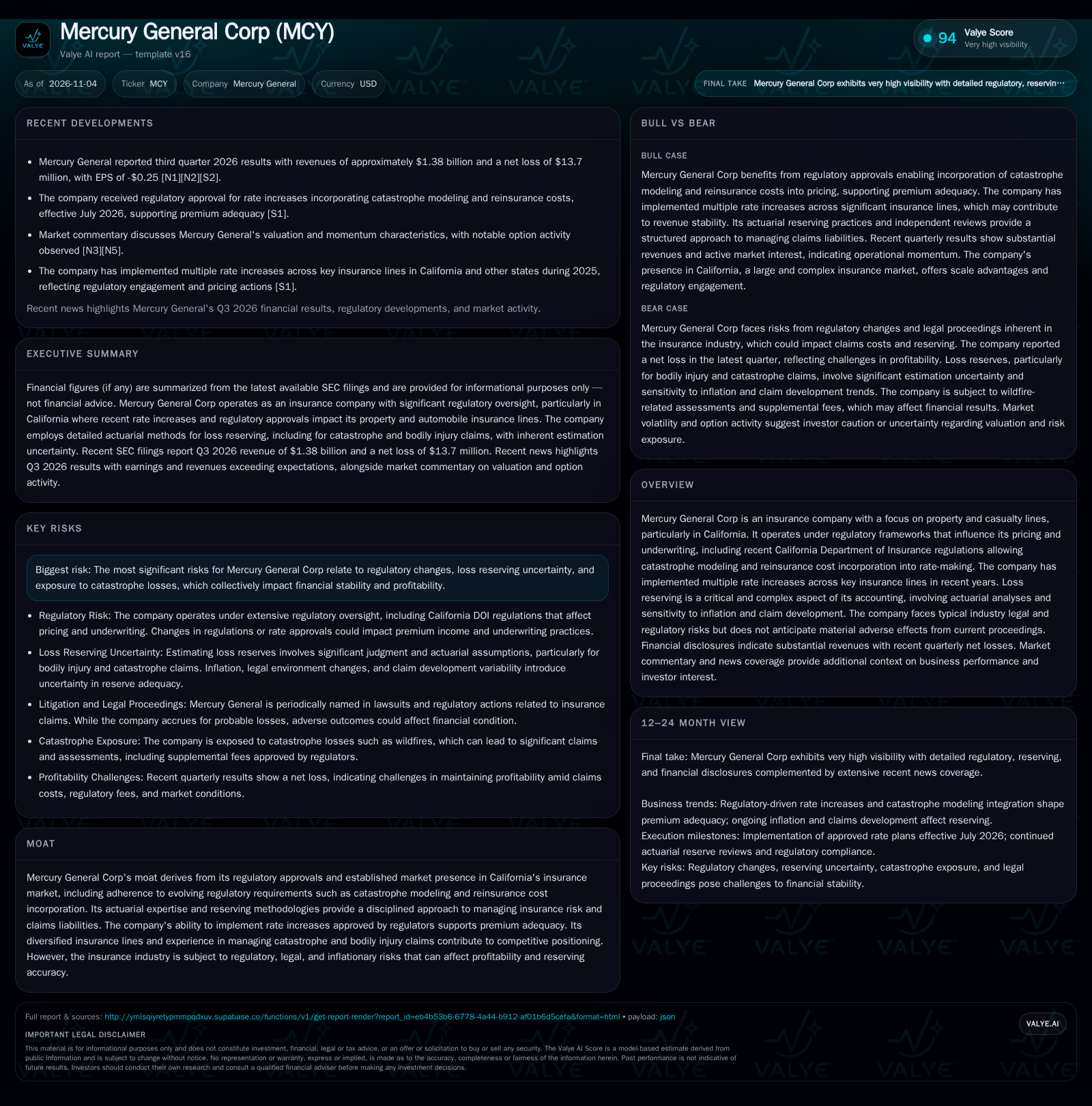
Mercury General is navigating a transformative period for California insurance, having secured regulatory approval to incorporate catastrophe modeling and reinsurance costs into rates effective July 2026. Despite implementing rate hikes across key lines and surpassing Q3 2026 revenue expectations, the company posted a net loss, underscoring the persistent challenge of accurately reserving for bodily injury and catastrophe claims in a volatile environment. The next phase hinges on execution of new rate plans and the evolving interplay between regulatory actions, inflation, and catastrophe risk.[S1] [S2] [N1] [N2]
Mercury General Corporation stands at a regulatory and operational crossroads in 2026. The company’s recent approval to build catastrophe modeling and reinsurance costs into California insurance rates represents a structural shift in pricing power, potentially supporting future premium adequacy. But even as Mercury implements significant rate increases across its major lines and delivers sizable quarterly revenues, the insurer faces the reality of net losses and high reserving uncertainty. With California’s wildfire risk and regulatory demands shaping both opportunity and risk, the company’s next chapter will be defined by its ability to translate regulatory wins into sustainable profitability.
Regulatory Rate Approval and Catastrophe Fallout Shape 2026 Operating Reality
Mercury General’s Q3 2026 revenue of $1.38 billion was accompanied by a net loss of $13.7 million, indicating that top-line momentum has not yet translated into bottom-line stability.[S2] [N1] [N2] The most notable recent development is the California Department of Insurance’s approval in December 2025 for Mercury to incorporate catastrophe modeling and reinsurance costs into rate-making, with these new rates effective from July 2026.[S1] This regulatory win arrives after a period of heightened wildfire losses, including a $50 million FAIR Plan assessment in 2025, half of which Mercury is permitted to recoup through temporary policyholder surcharges.[S1] These facts underscore the company’s acute exposure to catastrophe risk and its dependence on regulatory actions to realign premium adequacy.
How Premiums, Losses, and Regulation Interact in Mercury’s P&L
Mercury General’s business model is built on collecting premiums in exchange for underwriting property and casualty risks—especially in California, where regulatory oversight is intense and catastrophe risk is pronounced. The ability to pass through catastrophe modeling and reinsurance costs via rate increases could, over time, improve premium adequacy and pricing accuracy, potentially reducing the gap between earned premiums and ultimate loss costs. However, fixed costs—such as regulatory assessments and infrastructure—are high, and claims volatility (especially from wildfires) introduces significant unpredictability to loss ratios. Operating leverage is present: if rate increases (especially in auto and homeowners) stick and loss trends stabilize, incremental revenue can fall to the bottom line. But if catastrophe frequency or severity accelerates, or if inflation outpaces rate increases, underwriting margins can rapidly erode. Capital requirements are persistent, as insurers must maintain solvency margins and fund reserves for long-tail claims. The company’s actuarial reserving approach, particularly for bodily injury (BI) and catastrophe lines, is central to its economics but inherently subject to estimation error and inflation risk.[S1]
The interplay between premium adequacy and loss reserving is particularly nuanced in Mercury’s context, given the long-tail nature of many bodily injury claims and the episodic severity of catastrophe events. If the company’s catastrophe models accurately capture emerging risk patterns and inflationary pressures, the resulting rate adjustments can better align premiums with expected ultimate losses. However, these models depend on assumptions about climate trends, construction costs, and medical inflation that may evolve unpredictably. Moreover, the timing of premium recognition versus claim payments introduces cash flow considerations that can affect liquidity and capital management. A useful metric would be the company’s loss development factors over multiple accident years, which would help test the robustness of its reserving methodologies under varying inflation scenarios.
Regulatory Engagement as Both Moat and Constraint in California
Mercury General’s market position is defined by its long-standing regulatory engagement in California—both a source of advantage and a persistent constraint. The company’s ability to secure rate approvals that incorporate catastrophe modeling and reinsurance costs is not universal across all insurers, suggesting a degree of regulatory credibility and scale. This could provide relative pricing power versus smaller or less sophisticated peers unable to justify similar increases. However, the highly regulated environment also limits commercial flexibility and exposes Mercury to political risk: future changes in regulatory posture, rate disapprovals, or new requirements could curtail earnings power. Larger, diversified national insurers may be better able to absorb volatility or redeploy capital, while smaller incumbents may struggle to remain viable. Substitute risk—especially in auto insurance—remains moderate, as switching costs for consumers are low, but regulatory-driven product differentiation (such as catastrophe coverage terms) could be a lever for retention or margin.
Mercury’s regulatory engagement also functions as a dynamic moat by fostering closer relationships with key stakeholders, including regulators and consumer advocates. This engagement can facilitate more timely rate approvals and potentially influence the design of catastrophe coverage provisions, which may differentiate Mercury’s offerings in a crowded market. However, this advantage is conditional on maintaining a transparent and data-driven dialogue; any perception of regulatory capture or insufficient actuarial rigor could invite scrutiny or reversals. Additionally, the company’s scale in California enables investment in advanced analytics and catastrophe modeling capabilities that smaller competitors may lack, enhancing underwriting precision. Yet, this same scale demands navigating complex regulatory frameworks that can slow product innovation or adaptation to emerging risks, representing an ongoing operational constraint.
Rate Hikes, Reserve Accuracy, and Catastrophe Containment Drive Profitable Rebound
In a favorable scenario, Mercury’s July 2026 rate increases—backed by catastrophe modeling and reinsurance cost pass-throughs—prove sufficient to restore underwriting profitability in its core California lines. Claims frequency moderates, inflation in medical and auto repair costs is contained, and the company’s actuarial reserve estimates for bodily injury and catastrophe claims prove conservative. Regulatory relationships remain stable, allowing for further rate flexibility if needed. In this environment, incremental premium growth leverages fixed costs, driving a meaningful improvement in combined ratios and a return to positive net income. Confirmation would come from sequential improvement in loss and combined ratios, positive net income in subsequent quarters, and further regulatory approvals for actuarially justified rate actions.
Regulatory Relief Offsets Some, But Not All, Catastrophe and Inflation Headwinds
The most plausible trajectory is one of gradual improvement, but persistent volatility. Mercury’s new rate structure, effective mid-2026, helps to narrow the gap between premiums and expected losses—especially for catastrophe-exposed lines. However, inflation in claims costs and ongoing wildfire risk continue to pressure loss ratios, keeping profitability choppy. Loss reserve development remains a key source of earnings noise, as bodily injury claims and catastrophe losses are difficult to forecast with precision. Regulatory and legal environments remain challenging but manageable, and the company is able to modestly grow or at least defend its market share in core geographies. Evidence supporting this scenario would include stabilization (but not dramatic improvement) in quarterly combined ratios, continued rate action approvals, and absence of outsized reserve charges or catastrophic loss spikes.
Reserve Misses, Adverse Cat Events, or Regulatory Pushback Prolong Losses
The risk case centers on a combination of estimation error, adverse event frequency, and regulatory reversal. If Mercury’s loss reserves—particularly for bodily injury or catastrophe claims—prove materially inadequate, the company could face reserve strengthening charges that erode capital and delay a return to profitability. A severe wildfire season or new catastrophe event could overwhelm recent rate increases and trigger additional FAIR Plan assessments or policyholder surcharges, further pressuring margins. If regulators become less supportive of rate increases or impose new market-share or coverage mandates, Mercury’s ability to align premiums with risk would be compromised. Confirmation would include negative reserve development, further net losses, outsized catastrophe losses, or explicit regulatory pushback on future rate filings.
Testing the Thesis: What Will Reveal Mercury General’s True Trajectory?
Quarterly combined ratio trends—particularly in California auto and homeowners—will indicate whether rate increases are offsetting loss cost inflation and catastrophe risk.
Sequential movement in net income and earnings per share, post-July 2026, will help test whether new rate structures are translating into improved profitability.
Reported reserve development, especially for bodily injury and catastrophe claims, will show whether actuarial estimates are holding up or require strengthening.
Wildfire frequency and severity, as measured by claims and FAIR Plan assessments, will reveal if catastrophe exposure remains manageable.
Regulatory approval or denial of future rate filings—both in California and in other key states—will clarify the sustainability of Mercury’s pricing power.
Market share retention or growth, if disclosed, in core California lines will provide evidence on competitive positioning post-rate increases.
Option activity and valuation commentary, while not fundamental, could signal shifting market perceptions or anticipated volatility.[N3] [N5]
Disclaimer: This is research-only, informational analysis and not investment advice. It may include AI-generated interpretation and general industry context. Always verify important details using primary sources.

Comments