
Expro Group: Global Reach, Innovation Imperatives, and the Economics of Energy Service Cyclicality
Expro Group Holdings operates at the intersection of global energy infrastructure and service innovation, but faces the realities of industry cyclicality, competitive pressure, and tight margin dynamics. Recent earnings volatility underscores the critical importance of operational efficiency and technology-driven differentiation as the company navigates a shifting energy landscape.
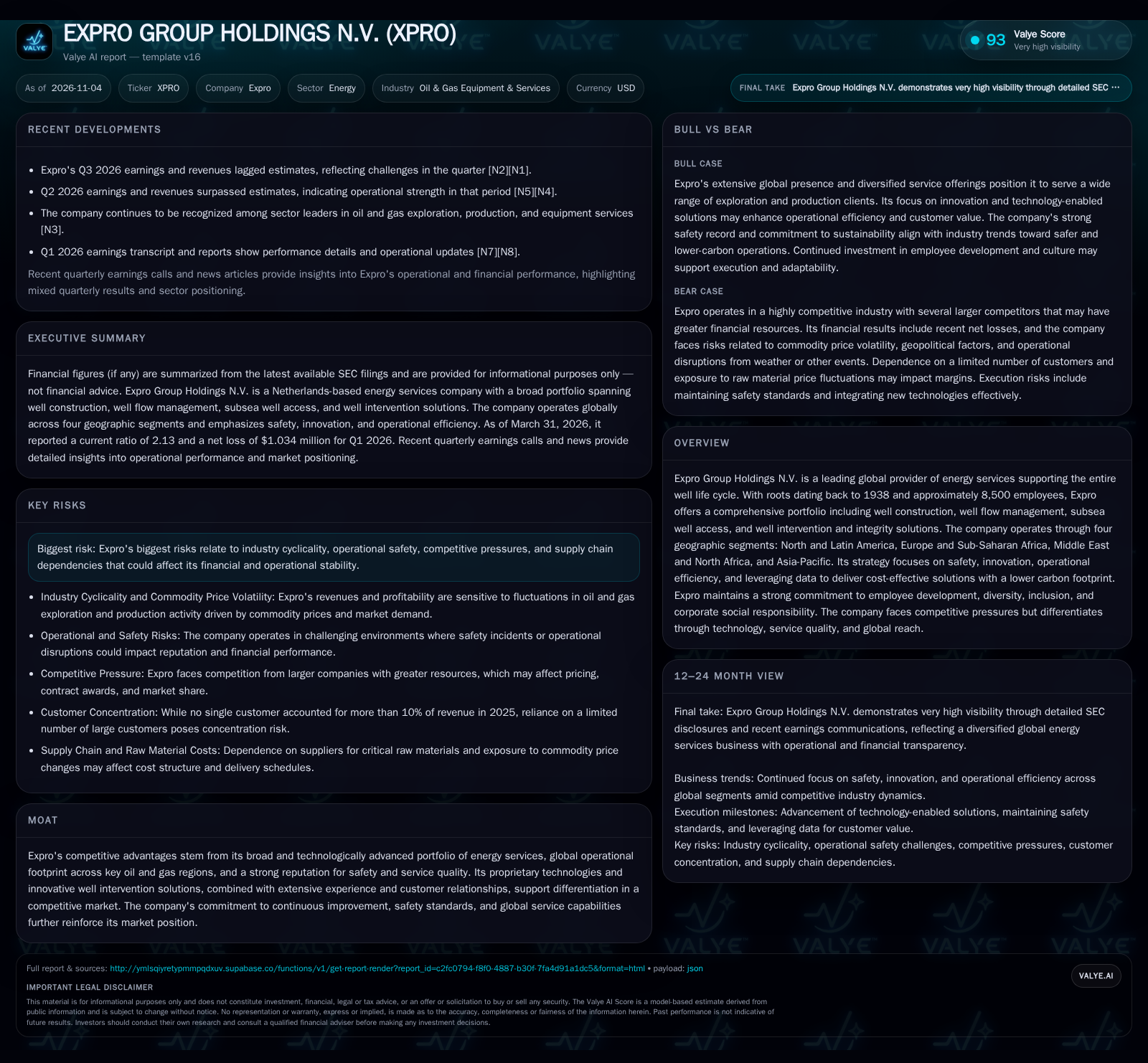
Expro Group Holdings (XPRO) is a Netherlands-based energy services provider with a comprehensive portfolio across well construction, flow management, subsea access, and intervention. Revenue for 2025 was $1.607 billion, diversified across four major regions, but recent quarters have seen mixed earnings performance and a small Q1 2026 net loss. The company competes with larger, well-capitalized peers and must balance innovation, cost control, and safety to defend margins in a cyclical, competitive market. The path forward depends on sustaining differentiated technology offerings and adapting to evolving customer and industry demands. [S1] [S2] [N1] [N2]
Expro Group Holdings stands as a global energy services provider with operations spanning four continents and a broad portfolio addressing the full well life cycle. With 2025 revenue topping $1.6 billion and a workforce of 8,500, the company’s reach and technology suite position it to serve a diverse set of oil and gas clients. Yet recent fluctuations in quarterly earnings, a Q1 2026 net loss, and the ever-present realities of commodity-driven demand highlight the delicate balance between innovation, operational discipline, and market volatility. As the energy industry faces ongoing transition and competition intensifies, Expro’s ability to leverage its technological edge and global footprint will be critical in determining its long-term trajectory. [S1] [S2] [N1] [N2] [N5]
Quarterly Earnings Volatility and Regional Revenue Mix Shape the Present Landscape
Expro Group’s most recent financials reveal a mix of resilience and challenge. The company delivered $1.607 billion in consolidated revenue for 2025, with a balanced geographic split: North and Latin America (34.7%), Europe and Sub-Saharan Africa (30.3%), Middle East and North Africa (22.6%), and Asia-Pacific (12.4%) [S1]. This broad distribution helps buffer against region-specific shocks but exposes the firm to global market swings.
Quarterly results have been uneven: Q2 2026 earnings and revenue exceeded analyst estimates, indicating operational strength, but Q3 2026 lagged expectations, reflecting either end-market softness, project timing, or competitive dynamics [N2] [N5]. As of March 31, 2026, the company reported $170.7 million in cash and equivalents, a current ratio of 2.13, and a cash ratio of 0.38, but posted a Q1 2026 net loss of $1.034 million [S2].
Operationally, Expro maintains a strong safety record, reporting a Lost Time Injury Frequency (LTIF) of 0.00 and a Total Recordable Case Frequency (TRCF) of 0.37 for 2025 [S1]. This safety performance is both a differentiator and a core requirement for winning and maintaining contracts in a safety-sensitive industry.
Revenue Streams, Cost Structure, and the Challenge of Margin Expansion
Expro’s revenue flows from a portfolio of services spanning the well life cycle: well construction, flow management, subsea well access, and intervention. These offerings are typically project-based, with contract structures that may include both lump-sum and time-and-materials components—though the report does not specify exact commercial mechanics.
The company’s advanced technologies—such as proprietary well intervention tools—may allow for premium pricing in certain niches, but the broader market remains highly price-competitive. Fixed costs are substantial, driven by a global workforce, equipment fleet, and R&D investment requirements. Variable costs scale with project activity, including field labor, consumables, and logistics.
Operating leverage is present but not extreme: higher utilization of assets and personnel can drive margin expansion during upcycles, but the business remains vulnerable to sudden volume declines when exploration and production activity slows. Capital needs are ongoing, especially to maintain and upgrade equipment and to develop new technologies, but Expro’s global scale may provide some procurement and operational efficiencies relative to smaller peers.
Defending Against Larger Rivals and the Limits of Technology Differentiation
Expro competes in a fragmented market alongside several larger, better-capitalized oilfield service companies. Its competitive position rests on a combination of technology-enabled offerings, safety track record, customer service, and global reach [S1]. In practice, the ability to win contracts often hinges on price, reliability, local content, and integration with customer operations.
Proprietary technologies such as CoilHose™, Octopoda™, and Galea™ may enable Expro to address specialized well intervention challenges, but larger competitors often have broader portfolios and deeper customer relationships. The company’s global footprint allows it to serve multinational customers across multiple basins, which can be an advantage in securing cross-regional contracts.
However, technology advantages can erode as innovations diffuse and as customers increasingly demand cost-effective solutions amid tighter capital budgets. Switching costs for customers are moderate: while operational continuity and safety records matter, most oilfield service contracts are time-bound and subject to retendering, keeping pricing pressure high.
Innovation-Led Market Share Gains and Margin Improvement Could Drive Outperformance
A favorable scenario would see Expro leveraging its proprietary technologies and safety leadership to win higher-value contracts, particularly in complex well intervention and subsea projects. If the company can demonstrate superior operational efficiency and deliver measurable customer cost savings, it could justify premium pricing or secure longer-term agreements.
Expansion in regions with rising E&P investment—especially where local content and safety are prioritized—could further boost volume. Successful commercialization of new products or digital solutions that improve well productivity or reduce downtime would also support both revenue and margin growth.
Evidence that would confirm this scenario includes sustained revenue outperformance versus peers, rising gross margins, new contract wins in technology-led segments, and customer testimonials or case studies highlighting operational excellence. Conversely, if innovation fails to translate into new business or if pricing remains constrained, the upside would be limited.
Navigating Cyclicality with Operational Discipline and a Diversified Portfolio
The most plausible trajectory is one of operational steadiness amid cyclical ups and downs. Expro is likely to see revenue and earnings fluctuate in line with global E&P spending, with regional diversity providing some insulation but not full immunity from downturns.
Margins may remain under pressure due to competitive pricing and customer cost sensitivity, but ongoing investment in safety, efficiency, and incremental technology upgrades could help defend market share. The company’s balanced geographic exposure and broad service suite enable it to participate in both brownfield optimization and new field development cycles.
Confirmation of this scenario would come from relatively stable annual revenue, modest margin improvement, and continued strong safety performance. Signs of more severe cyclicality, major contract losses, or sustained negative earnings would challenge this outlook.
Commodity Downturn, Margin Compression, and Competitive Disruption Threaten Stability
In a negative scenario, a sharp drop in oil and gas prices or a sustained reduction in E&P activity could lead to significant revenue declines. Larger competitors might intensify price competition to maintain utilization, eroding Expro’s margins and contract win rates.
Operational disruptions—whether from safety incidents, supply chain breakdowns, or geopolitical instability in key markets—could further strain financial performance and damage customer trust. If the company is unable to keep pace with technology shifts or loses key personnel, its differentiation could diminish.
Evidence for this scenario would include consecutive quarters of revenue decline, negative cash flow, deteriorating safety statistics, and customer or contract losses to larger or more innovative rivals. Failure to execute on new product launches or digital initiatives would amplify downside risks.
Signals That Will Test Expro’s Resilience and Competitive Edge in a Cyclical Market
Quarterly revenue growth (or contraction) by geographic segment—especially in North and Latin America and Europe/Sub-Saharan Africa—would help assess regional competitive dynamics and end-market demand.
Gross and operating margin trends, particularly during periods of E&P market softness, would indicate the company’s ability to defend pricing and control costs.
New contract awards or renewals in technology-led service lines such as well intervention and subsea access would signal successful differentiation.
Safety metrics, including Lost Time Injury Frequency (LTIF) and Total Recordable Case Frequency (TRCF), if disclosed quarterly, would provide early warnings of operational risk or lapses.
Commercialization timelines and adoption rates for proprietary technologies like CoilHose™, Octopoda™, and Galea™—disclosures of customer uptake or field results would be particularly informative.
Cash flow from operations and capital expenditure levels, if disclosed, would help gauge potential financial flexibility and investment discipline.
Customer concentration trends—if any one customer approaches or exceeds 10% of revenue, this would heighten risk and merit close scrutiny.
Any disclosed changes in contract structure (e.g., shift toward longer-term or performance-linked agreements) would provide clues about revenue visibility and pricing power.
Disclaimer: This is research-only, informational analysis and not investment advice. It may include AI-generated interpretation and general industry context. Always verify important details using primary sources.

Comments