
Avery Dennison in 2026: Materials Science, RFID Momentum, and the Challenge of Global Complexity
Avery Dennison continues to leverage its global scale and innovation in materials science and RFID-based digital identification, but faces mounting pressures from macroeconomic volatility, raw material costs, and intensifying competition. The integration of Taylor Adhesives and ongoing sustainability initiatives shape the company’s strategic direction as it seeks to maintain margin resilience and expand its digital solutions footprint.
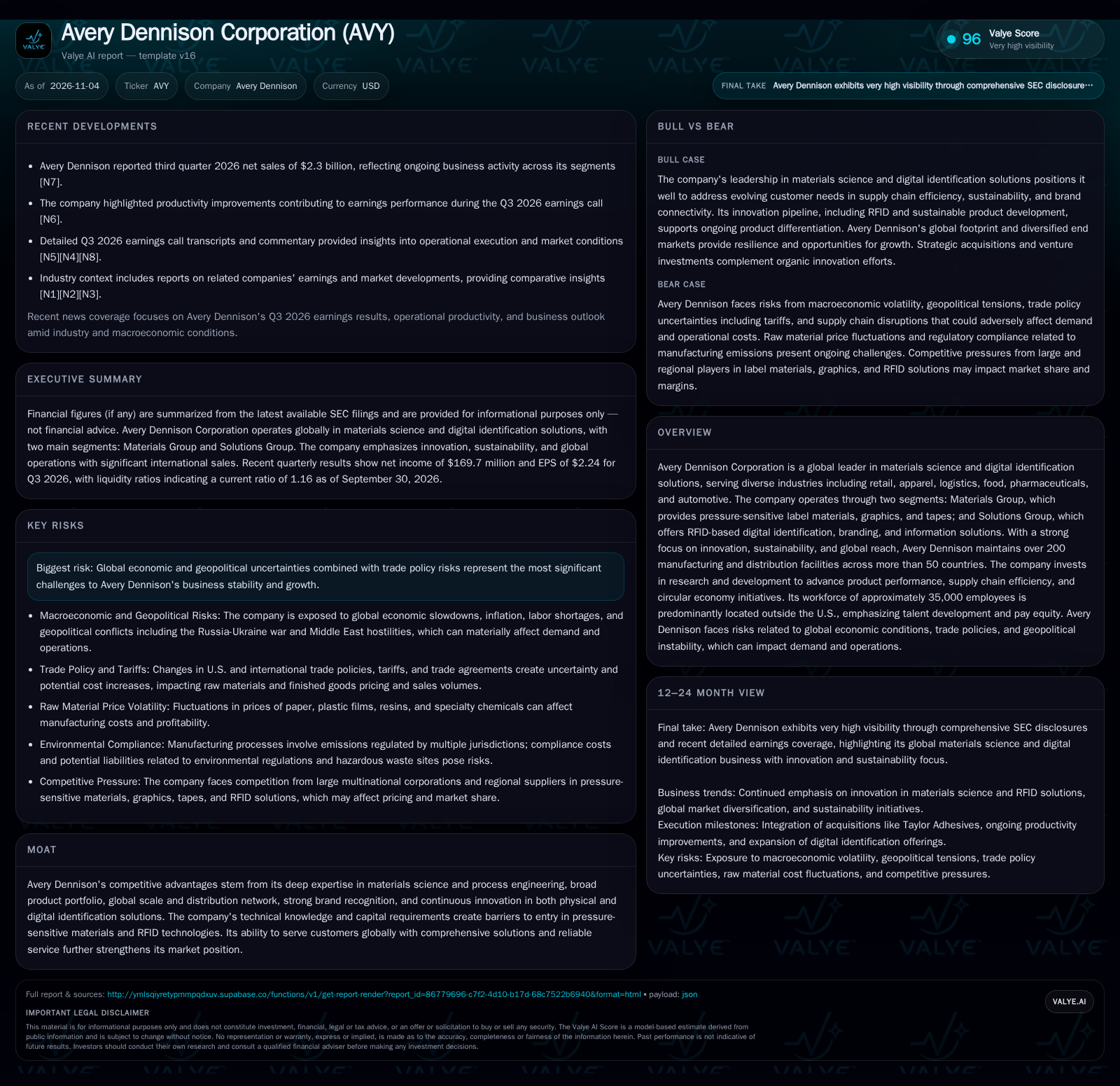
Avery Dennison reported Q3 2026 net sales of $2.3 billion and continues to prioritize innovation in materials science, RFID, and sustainability, while integrating recent acquisitions like Taylor Adhesives. The company’s global reach and diversified end markets offer resilience, but it faces significant challenges from economic and geopolitical risks, raw material price volatility, and competition across both its Materials and Solutions segments. Ongoing productivity improvements and execution on digital identification initiatives will be key to sustaining growth and margin stability in the next phase. [N7] [N6] [S2]
Avery Dennison’s 2026 profile is defined by a blend of legacy strength in materials science and an accelerating push into digital identification, particularly RFID-based solutions. With the majority of its sales and workforce outside the U.S., the company’s global footprint provides both resilience and exposure to economic and geopolitical volatility. Recent M&A activity, including the Taylor Adhesives acquisition, underscores a strategy of bolstering core competencies while venturing into adjacent high-growth domains. Yet, as Avery Dennison seeks to translate innovation and scale into durable profit growth, it must navigate persistent risks from raw material costs, regulatory pressures, and a competitive landscape that is rapidly evolving in both analog and digital domains.
Latest Developments: Earnings, Segment Mix, and Strategic Moves
Avery Dennison reported Q3 2026 net sales of $2.3 billion, with net income of $169.7 million and basic/diluted EPS of $2.24. These results reflect ongoing business activity across its two reportable segments, with the Materials Group delivering approximately 69% and the Solutions Group 31% of 2025 net sales.[N7] [S2] [S1]
The Taylor Adhesives acquisition for approximately $390 million in 2025 marks a strategic expansion in adhesives, aiming to enhance vertical integration and product breadth within the Materials Group. In parallel, five venture investments target emerging technologies, signaling a commitment to innovation beyond core legacy offerings.[S1]
Geographically, the company continues to derive about 69% of its net sales from outside the U.S., operating in over 50 countries. This global orientation both diversifies revenue and exposes the business to macroeconomic and geopolitical risks, including trade policy and regional conflicts.[S1]
How Avery Dennison Creates Value: Volume, Mix, and the Levers of Profitability
Avery Dennison’s business model is rooted in high-volume, process-intensive manufacturing, particularly in pressure-sensitive materials and adhesives. The Materials Group, with its broad reach across food, personal care, pharmaceuticals, automotive, and construction, generates stable, recurring demand but is exposed to raw material cost volatility. Pricing power is typically limited by the commoditized nature of some substrates, though innovation in specialty labels and sustainable materials can command premium pricing if customers value regulatory compliance or brand differentiation.
The Solutions Group operates with structurally different economics. RFID inlays and tags, along with digital identification software and branding solutions, offer higher growth potential and, if scaled, could deliver superior margins due to higher intellectual property content and potential for recurring revenue models. However, the transition from project-based deployments to multi-year, recurring software or platform contracts is not guaranteed; commercial mechanics in this area remain partly undisclosed, and the extent of recurring revenue is not established by current facts.
Operating leverage is significant in both segments, given the scale of manufacturing and global distribution. Productivity improvements—highlighted in recent earnings commentary—can have a meaningful impact on margins, particularly if volume recovers post-macroeconomic disruptions. Capital needs include ongoing investment in R&D, manufacturing upgrades (especially for sustainability and emissions control), and integration costs related to acquisitions like Taylor Adhesives. Working capital requirements are substantial but typical for a global materials business.[N6] [S1]
Competitive Dynamics: Barriers, Substitutes, and the Race in Digital ID
Avery Dennison’s moat in materials science is built on decades of process engineering expertise, global manufacturing scale, and a diverse product portfolio. Barriers to entry are highest in specialty pressure-sensitive materials and RFID technology, where know-how, capital intensity, and customer qualification cycles deter new entrants.
However, the company faces ongoing competition from both large multinationals and regional players in label materials, tapes, and graphics. In RFID and digital identification, the competitive set expands to include technology firms and hardware-software integrators, intensifying the race for share in retail, logistics, and supply chain digitization.
Substitution risk is present, particularly as customers seek alternatives to traditional labeling in favor of direct digital solutions or as new materials and environmental compliance standards shift the cost-benefit calculus. Avery Dennison’s ability to innovate—both organically and through M&A—will be key to defending and expanding its share in both legacy and emerging categories.
Unlocking Growth: If RFID Adoption Accelerates and Productivity Gains Hold
A favorable scenario for Avery Dennison hinges on sustained acceleration in RFID and digital identification adoption—particularly in retail, logistics, and supply chain traceability—driving above-market growth for the Solutions Group. If RFID projects move from pilot to full-scale, multi-year deployments, the company could see a higher mix of recurring software and services revenue, supporting margin expansion.
Productivity improvements—already cited in Q3 2026—could further enhance operating leverage, especially if raw material inflation remains contained or is offset by pricing and mix improvements in specialty products. Integration of Taylor Adhesives may yield cost and innovation synergies, strengthening the Materials Group’s competitive position.
Confirmation would come from disclosed increases in Solutions Group revenue growth rates, explicit reporting of recurring revenue from digital offerings, and margin expansion in both segments despite external cost pressures.
Global Diversification and Incremental Innovation Drive Steady Progress
The most plausible trajectory is one of steady, if unspectacular, growth driven by incremental innovation, global diversification, and ongoing productivity gains. The Materials Group remains an anchor, generating stable cash flows but facing continued margin pressure from raw material costs and competitive pricing. The Solutions Group grows faster, but its share of total sales rises only gradually as RFID adoption, while positive, remains lumpy and project-driven rather than fully recurring.
Profitability is supported by operational discipline and selective pricing actions, but major margin expansion is elusive unless there is a step-change in digital identification penetration or sustained relief in input costs. Integration of Taylor Adhesives proceeds smoothly, contributing to product portfolio depth but not fundamentally altering the company’s margin profile.
This scenario would be confirmed by modest year-over-year revenue and earnings growth, stable or slightly improved operating margins, and continued commentary on productivity and innovation as primary levers.
When Macroeconomic and Input Cost Shocks Overwhelm Innovation
A negative outcome materializes if global economic volatility, trade disruptions, or geopolitical crises lead to significant demand contraction in Avery Dennison’s end markets. Simultaneously, if raw material prices spike and cannot be passed through quickly, gross margins could compress sharply, particularly in the commoditized portions of the Materials Group.
Competitive pressure may intensify, eroding pricing further. If RFID and digital identification adoption stalls or faces integration challenges, the Solutions Group’s growth contribution could disappoint, leaving the company more exposed to the cyclical and margin constraints of its legacy businesses.
Evidence for this scenario would include sequential declines in volume, sharp margin compression, adverse earnings revisions, and management guidance that prioritizes cost containment over growth investments.
Milestones and Metrics That Will Define Avery Dennison’s Next Phase
Quarterly revenue growth rates by segment—especially Solutions Group—to assess the pace and consistency of digital identification adoption, if disclosed.
Gross and operating margin trends, with a focus on the company’s ability to offset raw material cost inflation through pricing, mix, and productivity.
Explicit disclosure of recurring revenue or multi-year software contracts in the Solutions Group would help test the durability of digital transformation.
Integration progress for Taylor Adhesives, including synergy realization and contribution to Materials Group margins or innovation pipeline.
Geographic revenue breakdowns, particularly exposure to and performance in emerging markets, given macroeconomic and geopolitical volatility.
Updates on sustainability initiatives and their impact on product mix, customer retention, and regulatory compliance costs.
Working capital and cash flow trends, especially in the context of global supply chain disruptions or inventory management challenges.
Management commentary on competitive dynamics and customer adoption curves for RFID and digital identification platforms.
Disclaimer: This is research-only, informational analysis and not investment advice. It may include AI-generated interpretation and general industry context. Always verify important details using primary sources.

Comments