
Socket Mobile’s Strategic Crossroads: Delisting, Cash Strain, and the Stakes of Software-Led Differentiation
Socket Mobile faces a pivotal period as it voluntarily delists from Nasdaq amid ongoing losses, liquidity pressures, and intensifying competition from industry giants. The company’s future hinges on the adoption of its integrated software and hardware solutions and its ability to maintain relevance in a rapidly evolving mobile data capture market.
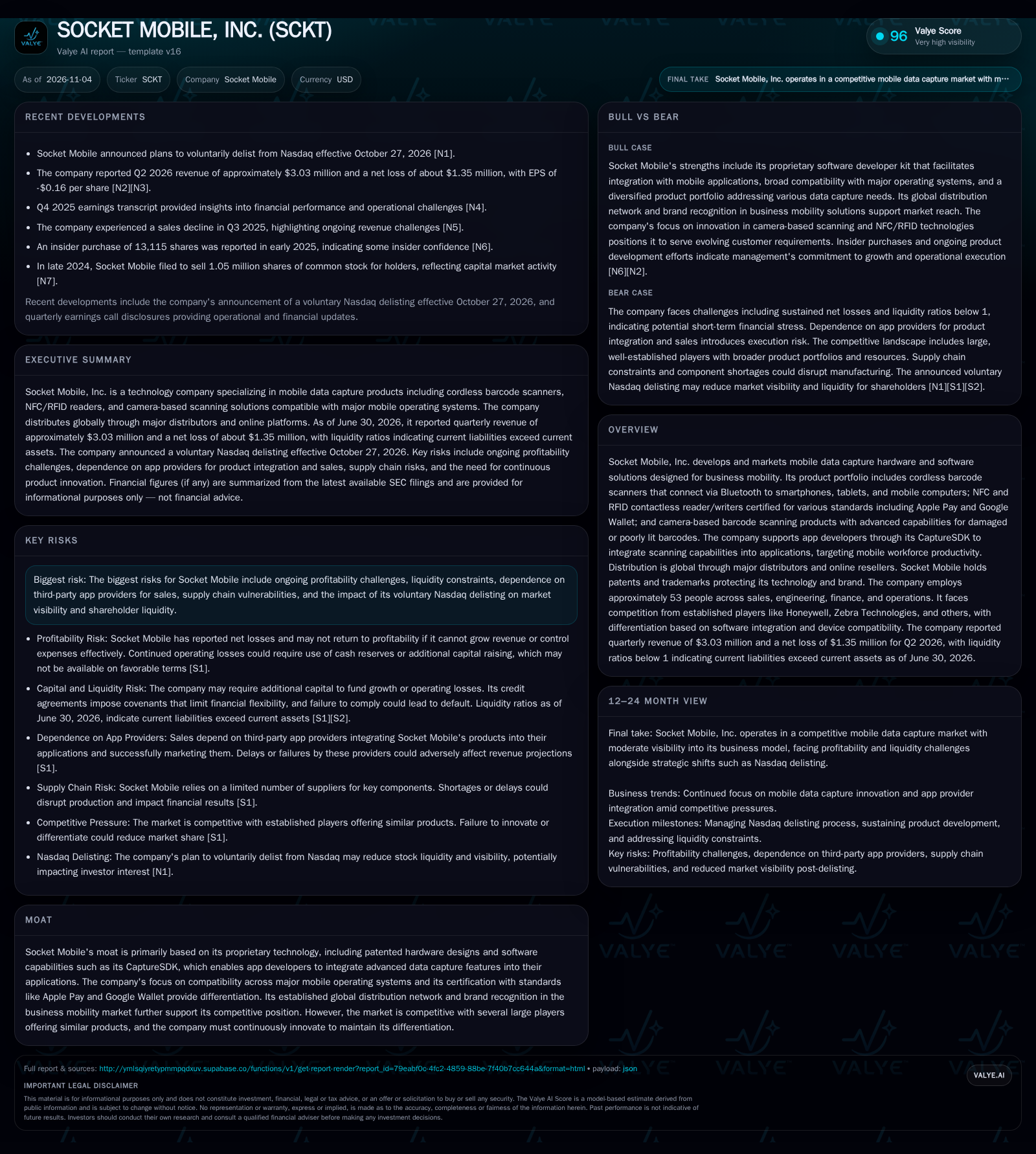
Socket Mobile reported a net loss for Q2 2026 and plans to delist from Nasdaq, highlighting mounting financial and strategic pressures. The company’s path forward will depend on execution around developer adoption, supply chain management, and its ability to innovate and maintain potential financial flexibility amid reduced market visibility. [S1] [S2] [N1]
Socket Mobile, Inc. is at a critical inflection point as it prepares to exit Nasdaq, contending with persistent net losses and a liquidity profile that signals little margin for error. The company’s product suite—encompassing mobile barcode scanners, NFC/RFID readers, and developer-focused CaptureSDK—positions it as an enabler of business mobility. Yet, with financial constraints, reliance on app integration partners, and formidable competition from sector giants, Socket Mobile’s ability to leverage its differentiated technology into sustainable economics is under acute scrutiny. The next phase will test whether its hybrid hardware-software approach can carve out defensible value, or whether financial and competitive pressures will force a strategic rethink. [S1] [S2] [N1]
Delisting, Losses, and Liquidity: Socket Mobile’s Current Pressures
Socket Mobile reported revenue of approximately $3.03 million and a net loss of about $1.35 million for Q2 2026, translating to -$0.16 per share [S2]. This marks another quarter of operating losses, underscoring persistent profitability challenges. The company’s balance sheet as of June 30, 2026, showed cash and equivalents of $1.61 million, current assets of $7.25 million, and current liabilities of $8.52 million, resulting in a current ratio of 0.85 and a cash ratio of 0.19—both below typical comfort thresholds [S2]. In October 2026, Socket Mobile announced it would voluntarily delist from Nasdaq, a move that may further limit market visibility and shareholder liquidity [N1]. These developments frame a business under financial strain, facing strategic and operational inflection points.
How Socket Mobile’s Hardware-Software Blend Shapes Its Economic Model
Socket Mobile’s revenue model is rooted in selling mobile data capture hardware—cordless barcode scanners, NFC/RFID readers, and camera-based solutions—distributed globally through major distributors and online resellers [S1]. A key differentiator is its proprietary CaptureSDK, which enables third-party app developers to integrate scanning capabilities directly into their applications. This software-driven feature could create stickiness and encourage volume sales if widely adopted by developers serving mobile workforces.
The company’s economics likely skew toward high variable costs given its modest scale (53 employees) and hardware focus, with gross margins subject to competitive pricing and supply chain fluctuations. While the CaptureSDK may offer higher-margin, software-enabled economics, its commercial impact depends on the extent and success of app integrations—something not quantified in available disclosures. Socket Mobile’s capital needs are acute: persistent losses and a sub-1.0 current ratio highlight the importance of either returning to profitability or securing additional funding. The announced Nasdaq delisting could complicate future capital-raising efforts by reducing investor access and share liquidity [N1] [S2].
Software Integration as Differentiator—But Giants Crowd the Field
Socket Mobile competes in the mobile data capture market against heavyweight manufacturers such as Honeywell and Zebra Technologies, as well as a host of smaller, niche players [S1]. The company’s competitive edge rests on its software integration capabilities—specifically, CaptureSDK and broad compatibility with Apple, Android, and Windows devices. This approach may appeal to app developers and end users seeking seamless integration and device flexibility.
However, the core market is characterized by rapid technological change, commoditization of hardware, and intense pricing pressure from larger, better-capitalized rivals. Socket Mobile’s dependence on third-party app providers introduces an additional vulnerability: if developers do not prioritize or successfully market integrated solutions, Socket Mobile’s addressable market may stagnate. Moreover, established competitors can respond with their own SDKs, deeper channel relationships, or bundled offerings, eroding Socket Mobile’s differentiation over time.
Developer Adoption and Mobile Workforce Digitization Drive a Turnaround
A favorable outcome for Socket Mobile would hinge on widespread adoption of its CaptureSDK by third-party app developers, leading to deeper integration of Socket’s hardware into vertical-specific mobile workflows—such as retail, logistics, and healthcare. If these integrations become essential for mobile workforce productivity, Socket Mobile could benefit from repeat hardware sales, higher-margin software licensing, and reduced price sensitivity.
Confirmation of this scenario would include a demonstrable uptick in units shipped through channel partners, evidence of major app providers standardizing on Socket’s SDK, and improved gross margins attributable to software-driven sales. A reversal of net losses, improved liquidity ratios, and renewed investor interest even post-delisting would further validate the case. Conversely, if developer engagement stagnates or integration rates decline, this scenario would be falsified.
Managing Through Financial Strain and Competitive Intensity
The most plausible trajectory is one of constrained growth and operational belt-tightening. Socket Mobile may continue to serve a niche of app-integrated data capture users but faces ongoing margin pressure and limited pricing power due to competitive dynamics and customer bargaining leverage. Developer adoption of CaptureSDK may support a steady (but not rapidly expanding) customer base.
In this scenario, Socket Mobile remains challenged by its liquidity position and the loss of public market visibility post-delisting. Incremental improvements in cost control or supply chain management could stabilize losses, but without a clear catalyst for revenue acceleration, the company likely operates at or near break-even, with periodic risk of covenant breaches or capital shortfalls if disclosed. This scenario is confirmed by stable but unremarkable revenue, flat or modestly improving margins, and persistent dependence on channel and developer partnerships.
Liquidity Crunch or Erosion of Differentiation Triggers Strategic Reset
The adverse scenario involves Socket Mobile’s liquidity falling to critical levels, forcing operational cutbacks, distressed asset sales, or unfavorable capital raises. If major app providers reduce support or switch to rival SDKs, Socket’s integration-driven differentiation could erode quickly—leading to declining sales and further loss of channel relevance.
This scenario would be confirmed by rapid cash burn, missed supplier payments, layoffs, or covenant violations if disclosed, alongside shrinking channel presence and loss of significant app-provider relationships. Further, the delisting may intensify these risks by making it harder to attract new investors or strategic partners, limiting options for recapitalization or strategic alternatives.
Benchmarks for Testing Socket Mobile’s Post-Delisting Trajectory
Quarterly unit shipment trends through key distribution partners (e.g., Ingram Micro, ScanSource) would help clarify demand and channel strength if disclosed.
Gross margin evolution, particularly any improvement attributable to software or SDK-driven sales mix, would indicate whether integration is delivering economic leverage.
Adoption rates of CaptureSDK among third-party app providers—a useful metric would be the number and scale of active integrations—would test the thesis that software is driving differentiation.
Cash and liquidity metrics, including changes in the current and cash ratios, would signal the company’s ability to navigate operating losses without resorting to distressed financing.
Any new capital-raising events, credit agreement amendments, or signs of covenant strain would provide early warning of financial stress.
Customer concentration and retention rates, if disclosed, would reveal the durability of the company’s relationships with major app developers and end markets.
Evidence of supply chain disruptions or changes in component availability would help assess operational resilience and margin risk.
Post-delisting trading volume and share price stability (if traded OTC) would indicate shareholder sentiment and the company’s ongoing access to equity capital.
Disclaimer: This is research-only, informational analysis and not investment advice. It may include AI-generated interpretation and general industry context. Always verify important details using primary sources.

Comments