
Capital One in 2026: Capital Strength, Risk Management, and the Next Phase of Integration
Capital One enters late 2026 with robust regulatory capital ratios, a disciplined risk management framework, and active shareholder returns. The company’s large-scale lending commitments and recent integration efforts set the stage for both opportunity and heightened sensitivity to credit and interest rate cycles.
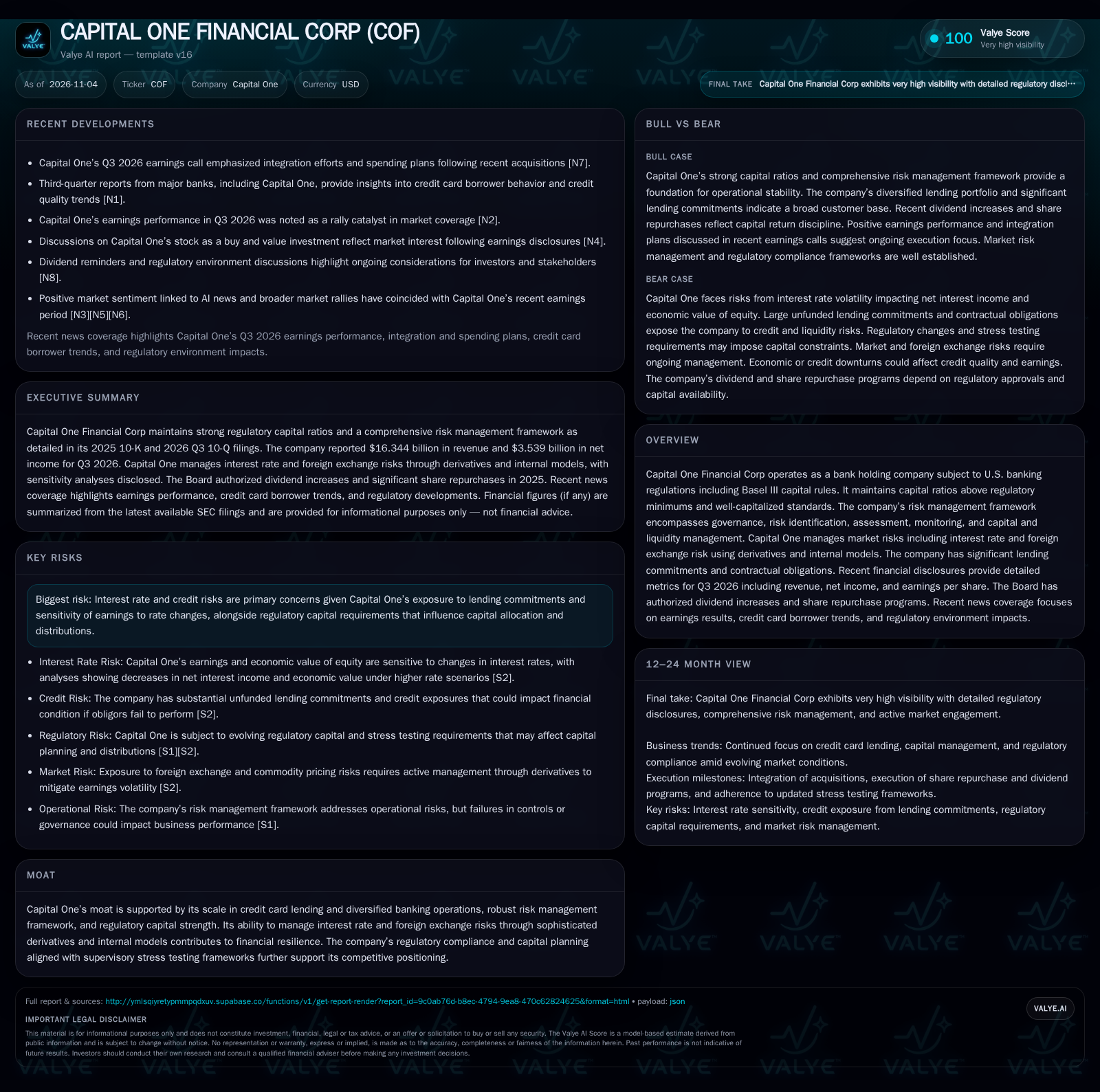
Capital One’s Q3 2026 results highlight strong capital ratios, significant lending commitments, and active capital return programs. The bank’s risk management is comprehensive, but exposure to rate volatility and credit risk remains pronounced. Integration of recent acquisitions and execution on capital allocation will shape the next chapters.
Capital One Financial Corp’s late-2026 positioning reflects a balance of capital strength, risk management rigor, and scale-driven opportunity—offset by the persistent risks inherent in its large consumer credit book and sensitivity to macroeconomic cycles. With regulatory capital ratios comfortably above thresholds, recent capital returns, and a focus on integrating new business lines, the company is well-insulated from immediate shocks but exposed to the evolving interplay between credit conditions, interest rates, and regulatory expectations. The next phase will test whether Capital One can convert its scale and discipline into durable earnings power while navigating industry headwinds.
Recent Capital Actions and Earnings Underscore Financial Firepower
Capital One reported a Common Equity Tier 1 (CET1) capital ratio of 14.3% as of December 31, 2025, significantly above the well-capitalized regulatory minimums [S1]. This capital cushion provides flexibility for both risk absorption and shareholder returns. For Q3 2026, the company posted $16.344 billion in revenue and $3.539 billion in net income, with basic EPS of $5.62 [S2]. The Board authorized a dividend increase to $0.80 per share starting Q4 2025 and completed $3.8 billion in share buybacks during 2025 [S1]. These actions, paired with management's focus on integration and spending following recent acquisitions, highlight both financial strength and a willingness to deploy capital for growth and shareholder value [N7].
However, Capital One’s unfunded lending commitments reached $778.5 billion as of September 30, 2026, representing significant off-balance-sheet exposure if credit conditions deteriorate [S2].
How Capital One Makes—and Risks—Money: Credit, Interest Margins, and Cost Discipline
Capital One’s core economic engine is the spread between interest earned on its loan portfolio (especially credit cards and consumer lending) and the cost of funding those assets. Net interest income (NII) is sensitive to both the level and shape of the yield curve. Because a substantial portion of the asset base is in variable-rate and short-duration consumer credit, repricing can be relatively swift—amplifying both upside and downside in volatile rate environments.
Fee income supplements NII, but interest remains the primary lever. The company’s large scale affords fixed-cost leverage in technology, marketing, and compliance, but also requires consistent investment in risk management and regulatory infrastructure. Shareholder returns through dividends and buybacks are only sustainable if underlying earnings continue to support excess capital generation.
Capital intensity is high, with regulatory capital requirements dictating the amount of balance-sheet growth and risk-taking. The $778.5 billion in unfunded lending commitments points to a business model that monetizes both funded and contingent exposures—offering upside in benign cycles but heightening tail risk in stress scenarios [S2].
Scale, Data, and Risk Controls: Competitive Levers in a Crowded Market
Capital One competes primarily with other large diversified banks and specialty consumer finance companies. Its historical advantage has been scale in credit card lending, sophisticated data analytics, and a willingness to invest in digital banking infrastructure. These capabilities allow for mass-market reach and granular risk segmentation—key in an industry where underwriting discipline and customer acquisition efficiency drive long-term returns.
However, the competitive environment is shifting. Fintech entrants, large technology platforms, and traditional banks are all converging on digital lending and payments. Capital One’s regulatory capital strength and risk management sophistication provide resilience, but also bind it to higher compliance costs and potentially slower innovation cycles compared to less-regulated digital challengers.
Switching costs for consumers are low, but brand, rewards programs, and digital user experience can support retention. The question is whether Capital One can continue to differentiate on technology and risk-adjusted returns as the industry’s economics evolve.
If Credit Quality Holds and Integration Delivers, Earnings Power Could Compound
A favorable scenario would see benign consumer credit conditions persist, allowing the company to monetize its large unfunded lending commitments without a spike in defaults or provisioning. Successful integration of recent acquisitions—if they yield cross-selling and cost synergies—could further boost return on equity. The elevated CET1 ratio provides ample flexibility for continued buybacks or opportunistic growth initiatives.
Confirmation would come from stable or improving credit loss rates, positive trends in net interest margins, and visible expense synergies post-integration.
Falsification would be evident if credit quality deteriorates, integration costs overrun, or regulatory capital requirements tighten unexpectedly, constraining distributions.
Earnings Normalize as Credit Cycles and Rate Volatility Shape the Outlook
The most plausible outcome is that Capital One’s earnings and returns remain solid but cyclically sensitive. Interest rate volatility and evolving credit conditions will drive quarter-to-quarter swings in net interest income and provisioning. The company continues to return capital through dividends and buybacks, but at a pace dictated by regulatory and macroeconomic developments.
This scenario would be confirmed by steady (but not accelerating) EPS, modest credit loss volatility, and management commentary emphasizing both discipline and adaptability. Investors should expect continued investment in risk management and digital capabilities, with integration benefits accruing gradually.
A deviation from this path would occur if a sharp macro downturn triggers a spike in delinquencies or if regulatory changes force a step-up in capital retention, dampening shareholder returns.
Rising Defaults or Rate Shocks Could Pressure Capital and Erode Returns
A negative turn would involve a material deterioration in consumer credit, with charge-offs and delinquencies rising across the portfolio. The large unfunded lending commitments could become funded at the worst point in the cycle, increasing risk-weighted assets and straining capital ratios. Simultaneously, adverse interest rate movements—such as an inverted or sharply rising yield curve—could compress net interest margins.
In this scenario, regulatory capital requirements could force a reduction or suspension of dividends and buybacks. Management would likely shift focus from growth to capital preservation, with cost-cutting and credit tightening following. Confirmation would come from rising provisioning expenses, declining capital ratios, and negative earnings surprises.
Recovery would depend on the speed and magnitude of credit normalization, regulatory flexibility, and the company’s ability to reprice risk and restore profitability.
What Will Test Capital One’s Thesis in the Next 12–24 Months?
Quarterly trends in net charge-offs and delinquency rates—if disclosed—will be the clearest signal of underlying credit health.
Updates on realized and expected expense synergies, integration costs, and cross-sell revenue from recent acquisitions would help test the value creation thesis.
Sustained CET1 ratio levels, especially after capital returns, will indicate ongoing capital discipline.
Net interest margin evolution under different rate scenarios (as disclosed in sensitivity analyses) will show how well the company is managing interest rate risk.
Changes in total unfunded lending commitments could signal shifts in risk appetite or tightening/loosening of credit standards.
Regulatory developments or commentary on stress testing results—especially if capital requirements change—will affect the capital return outlook.
Management guidance on dividend and buyback plans, if updated, would clarify the capital allocation trajectory.
Any material moves by fintech or large bank competitors in core lending or payments could alter the competitive landscape.
Disclaimer: This is research-only, informational analysis and not investment advice. It may include AI-generated interpretation and general industry context. Always verify important details using primary sources.

Comments