
BlueLinx’s Liquidity Strength Meets the Test of Construction Market Volatility
Despite commanding a robust balance sheet, BlueLinx faces profitability pressures as cyclical demand and competitive intensity in construction materials distribution challenge margin recovery. The company’s ability to translate operational scale and liquidity into sustained earnings growth remains the central test.
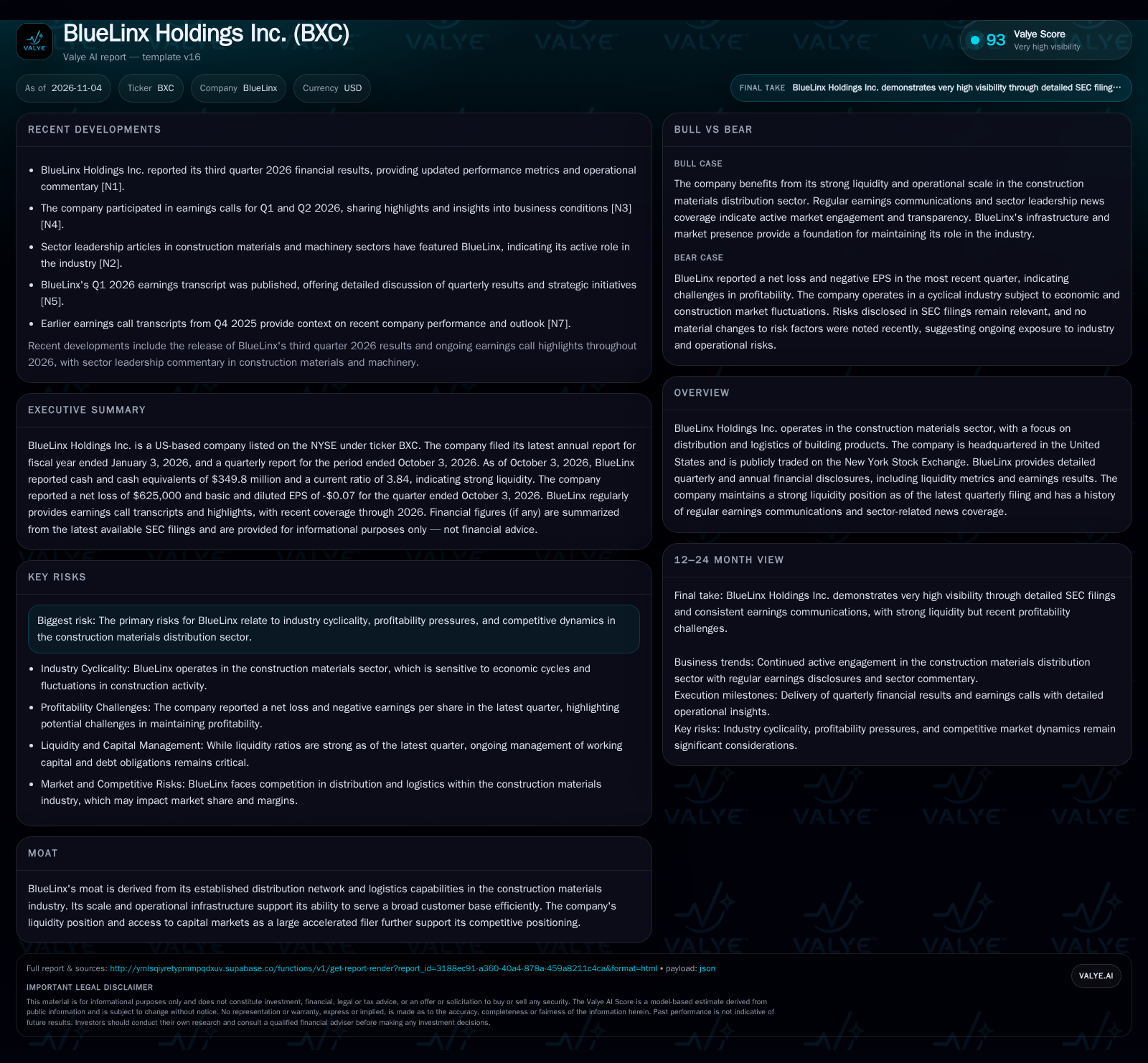
BlueLinx Holdings Inc. reported a net loss for Q3 2026 despite maintaining reported liquidity position, with $349.8 million in cash and a current ratio of 3.84. As a major distributor in the US construction materials sector, BlueLinx’s near-term prospects depend on its capacity to manage industry cyclicality, pricing power, and operational efficiency. The company’s scale and capital position provide resilience, but profitability remains under pressure and will be the critical factor to monitor over the next several quarters. [S2] [N1]
BlueLinx Holdings Inc., a leading US distributor in the construction materials sector, enters late 2026 with a blend of financial resilience and operational headwinds. As BlueLinx maintains active engagement through earnings calls and sector leadership commentary, the core question is whether its scale and capital strength can be leveraged into consistent earnings, or if persistent industry headwinds will continue to weigh on profitability. [S2] [N1]
Q3 2026 Results Underscore BlueLinx’s Tug-of-War Between Liquidity and Profitability
BlueLinx Holdings Inc. reported a net loss of $625,000 and EPS of -$0.07 for the quarter ended October 3, 2026, despite a substantial cash position of $349.8 million and a current ratio of 3.84. These figures highlight a business with considerable liquidity but which is currently unable to translate that strength into positive earnings. The company’s ongoing disclosures and earnings calls emphasize transparency and an active approach to market engagement. However, with no material changes to risk factors and continued sector volatility, the recent loss signals that BlueLinx remains vulnerable to margin compression and cyclical swings in construction demand. [S2] [N1]
How BlueLinx’s Distribution Model Navigates Margin Pressures and Fixed-Cost Leverage
BlueLinx’s core business model centers on the distribution and logistics of construction materials—a sector characterized by large volumes, thin gross margins, and significant fixed costs related to warehousing and transportation infrastructure. Revenue is driven by product mix (commodity lumber, specialty building products), pricing power, and volume throughput, all of which are sensitive to broader construction activity and housing starts. While scale provides potential for procurement advantages and operational leverage, operating profitability can rapidly erode if volumes soften or pricing deteriorates.
The company reported cash and liquidity metrics for the period; these figures do not by themselves establish operating runway, investment capacity, financial flexibility, or financing capacity. Fixed costs must be covered through sufficient throughput, making BlueLinx’s economics particularly exposed to demand shocks. The combination of slow-moving inventory, credit risk in customer accounts, and the need to maintain broad product availability further complicates the margin structure. If BlueLinx can optimize logistics and leverage supplier relationships, incremental volume gains may deliver outsized margin improvement, but the model remains fundamentally volume- and cycle-dependent.
The interplay between fixed and variable costs in BlueLinx’s distribution model is a critical determinant of profitability resilience. While fixed costs related to infrastructure and logistics create operational leverage during volume expansions, they conversely amplify losses when demand contracts. This dynamic necessitates precise forecasting and agile cost management to avoid margin erosion. Additionally, the inventory holding strategy must balance the risk of obsolescence and capital lockup against the service level expectations of customers who rely on timely availability. The credit risk embedded in customer receivables also requires vigilant monitoring, as economic downturns can increase default rates, further pressuring cash flow and working capital requirements. Effective risk mitigation in these areas could materially influence the company’s capacity to sustain earnings during cyclical downturns.
Distribution Scale as a Double-Edged Sword in a Fragmented Construction Materials Market
BlueLinx’s competitive positioning is built on its national distribution footprint and logistics capabilities, which enable it to serve a broad array of customers including builders, remodelers, and contractors. This scale can create procurement advantages and service differentiation, especially for specialty products that require complex handling or just-in-time delivery. However, the distribution market remains fragmented, with regional wholesalers, vertically integrated manufacturers, and large home improvement retailers all vying for share.
Competitive intensity is exacerbated by the commoditized nature of many core products, limiting pricing power.
Scale advantages in distribution can be mitigated by the heterogeneous nature of customer requirements and regional market dynamics. BlueLinx’s ability to customize service offerings, such as specialized delivery schedules or product bundling, may differentiate it from smaller competitors but also increases operational complexity and cost. Moreover, the fragmented market structure means that pricing power is often localized and subject to competitive responses that can quickly erode margins. The threat from vertically integrated manufacturers who bypass distributors by selling directly to end-users adds another layer of competitive pressure, potentially limiting BlueLinx’s long-term pricing flexibility. Thus, maintaining a balance between broad geographic reach and tailored customer solutions is essential to protect and grow market share without sacrificing profitability.
Margin Expansion If Construction Demand Recovers and BlueLinx Leverages Its Scale
A favorable scenario for BlueLinx would see a rebound in US construction activity—driven by new housing starts, infrastructure stimulus, or repair/remodel trends—leading to higher volumes and improved pricing power. In this context, the company’s scale and logistics network could allow it to capture incremental market share and negotiate better terms with suppliers, translating into margin expansion. If management successfully executes on cost controls and operational efficiency initiatives, the fixed-cost base could yield significant operating leverage as volumes recover.
Confirmation of this scenario would include a return to positive net income, sequential improvement in gross and operating margins, and management commentary highlighting volume growth and pricing discipline. Sustained positive earnings per share and evidence of share gains in specialty product categories would further strengthen the case for a durable earnings rebound.
Navigating a Choppy Recovery: BlueLinx Maintains Liquidity but Faces Ongoing Margin Volatility
The most plausible near-term scenario is one of gradual recovery in construction demand, punctuated by continued cyclicality and competitive pricing. BlueLinx likely maintains its reported liquidity position and operational footprint but experiences fluctuating margins as it works to align costs with volumes. Periodic net losses or breakeven quarters could persist, particularly if pricing remains soft for commodity products or if regional demand diverges.
Evidence confirming this scenario would include sustained high current and cash ratios, modest revenue growth, and ongoing management focus on cost discipline in earnings calls. A lack of material change in risk disclosures and continued sector volatility would reinforce the view that BlueLinx is managing through a challenging cycle rather than inflecting into a new growth phase.
Prolonged Construction Slowdown or Margin Squeeze Could Erode Earnings and Strategic Options
In a more adverse scenario, a deeper or longer-than-expected construction downturn could suppress volumes and force aggressive price competition, driving margins further into negative territory. If competitors with lower cost structures or digital models accelerate share gains, BlueLinx may struggle to generate positive operating cash flow.
Signs of this scenario would be persistent quarterly net losses, declining gross margins, negative operating cash flow, and management guidance focused on restructuring, asset sales, or other defensive moves.
In a prolonged downturn scenario, the fixed-cost intensity of BlueLinx’s operations could necessitate difficult strategic decisions, including capacity rationalization or restructuring initiatives. If volume declines persist, the company may face pressure to reduce capital expenditures or defer maintenance, potentially impacting service quality and long-term competitiveness. Additionally, a sustained margin squeeze could constrain free cash flow generation, limiting the ability to invest in technology or process improvements that enhance operational efficiency. The risk of losing customers to more agile or digitally enabled competitors could further accelerate market share erosion. Consequently, the company’s strategic flexibility and access to liquidity will be pivotal in navigating extended adverse conditions without compromising its core distribution capabilities.
Milestones That Will Reveal Whether BlueLinx Can Convert Liquidity Into Durable Profitability
Quarterly net income trends: Sustained positive or negative earnings will be the clearest indicator of whether margin recovery is underway. [S2]
Gross and operating margin progression: Sequential improvement would suggest successful cost management and pricing discipline; deterioration would indicate competitive or demand pressure. If disclosed, tracking specialty versus commodity product margins would sharpen this analysis.
Volume growth in core product categories: Increases in distribution volumes, especially in specialty products, would help test whether BlueLinx is gaining share or benefiting from sector recovery. If disclosed.
Working capital efficiency: Trends in inventory turnover and days sales outstanding would indicate how effectively BlueLinx is managing operational risk in a volatile market. If disclosed.
Management commentary on construction market outlook: Qualitative updates from earnings calls or filings about demand trends, pricing dynamics, and competitive strategy are critical for scenario assessment. [N3] [N5]
Capital allocation actions: Share buybacks, dividends, or debt paydown—if disclosed—would clarify management’s confidence in long-term cash generation and balance-sheet priorities.
Disclaimer: This is research-only, informational analysis and not investment advice. It may include AI-generated interpretation and general industry context. Always verify important details using primary sources.

Comments