
Huron Consulting’s Growth Ambition: AI Integration, Managed Services, and the Challenge of Scale
With Q3 2026 results surpassing benchmarks and a stated target for double-digit growth through 2029, Huron Consulting is betting on AI-enabled consulting and managed services expansion. The firm’s sector diversification and acquisition activity are strategic strengths, but integration execution and liquidity management will test its ability to convert vision into durable value.
Huron Consulting Group posted strong Q3 2026 results, outpacing prior benchmarks while signaling a multi-year, AI-led growth plan. The next phase hinges on scaling managed services, extracting synergies, and navigating competitive pressures.
Huron Consulting Group is positioning itself at the intersection of traditional consulting and digital transformation, as evidenced by a robust Q3 2026 performance and a declared ambition for double-digit growth through 2029. Leveraging acquisitions, sector diversification, and an expanding portfolio of AI and managed services, Huron’s strategy seeks to convert consulting expertise into scalable, recurring revenue streams.
Recent Performance and Growth Targets Set the Stage
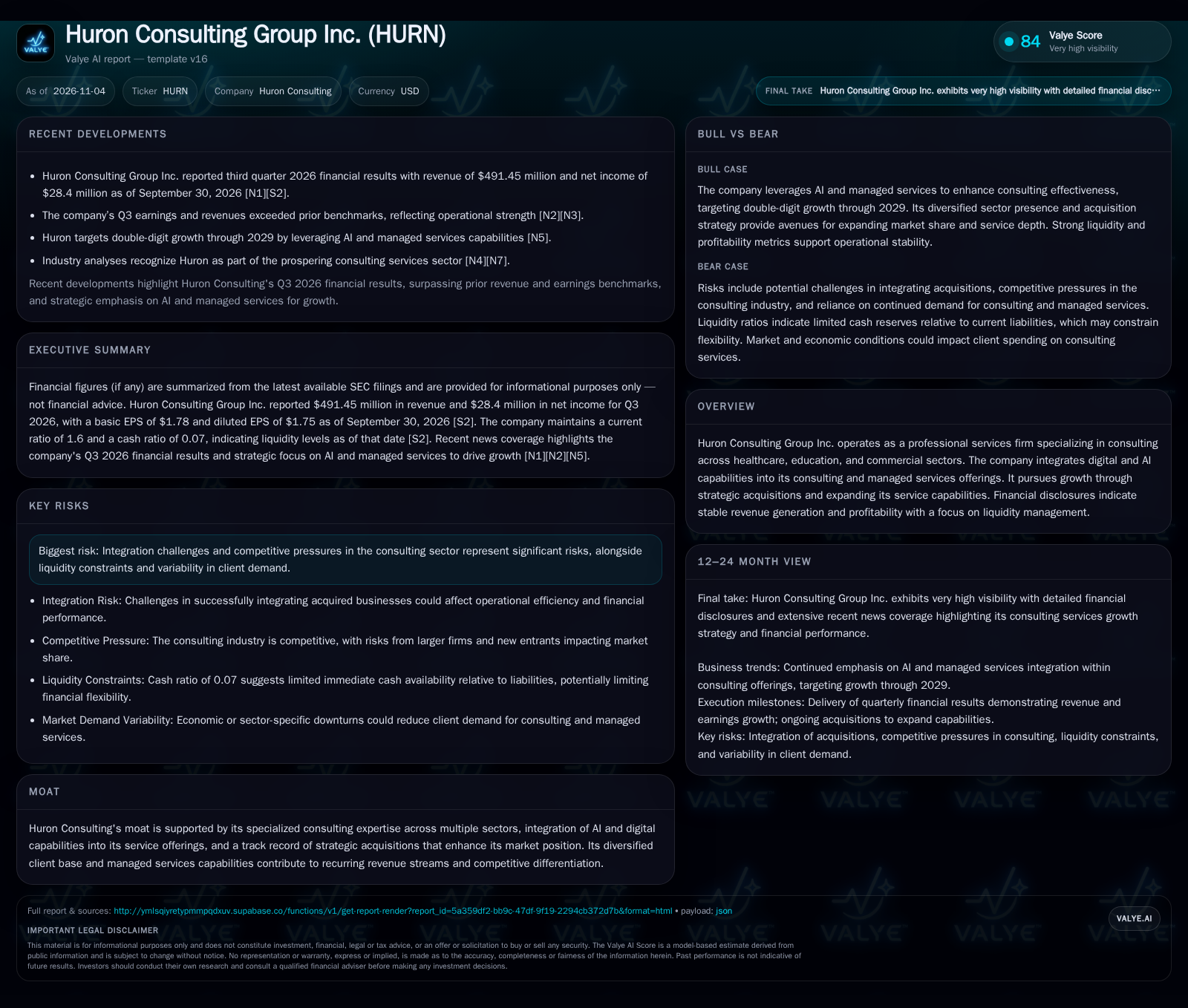
Huron Consulting reported $491.45 million in revenue and $28.4 million in net income for Q3 2026, equating to a diluted EPS of $1.75 [S2]. These results surpassed prior benchmarks, indicating operational strength and momentum [N2] [N3]. The company is targeting double-digit growth through 2029, driven by investments in AI and managed services [N5]. As of September 30, 2026, Huron’s cash and cash equivalents stood at $25.6 million, with a current ratio of 1.6 and a cash ratio of 0.07, highlighting limited near-term cash reserves relative to liabilities [S2]. The firm continues to pursue acquisitions and broaden its consulting and managed services offerings across healthcare, education, and commercial sectors.
How Huron Converts Consulting Expertise into Scalable Revenue
Huron’s primary revenue engine is fee-based consulting, historically characterized by high utilization rates, billable hours, and project-based engagements. The firm’s push into managed services and digital platforms—especially those leveraging AI—suggests a shift towards more recurring and potentially higher-margin revenue streams. In managed services, revenue models may include multi-year contracts, performance-based fees, or subscription-like arrangements, but the precise mechanics are not disclosed. This evolution could improve revenue visibility and operating leverage if Huron can standardize offerings and scale delivery.
The company’s sector diversification—healthcare, education, and commercial—helps smooth cyclical swings, but also demands specialized talent and constant capability upgrades. Acquisitions accelerate growth and expand the service portfolio, yet introduce integration costs and execution risk.
The transition from traditional project-based consulting to managed services and AI-driven digital platforms involves significant operational shifts. Managed services require building scalable delivery models with standardized processes and technology infrastructure, which can reduce client customization but increase efficiency and margin potential. However, this standardization can also limit flexibility, potentially constraining the firm’s ability to address highly specialized client needs. Therefore, Huron’s success depends on balancing the benefits of recurring revenue and operational leverage against the risks of commoditization and client dissatisfaction if offerings become too rigid.
Moreover, the firm’s ability to leverage AI effectively hinges on developing proprietary algorithms and data assets that provide sustainable competitive advantages. If AI capabilities are largely based on third-party tools or widely available technologies, differentiation may be limited. In contrast, embedding AI deeply into consulting workflows—such as predictive analytics for client operations or automated compliance monitoring—could unlock unique value propositions. The pace of AI adoption within client industries and regulatory acceptance of AI-driven recommendations will also influence the scalability and profitability of these services.
Differentiation in a Crowded and Evolving Consulting Market
The consulting industry is intensely competitive, featuring global giants, niche specialists, and emerging digital-first players. Huron’s competitive position is anchored in its multi-sector expertise and its integration of AI and digital solutions into traditional consulting services. This hybrid approach could create switching frictions for clients seeking continuity between strategic advice and operational execution.
However, barriers to entry in consulting remain moderate: client relationships, reputation, and intellectual property matter, but talent mobility and client retendering are persistent risks. Larger competitors may have greater resources to invest in proprietary technology or to underprice on commoditized contracts. The rapid adoption of AI and automation tools could erode traditional consulting margins if Huron cannot differentiate its digital offerings or demonstrate clear client ROI. The firm’s acquisition strategy may buy market share and capabilities, but also exposes it to integration missteps against faster-moving or more focused rivals.
AI-Driven Services and Seamless Integration Unlock Outsized Growth
In a favorable scenario, Huron’s investment in AI and managed services leads to meaningful differentiation, enabling the firm to win larger, longer-term contracts—especially in sectors undergoing digital transformation. Successful integration of acquisitions expands both the depth and breadth of Huron’s offerings, allowing for cross-selling and higher wallet share per client. If managed services gain traction, recurring revenues could improve earnings predictability and justify premium pricing.
Confirmation would come from sustained double-digit revenue growth, rising margins, and evidence of multi-year managed services contracts or digital platform adoption. Announcements of major client wins tied to AI-enabled solutions, improved client retention, and positive operating leverage would further validate the upside thesis.
Expansion Continues, but Integration and Margin Pressures Persist
The most plausible trajectory sees Huron maintaining above-industry-average growth but contending with ongoing integration costs, talent retention issues, and pricing pressure in core consulting. While AI and managed services contribute to incremental growth, the transition from project-based to recurring revenue remains gradual, with legacy consulting still driving the bulk of earnings. Acquisitions add capabilities and clients, but synergies are slow to materialize and margin expansion is muted by integration expenses.
Evidence would include steady (but not accelerating) revenue growth, stable or slightly improving margins, and continued acquisition activity. A modest improvement in cash generation or working capital efficiency would suggest operational discipline, while persistent integration charges or one-off restructuring costs would confirm the friction of the current strategy.
Integration Complexity and Liquidity Constraints Undermine Momentum
Heightened competition and rapid technology shifts may commoditize core offerings, eroding pricing power and utilization rates.
Confirmation would manifest as missed growth targets, margin compression, or negative operating cash flow. Evidence of project delays, client losses, or restructuring announcements would reinforce the downside risk—especially if coupled with additional capital raises or credit facility draws to fund ongoing operations.
Signals That Will Clarify Huron’s Ability to Deliver on Its Growth Thesis
Sustained double-digit revenue growth across reporting periods, particularly from AI-enabled and managed services offerings, would indicate progress toward strategic goals.
Disclosure of the proportion of revenue derived from multi-year managed services or digital contracts, if available, would help assess the shift toward recurring revenue.
Gross and operating margin trends: improvements would signal successful integration and operational leverage; declines may indicate cost overruns or pricing pressure.
Cash flow from operations and changes in working capital efficiency: positive trends would suggest better liquidity management and resilience.
Employee turnover rates, if disclosed, would indicate Huron’s ability to retain key talent amid integration and sector competition.
Client retention and contract renewal rates, if reported, would help gauge the stickiness of new service offerings.
Acquisition integration costs and timelines: lower-than-expected charges and quick realization of synergies would support the bullish case.
Any credit facility drawdowns, new debt issuances, or equity raises would signal liquidity stress or opportunistic growth funding.
Disclaimer: This is research-only, informational analysis and not investment advice. It may include AI-generated interpretation and general industry context. Always verify important details using primary sources.

Comments