
American Well in 2026: Margin Pressure, Regulatory Complexity, and the Test of Telehealth Scale
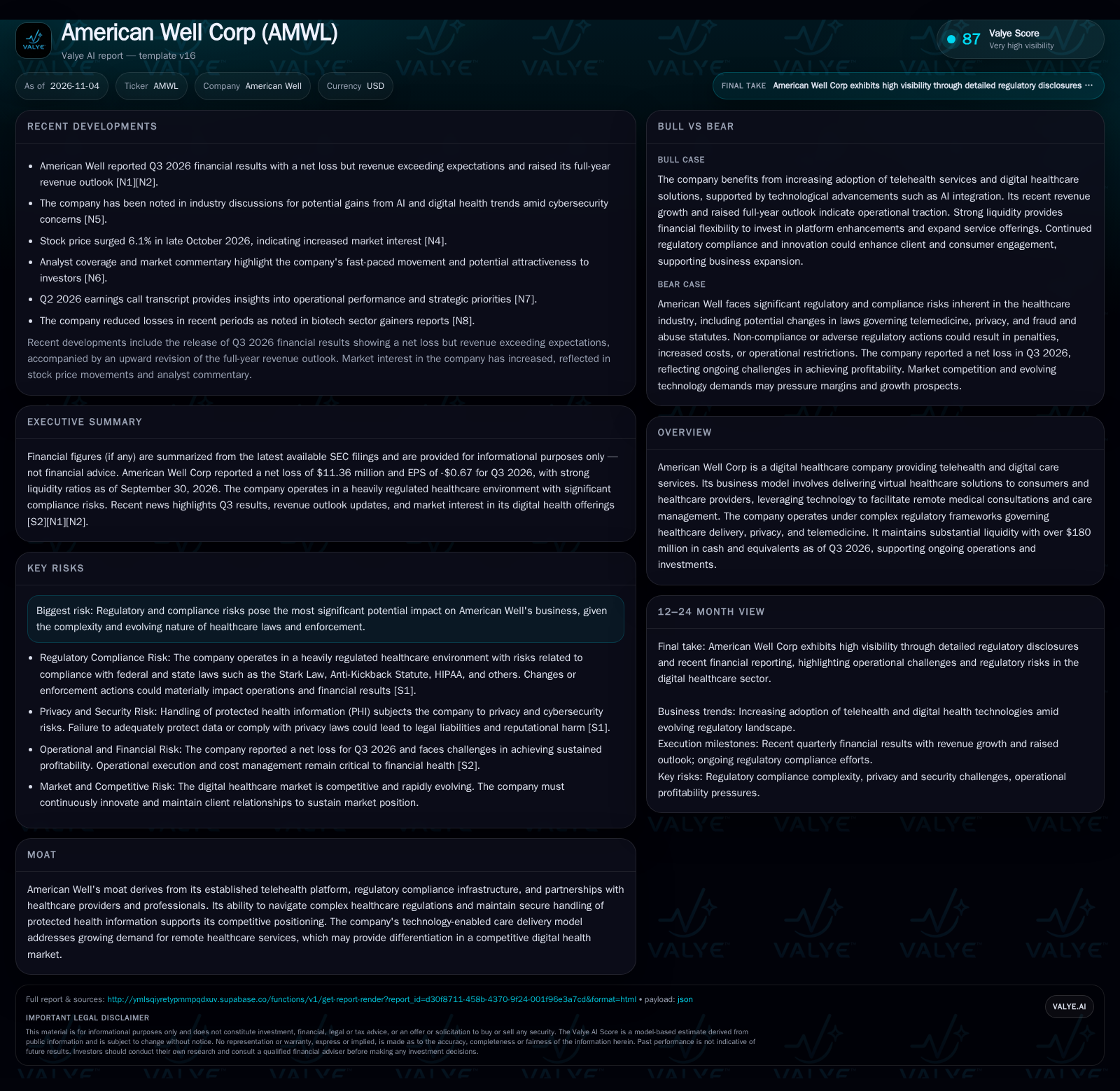
American Well’s Q3 2026 results highlight persistent unprofitability despite revenue outperformance and a raised outlook.
The path forward hinges on translating telehealth adoption and AI-driven innovation into sustainable margins while navigating complex healthcare regulations. [S2] [N1] [N2]
American Well Corp’s Q3 2026 results encapsulate a familiar tension in digital health: strong top-line signals and technology tailwinds are offset by ongoing operating losses and a regulatory environment that resists fast, frictionless scaling. With over $180 million in cash and a raised revenue outlook, the company has room to maneuver, but must convert adoption trends and platform investments into sustainable economic returns. The next phase will test whether American Well can achieve operating leverage and regulatory fluency fast enough to withstand intensifying competition and evolving compliance demands.
Recent Results Show Revenue Momentum but Persistent Losses
American Well reported a net loss of $11.36 million for Q3 2026, with basic and diluted EPS of -$0.67 per share. Despite this, the company exceeded revenue expectations for the quarter and raised its full-year revenue outlook, signaling operational traction on the top line. As of September 30, 2026, American Well held $180.8 million in cash and equivalents, with a current ratio of 3.01 and a cash ratio of 3.38, indicating reported liquidity position for the near term. The company reported cash and liquidity metrics for the period; these figures do not by themselves establish operating runway, investment capacity, financial flexibility, or financing capacity. The company’s operations remain subject to rigorous federal and state healthcare regulations, which introduce both compliance costs and strategic constraints. [S1] [S2] [N1] [N2]
Telehealth Economics: Volume Growth, Margin Drag, and the Leverage Challenge
American Well’s business model centers on providing telehealth and digital care solutions to healthcare providers and consumers. Revenue is likely generated through a mix of per-visit fees, subscription-based contracts with health systems and payers, and potentially technology licensing or integration fees, though the precise commercial mechanics are not established in the report. The model’s economic appeal hinges on scaling fixed platform investments—technology infrastructure, compliance, and support—across a growing user base to achieve operating leverage.
However, the telehealth sector faces significant margin pressure. Upfront technology and compliance investments are high, while per-visit or per-member revenue may be constrained by payer negotiations, regulatory cost controls, and competition. Variable costs include clinician compensation, customer support, and data security. Achieving profitability requires either substantial volume growth or a shift toward higher-value, stickier service offerings—such as integrated chronic care management, AI-driven triage, or analytics—that can command premium pricing.
A deeper analysis of telehealth economics reveals that the interplay between fixed and variable costs is critical to American Well’s margin trajectory. Fixed costs such as platform maintenance, regulatory compliance infrastructure, and technology development create a high baseline expense that must be amortized over an expanding user base. However, variable costs—particularly clinician compensation and customer support—scale more directly with volume, limiting the degree of operating leverage achievable without service innovation. If the company can shift its revenue mix toward subscription or licensing models with more predictable, recurring income streams, it may reduce revenue volatility and improve cash flow visibility. Conversely, reliance on per-visit fees exposes the business to reimbursement rate fluctuations and episodic demand patterns, complicating margin expansion efforts.
Another important dimension is the potential for American Well to leverage data analytics and AI to optimize operational efficiency. By automating routine clinical workflows and triage, the company could reduce reliance on higher-cost clinicians, thereby lowering variable costs per encounter. Additionally, AI-driven insights may enable more personalized and preventive care pathways that improve patient outcomes and reduce downstream costs, which payers increasingly value. However, realizing these benefits depends on successful integration of AI within existing clinical and regulatory frameworks, as well as user adoption by both providers and patients. The timing and scale of these technology-driven cost savings will be a key determinant of whether telehealth platforms can transition from growth-focused to profit-generating enterprises.
Regulatory Mastery and Platform Depth as Potential Differentiators
American Well’s competitive position is shaped by three core factors: regulatory fluency, platform breadth, and the ability to integrate emerging technologies such as AI. The company’s moat is described as stemming from its established telehealth platform, regulatory compliance infrastructure, and healthcare provider partnerships. In practice, this means American Well may be better equipped than newer entrants to navigate complex privacy, anti-kickback, and healthcare delivery rules—which can serve as a barrier to entry.
However, the sector is intensely competitive, with large incumbents, agile startups, and diversified health technology providers all targeting telehealth’s growth. Key counterforces include competing platforms with deeper integration into electronic health records, broader service portfolios, or superior consumer experiences. Technology substitution risk is real: advances in AI, remote monitoring, and direct-to-consumer health apps could erode traditional telehealth value propositions unless American Well continuously innovates. The question is whether regulatory expertise and platform scale can be parlayed into differentiated, defensible economics as the market matures.
If AI-Driven Services and Regulatory Adaptation Unlock Profitable Scale
A favorable scenario for American Well would see continued acceleration in telehealth adoption—driven by payer acceptance, consumer comfort, and regulatory support for digital care reimbursement. If the company successfully integrates AI-driven triage, diagnostics, or care management tools, it could both expand its addressable market and improve unit economics by reducing clinician time per encounter and enabling higher-margin service tiers.
Regulatory adaptation, such as permanent relaxation of telehealth reimbursement restrictions or streamlined multistate licensure, would further support platform utilization. Evidence confirming this scenario would include sustained revenue growth outpacing expense growth, margin expansion, new high-value service launches, and durable partnerships with health systems or payers that lock in recurring revenue streams. Material reductions in net loss or a path to breakeven, alongside continued regulatory compliance, would also support the upside case.
In scenarios where AI-powered services unlock new revenue streams, American Well could also benefit from enhanced customer stickiness and reduced churn. Advanced capabilities such as predictive analytics, personalized care recommendations, and automated follow-up can deepen engagement with both patients and healthcare providers, creating higher switching costs. This stickiness is particularly valuable in a fragmented healthcare market where provider loyalty is often weak. Furthermore, if regulatory frameworks evolve to recognize and reimburse value-based care models facilitated by digital platforms, American Well’s integrated AI tools could position it as a preferred partner for payers and health systems seeking to improve quality metrics and cost efficiency. Such alignment would strengthen the company’s bargaining power and pricing flexibility.
Sustained Growth, But Profitability Remains a Distant Target
The most plausible near-term outcome is that American Well continues to grow revenue in line with raised outlooks, but remains constrained by high compliance, technology, and operational costs. Top-line momentum may be supported by ongoing telehealth adoption and incremental service enhancements, but competitive pricing and persistent regulatory overhead limit the pace of margin improvement.
Confirmation of this scenario would include further revenue outperformance paired with only modest narrowing of losses, continued regulatory disclosures, and incremental progress in product development rather than transformative breakthroughs.
If growth continues without meaningful margin improvement, American Well may face pressure to balance investment in innovation with cost discipline. The telehealth market’s competitive intensity will likely force ongoing feature enhancements and regulatory compliance expenditures, limiting free cash flow generation. In this context, the company might need to prioritize incremental product improvements and operational efficiencies over transformative innovation to sustain its market position. Additionally, the persistence of regulatory complexity could necessitate sustained investment in compliance infrastructure, which may act as a fixed cost floor. This scenario underscores the importance of disciplined cost management and strategic prioritization to avoid margin erosion despite topline growth.
Regulatory Shocks or Competitive Displacement Erode Economic Viability
The adverse scenario is defined by regulatory tightening—such as new restrictions on telehealth reimbursement, aggressive enforcement of privacy or fraud statutes, or state-level barriers to virtual care delivery. Such changes could drive up compliance costs, limit addressable markets, or expose the company to legal liabilities. Alternatively, rapid innovation by competitors—especially those with superior AI, broader platforms, or direct payer/provider relationships—could compress pricing, increase churn, or shift market share away from American Well.
Evidence of this downside path would include regulatory investigations or penalties, negative changes in reimbursement policy, stagnation or decline in user volumes, margin compression, or a reversal of recent revenue growth trends. Accelerated cash burn or the need for dilutive financing would further validate the thesis that the company’s current model is not self-sustaining under adverse conditions.
Milestones That Will Determine Whether American Well Converts Opportunity into Durable Value
Quarterly revenue growth relative to cost escalation—a widening gap would signal emerging operating leverage.
Gross margin and EBITDA margin trends—if disclosed—are critical for assessing progress toward profitability.
Launch and uptake of AI-driven or high-value service modules; evidence of successful up-selling or expansion within existing customer accounts would help test the thesis.
Regulatory developments affecting telehealth reimbursement, cross-state practice, or healthcare data privacy—material changes would directly impact addressable markets and compliance costs.
Customer retention rates and contract renewal velocity—if disclosed—would indicate competitive resilience and recurring revenue stability.
Evidence of major new partnerships with health systems, payers, or technology integrators, which could accelerate scale and deepen platform lock-in.
Disclaimer: This is research-only, informational analysis and not investment advice. It may include AI-generated interpretation and general industry context. Always verify important details using primary sources.

Comments