
Contineum Therapeutics: Pipeline Ambition, Clinical Setbacks, and the Economics of High-Stakes Drug Development
The next phase hinges on clinical readouts, regulatory navigation, and the company’s ability to convert scientific promise into commercial reality.
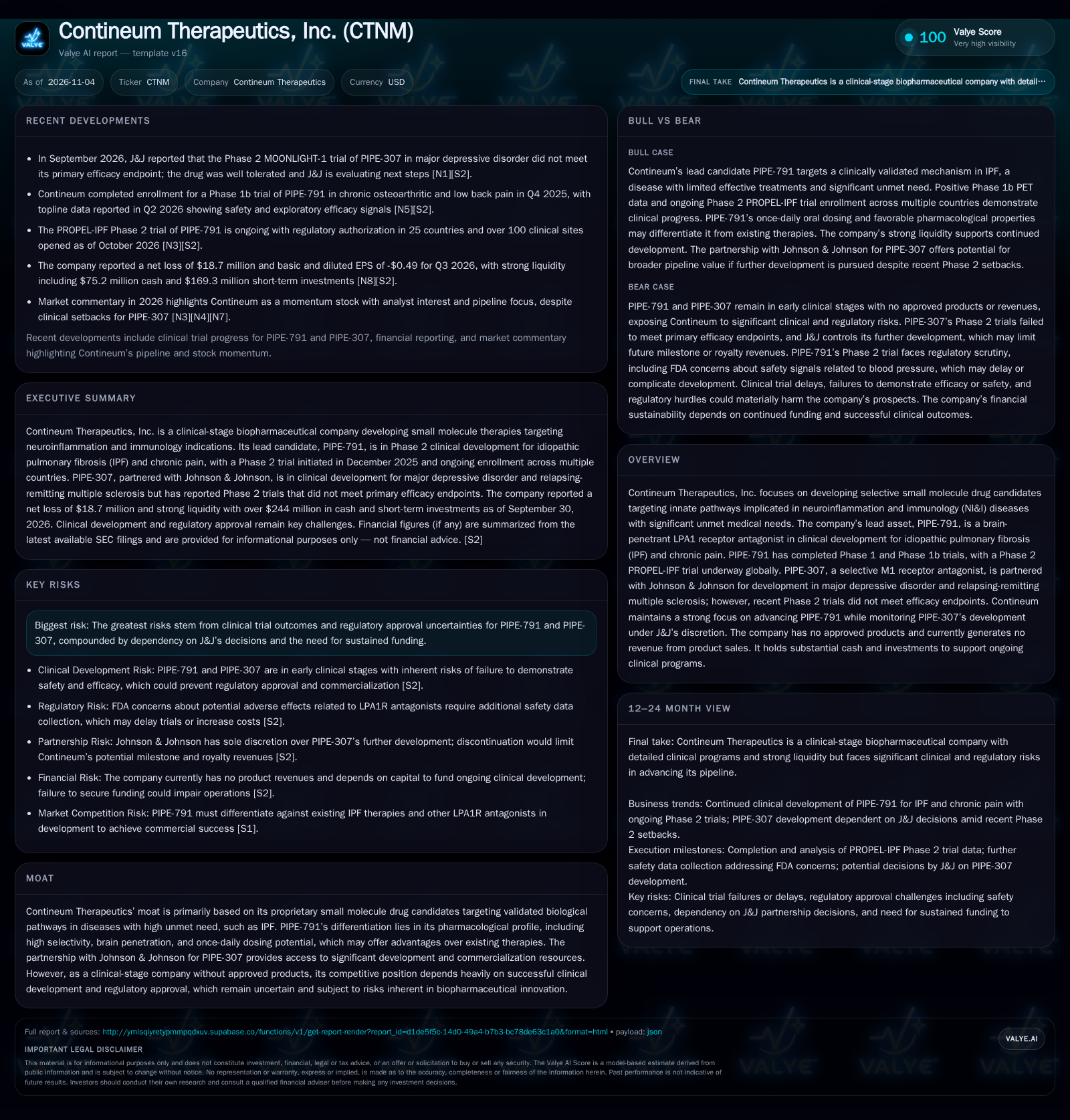
Contineum Therapeutics holds two clinical-stage drug candidates—PIPE-791 for idiopathic pulmonary fibrosis and pain (wholly owned), and PIPE-307 for depression and RRMS (licensed to J&J). PIPE-791’s Phase 2 IPF trial is underway, while PIPE-307 recently failed Phase 2 efficacy endpoints in both MDD and RRMS. Contineum retains over $244 million in cash and investments, but has no approved products or revenue, making future prospects highly dependent on clinical and regulatory outcomes. [S2]
Contineum Therapeutics exemplifies the high-wire act of clinical-stage biotech: it has reported liquidity position and two internally discovered, mechanism-driven compounds targeting diseases with high unmet needs, but faces immediate headwinds after both Phase 2 trials of PIPE-307 failed to meet efficacy endpoints. With no commercialized products and PIPE-791 now the clear focal point, the company’s future will be determined by clinical trial outcomes, regulatory feedback, and the ability to differentiate in the competitive and risk-laden field of fibrosis and pain therapeutics. The next 12-24 months are likely to be pivotal as Contineum tests whether its scientific approach can translate into clinical and commercial wins.
Clinical Milestones and Setbacks Shape the Immediate Outlook
As of November 2026, Contineum Therapeutics is defined by three key facts: (1) PIPE-791, its wholly owned LPA1R antagonist, has entered a multi-country Phase 2 trial for idiopathic pulmonary fibrosis (IPF) with over 100 clinical sites open; (2) PIPE-307, the company’s partnered M1R inhibitor, failed to meet efficacy endpoints in two Phase 2 trials for major depressive disorder (MDD) and relapsing-remitting multiple sclerosis (RRMS), leaving its future in the hands of Johnson & Johnson; and (3) the company maintains a robust balance sheet, with $75.2 million in cash and $169.3 million in short-term investments as of September 30, 2026, but reported a net loss of $18.7 million for the quarter and has no product revenue. [S2]
These developments matter because they sharpen Contineum’s dependency on PIPE-791’s success for IPF and chronic pain, especially as cash burn continues and PIPE-307’s trajectory is uncertain. The failure of both PIPE-307 trials heightens the stakes for PIPE-791’s ongoing studies and regulatory interactions, while the reported liquidity position buys time but not certainty.
Economics of a One-Asset Biotech: Capital Intensity and the Search for Value-Inflecting Data
Contineum’s business model is typical of clinical-stage biotechs: heavy upfront R&D investment, no product revenue, and high dependence on external funding or partnerships. The company’s quarterly net loss of $18.7 million reflects ongoing clinical trial costs, with operating leverage only achievable if a lead asset achieves late-stage success and subsequent commercialization. [S2]
PIPE-791, if successful, could address a high-value market in IPF, where existing therapies are often poorly tolerated and new oral options are in demand. The economics of such an asset—if approved—would likely involve premium pricing, modest patient volume due to IPF’s rarity, and significant gross margins characteristic of specialty drugs. However, commercialization would require substantial additional investment in sales, medical affairs, and reimbursement infrastructure, unless a partnership or acquisition occurs. For chronic pain, the addressable market is larger but also more competitive and price-sensitive.
PIPE-307’s economics are now largely outside Contineum’s control, as J&J holds exclusive development and commercial rights. Any future milestone or royalty revenue is contingent on J&J’s willingness to continue development after the recent Phase 2 failures. Without near-term out-licensing or partnership opportunities for other pipeline assets, Contineum’s capital needs will remain high, and future dilution or additional funding rounds could be necessary if PIPE-791’s trials are delayed or unsuccessful.
Differentiation, Substitution, and the Competitive Landscape in IPF and Pain
Contineum’s competitive thesis rests on PIPE-791’s differentiated profile as a brain-penetrant, once-daily oral LPA1R antagonist for IPF—a market historically dominated by drugs like pirfenidone and nintedanib, both of which have efficacy but are limited by tolerability and side effects. PIPE-791’s target is clinically validated, and improved dosing or side effect profiles could drive adoption if efficacy is proven. [S1]
However, the competitive landscape is crowded: multiple companies are developing next-generation fibrosis therapies, including other LPA1R antagonists and anti-fibrotic agents with alternative mechanisms. In chronic pain, PIPE-791 would face entrenched generic therapies, established branded drugs, and a high bar for payer coverage and differentiation.
Switching costs in rare diseases like IPF are typically low if a new therapy demonstrates superior efficacy or tolerability, but regulatory hurdles and physician inertia can slow uptake. Contineum’s ability to secure a favorable label and demonstrate clear patient benefit will be critical to establishing a durable commercial position. Without first-mover advantage or clear superiority, PIPE-791 could struggle against both existing therapies and late-stage competitors.
If PIPE-791 Delivers: The Path to Transformational Value Creation
The most favorable scenario for Contineum is that PIPE-791 demonstrates robust efficacy and safety in Phase 2 IPF trials, leading to accelerated regulatory engagement and, potentially, a lucrative partnership or acquisition. Strong data could enable PIPE-791 to differentiate on dosing convenience and tolerability, supporting premium pricing and rapid uptake in a market with high unmet need.
Confirmation would come from positive Phase 2 efficacy signals (e.g., improvements in lung function or progression-free survival versus placebo), manageable safety profile (especially regarding blood pressure effects highlighted by the FDA), and interest from major biopharma partners or acquirers. Early demonstration of efficacy in chronic pain could further expand the addressable market and strengthen negotiating leverage. Evidence of payer willingness to reimburse at specialty drug price points would further validate the upside thesis.
Falsification would be signaled by lackluster efficacy, safety concerns, or regulatory setbacks that prevent advancement to Phase 3 or meaningful partnering activity.
A Waiting Game: Clinical Progress Amid Unavoidable Uncertainty
The most plausible outcome is that Contineum continues to advance PIPE-791 through Phase 2 IPF and pain studies over the next 12-24 months, with interim data providing incremental clarity but not full de-risking.
For PIPE-307, the base case is that J&J either terminates development or, at best, pursues further studies in narrower indications or subpopulations. No near-term revenue is likely from this collaboration given the recent Phase 2 failures.
Evidence confirming this scenario would include steady trial enrollment, timely data releases, and ongoing cash burn in line with expectations. Conversely, major trial delays, early safety signals, or partner withdrawals would falsify this middle-path scenario.
When Clinical and Regulatory Risk Materialize: Scenarios for Value Destruction
Adverse outcomes could occur if PIPE-791 fails to demonstrate compelling efficacy or is hampered by safety issues, particularly with respect to the FDA’s concerns about blood pressure effects of LPA1R antagonists. Regulatory setbacks—such as clinical holds, requests for additional studies, or failure to progress to Phase 3—would erode investor confidence and force Contineum to seek additional funding under less favorable terms.
A negative scenario for PIPE-307 is already partially realized, with both Phase 2 trials failing primary endpoints; full discontinuation by J&J would eliminate any hope of milestone or royalty revenue from this asset. If PIPE-791 is also delayed or fails, Contineum may be forced to defer or abandon other pipeline programs, and the value of its R&D platform would be sharply discounted.
Confirmation of the downside would come from negative trial data, clinical holds, regulatory rejections, or announcements of major cost-cutting, layoffs, or halted programs. Deterioration in balance sheet strength without clear pipeline progress would also reinforce the bear case.
Milestones That Will Define Contineum’s Transition From Promise to Proof
Topline efficacy and safety results from the ongoing Phase 2 PROPEL-IPF trial for PIPE-791, including specific readouts on lung function and adverse event rates.
Regulatory feedback from the FDA and ex-U.S. agencies regarding the sufficiency of safety data for LPA1R antagonists, especially related to blood pressure effects.
Updates from Johnson & Johnson regarding next steps for PIPE-307, including any decisions to continue, modify, or terminate development in depression or RRMS.
Cash burn rate and runway projections, particularly in relation to the timing of major data readouts and the need for additional financing if development timelines extend.
Evidence of partnership interest or strategic transactions around PIPE-791, such as licensing deals, co-development agreements, or acquisition offers.
Initiation or advancement of deferred pipeline programs (e.g., progressive MS or CTX-343) if additional funding is secured.
If disclosed, enrollment rates and site activation pace in ongoing clinical trials to assess operational execution.
A useful metric would be progress on payer engagement and commercial readiness planning for PIPE-791, should efficacy data warrant late-stage development.
Disclaimer: This is research-only, informational analysis and not investment advice. It may include AI-generated interpretation and general industry context. Always verify important details using primary sources.

Comments