
RxSight’s Adjustable Lens System: Customization Bet Faces Adoption and Execution Headwinds
RxSight’s light-adjustable intraocular lens technology aims to disrupt the premium cataract surgery segment by enabling post-surgical vision customization—a unique value proposition relative to fixed-power IOLs. While a growing installed base and collaboration with Alcon offer recurring revenue potential and expanded reach, ongoing losses, dependence on a concentrated surgeon base, and underpenetration of the premium IOL market highlight the operational and adoption risks that will shape the company’s trajectory.
RxSight is commercializing the only FDA-approved premium intraocular lens system that allows surgeons to adjust a patient’s vision after cataract surgery, addressing a key limitation of traditional premium IOLs. With a razor-and-blade business model and a growing installed base, the company targets recurring revenue streams. However, net losses persist, market penetration remains limited, and adoption depends on shifting surgeon and patient behavior. Execution—including the Alcon collaboration and expanding device utilization—will determine whether RxSight’s differentiated technology translates to sustainable growth.
RxSight, Inc. is betting that its proprietary light-adjustable intraocular lens system can redefine outcomes in premium cataract surgery by solving a long-standing problem: fixed-power IOLs require surgeons and patients to commit to a visual outcome before surgery, often leading to compromises and dissatisfaction. By enabling post-surgical, non-invasive lens adjustments, RxSight aims to offer both patients and surgeons a new level of control and customization, positioning itself as a disruptive force in an underpenetrated segment. Yet, the company’s future will be dictated not just by technological differentiation, but by its ability to drive adoption among a cautious surgeon base, convert clinical advantage into sustained utilization, and execute amid persistent losses and collaboration dependencies.
Recent Performance Anchors Expectations for RxSight’s Commercial Traction
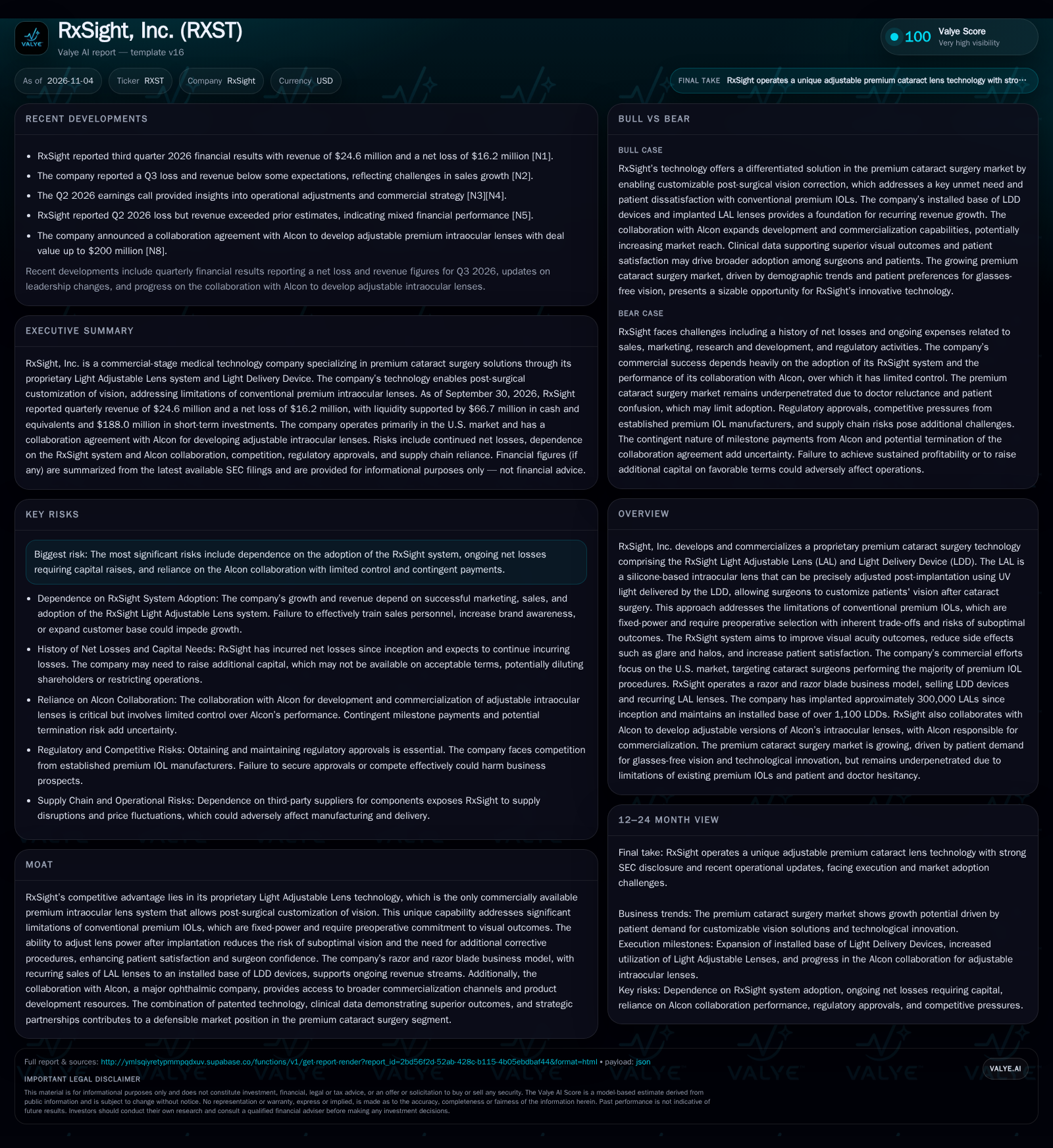
The most material facts shaping RxSight’s outlook are its Q3 2026 financial results, installed base progress, and commercial alignment with Alcon. The company reported revenue of $24.6 million and a net loss of $16.2 million for the third quarter, with liquidity comprising $66.7 million in cash and $188 million in short-term investments [S2]. As of December 31, 2025, RxSight had 1,134 LDDs installed and approximately 300,000 LALs implanted, reflecting ongoing adoption but also highlighting the early stage of premium IOL penetration [S1]. A collaboration agreement with Alcon offers up to $130 million in contingent milestone payments, but with Alcon controlling commercialization and the risk of termination, this partnership presents both upside and uncertainty [S2]. These facts underscore that while the business model is scaling, profitability and market penetration remain unresolved, and external partnerships introduce execution risk.
How RxSight’s Razor-and-Blade Model Seeks to Capture Recurring Value
RxSight employs a classic razor-and-blade model: the Light Delivery Device (LDD) is the installed hardware platform, while the Light Adjustable Lens (LAL) provides recurring, procedure-driven consumable revenue. This structure typically offers attractive long-term economics if utilization per installed device grows—each surgery creates demand for a new LAL, and clinical follow-up for adjustment delivers repeat engagement.
However, the company’s operating leverage is not yet manifesting as positive net income, with ongoing investments in sales, marketing, and R&D to drive adoption and support regulatory and commercial expansion [S2]. The high gross margins typical of advanced medical devices may be offset by these fixed costs and the need to support surgeon training and patient education. RxSight’s capital needs are typical for a growth-stage medtech firm, as evidenced by continued net losses. The company reported cash and liquidity metrics for the period; these figures do not by themselves establish operating runway, investment capacity, financial flexibility, or financing capacity.
The model’s success depends on increasing the average number of LAL procedures per installed LDD. If utilization per device remains low, device sales alone will not yield sustainable profitability. Furthermore, the business is highly sensitive to the pace of market adoption, reimbursement dynamics, and the ability to displace conventional premium IOLs.
Customization Advantage Meets Entrenched Premium IOL Competition
RxSight’s central differentiator is its ability to offer post-surgical, non-invasive lens power adjustment—a feature unavailable in conventional premium IOLs, which are fixed-power and often require preoperative trade-offs [S1]. This could meaningfully improve patient satisfaction and reduce the need for corrective procedures, theoretically raising surgeon confidence in recommending premium IOLs.
Yet, incumbent premium IOL manufacturers have established relationships, broad product portfolios, and deep sales infrastructures. Surgeons may be reluctant to change established workflows or adopt new technology without compelling, peer-validated clinical data and clear reimbursement pathways. The premium IOL market is further hampered by patient confusion and hesitancy, as many patients are unaware of the trade-offs involved in fixed-power solutions.
The collaboration with Alcon, a leading ophthalmic player, could expand RxSight’s reach and provide validation, but it also means RxSight has limited control over commercial execution and is subject to milestone-based economics [S2]. Ultimately, the company’s moat rests on the uniqueness and clinical value of its technology, but the risk of slow adoption and competitive counter-moves remains significant.
Unlocking Utilization: What a Breakout Adoption Cycle Would Look Like
The most favorable scenario for RxSight is one where its installed base of LDDs translates into rapidly compounding LAL procedure volumes, driven by surgeon advocacy and growing patient demand for precise, glasses-free outcomes. If clinical data continue to validate superior visual acuity and lower side-effect rates, and if surgeon champions drive word-of-mouth adoption, RxSight could see utilization per device increase, driving high-margin consumable revenue and operating leverage.
A major upside trigger would be the successful commercialization by Alcon of light-adjustable versions of its own IOLs, with milestone payments and expanded market reach. If RxSight’s technology becomes the new standard for premium cataract patients—especially as demographic trends increase demand for post-surgical customization—market share gains could accelerate.
Evidence supporting this scenario would include a sustained rise in LAL procedures per LDD, positive surgeon and patient testimonials, accelerating milestone revenue from Alcon, and progress toward profitability. Regulatory approvals in new geographies and further clinical endorsements would further reinforce the breakout thesis.
Incremental Gains Amid Adoption Friction and Execution Risk
The most plausible path for RxSight is moderate, stepwise growth in both installed base and LAL utilization, constrained by the inertia of established surgeon behavior and the slow pace of premium IOL market expansion. While the clinical benefits are clear, conversion of skeptical surgeons and confused patients may require sustained investment in education and support, with utilization ramping gradually rather than explosively.
Alcon’s collaborative commercialization may yield some milestone payments, but with RxSight’s limited control, the pace and magnitude of this contribution are uncertain. The business is likely to remain loss-making in the near term as fixed costs for sales and support remain high relative to revenue.
Confirmation of this scenario would be continued growth in installed LDDs and gradual increases in LAL procedures, but with net losses persisting and only modest improvement in operating leverage. A lack of major inflection points in patient or surgeon adoption would also support this base case.
Stalled Penetration: When Differentiation Fails to Overcome Market Barriers
The adverse scenario is one where RxSight’s unique technology fails to drive substantial adoption, either because surgeons remain reluctant to embrace workflow changes, or because premium IOL patients continue to opt for established solutions. If utilization per installed LDD stagnates, recurring revenue growth will disappoint, and the high fixed cost structure will prolong or deepen losses.
A breakdown or underperformance in the Alcon collaboration—such as missed milestones, slow rollout, or early termination—would remove a major growth lever and could signal a lack of commercial validation. Regulatory setbacks, supply chain disruptions, or new competitive entrants with alternative post-surgical customization technologies could further erode RxSight’s position.
Indicators for this downside would be flat or declining LAL procedure volumes per device, absence of milestone revenue from Alcon, persistent or widening net losses, and negative surgeon or patient feedback regarding complexity, workflow, or outcomes.
Signals That Will Define RxSight’s Trajectory in Premium Cataract Surgery
Quarterly growth in LAL procedure volume per installed LDD would clarify whether utilization is scaling or stalling.
The pace and size of milestone payments and commercial progress reported by Alcon will reveal the true impact of the collaboration on RxSight’s economics.
Gross margin trends, if disclosed, would indicate whether increased utilization is translating into operating leverage.
Surgeon adoption rates—specifically new surgeon onboarding and repeat usage—would help test the thesis of growing clinical acceptance.
Patient satisfaction scores and rates of 20/20 or better uncorrected visual acuity, if updated, would provide evidence for the clinical value proposition.
Regulatory milestones for new geographies or expanded indications could serve as additional catalysts or risk points.
Disclaimer: This is research-only, informational analysis and not investment advice. It may include AI-generated interpretation and general industry context. Always verify important details using primary sources.

Comments