
FormFactor: AI-Driven Memory Testing Fuels Growth, but Cyclicality and Tech Shifts Loom
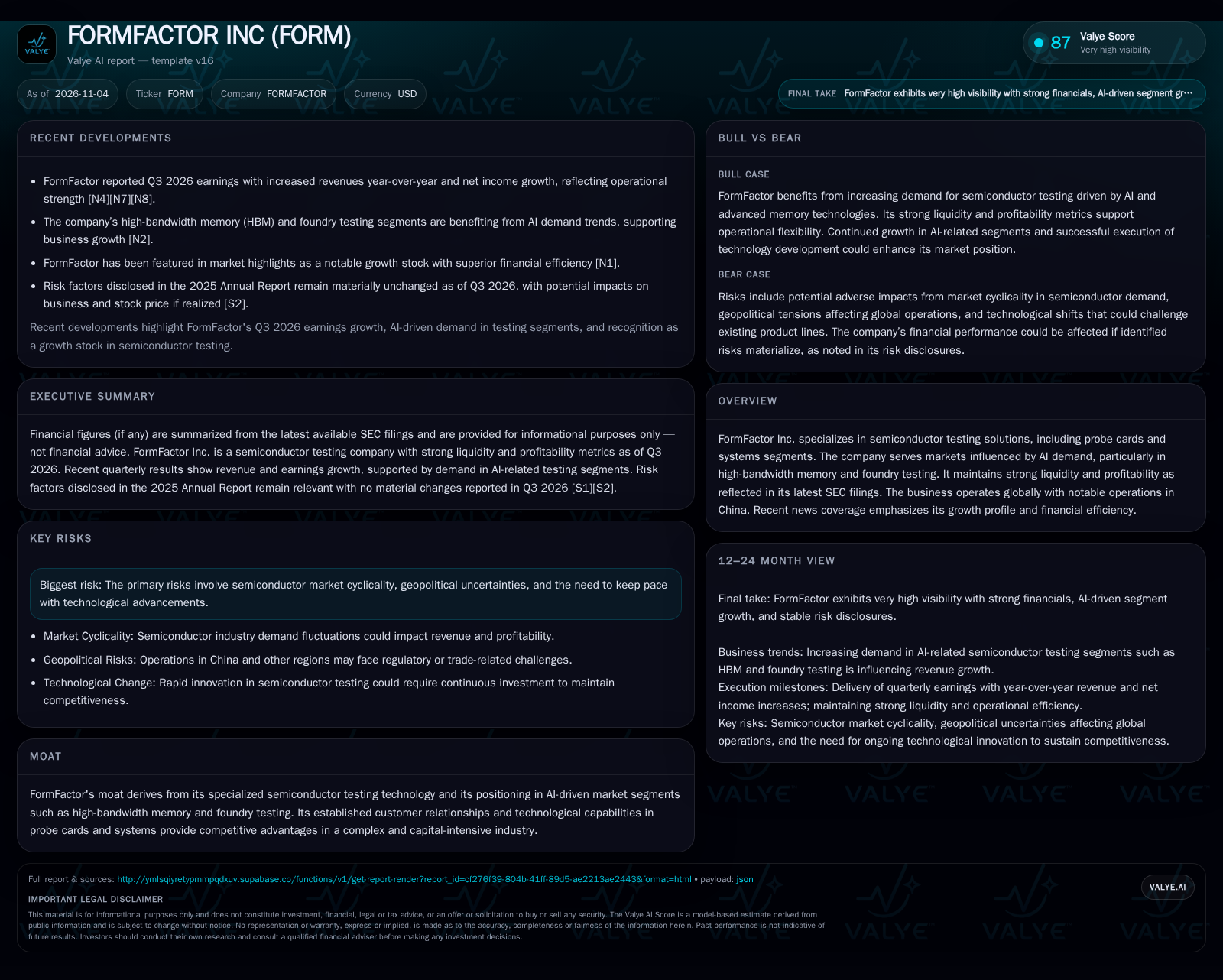
FormFactor’s strong Q3 2026 results highlight how surging demand in AI-related high-bandwidth memory and foundry testing is powering the company’s growth.
FormFactor reported year-over-year revenue and net income growth in Q3 2026, underpinned by strength in AI-driven high-bandwidth memory and foundry testing segments. Monitoring segment momentum, competitive dynamics, and execution on innovation will be critical for the next phase.
FormFactor Inc. enters late 2026 with clear tailwinds from AI-driven demand for advanced semiconductor testing, particularly in high-bandwidth memory and foundry applications. Its third-quarter results show notable year-over-year revenue and profit gains, supported by a reported liquidity position and operational efficiency. However, as the semiconductor industry remains notoriously cyclical and subject to rapid technological change, FormFactor’s ability to sustain this growth will depend on continued execution in its core segments, resilience to market swings, and ongoing investment in next-generation testing technologies.
Q3 2026: Financial Strength, AI Tailwinds, and Segment Momentum
FormFactor’s Q3 2026 results mark a period of operational strength, with year-over-year revenue growth and net income reaching $73.82 million; basic EPS stood at $0.94 [S2] [N4] [N7] [N8]. The company reported cash and cash equivalents of $138.2 million, a current ratio of 3.68, and a cash ratio of 1.06 as of September 26, 2026, reflecting a reported liquidity position [S2]. Segmentally, the high-bandwidth memory (HBM) and foundry testing businesses are highlighted as growth engines, benefiting from AI-driven semiconductor demand [N2]. Risk disclosures from the prior year remain pertinent, underlining the persistent uncertainty tied to market cycles and global operations [S2]. These facts collectively frame a business currently capitalizing on AI adoption, while remaining structurally exposed to industry volatility and external risks.
How FormFactor’s Testing Solutions Capture Value in a Shifting Semiconductor Landscape
FormFactor monetizes its position in the semiconductor supply chain by providing critical testing equipment—primarily probe cards and systems—used by foundries, integrated device manufacturers, and memory producers. The economics of this model blend high upfront R&D and capital investment with recurring revenue potential from consumables, upgrades, and maintenance. Pricing power is typically highest for leading-edge solutions, such as those required for HBM and advanced logic nodes, where technical complexity and customer qualification barriers are high.
Demand for FormFactor’s offerings is tightly linked to semiconductor capital expenditure cycles, which are themselves increasingly shaped by AI-driven workloads requiring high-performance memory and logic. When AI adoption accelerates, customers invest in HBM and advanced foundry processes, boosting demand for FormFactor’s most profitable products. However, the business is exposed to sharp volume swings during downturns, as customers delay or cut capital investments.
Operating leverage can be significant: incremental revenue in high-utilization periods often drops to the bottom line, as fixed engineering and overhead costs are absorbed. However, maintaining technological leadership requires sustained R&D spending, and gross margins can be pressured if price competition intensifies, especially in more commoditized or mature product lines. If FormFactor can continue to lead in next-generation testing (for example, for advanced packaging or 3D memory), it could sustain premium pricing and margin resilience.
Technology Leadership and Customer Entrenchment: Barriers and Vulnerabilities
FormFactor’s competitive edge rests on its specialized technology and its deep integration with semiconductor customers’ manufacturing and development processes. In probe cards and advanced testing systems, qualification cycles are long, and switching costs can be material—customers are reluctant to risk yield loss or delays from changing suppliers. This creates a degree of stickiness, particularly for leading-edge memory and foundry customers.
However, the competitive landscape is dynamic. Global probe card and test system peers (including both pure-play and diversified equipment makers) continually invest in R&D, and customers regularly benchmark suppliers for price, performance, and support. The rise of new memory architectures, chiplet designs, and advanced packaging could shift demand patterns or invite new entrants with disruptive approaches.
FormFactor’s operations in China present both opportunity and risk: China is a major semiconductor market, but also a zone of regulatory, trade, and intellectual property uncertainty. Sustained differentiation will require ongoing technological innovation and close customer alignment, while guarding against both commoditization and geopolitical shocks.
Sustained AI Memory Boom Drives High-Margin Expansion
If AI adoption in data centers, edge devices, and consumer electronics continues to accelerate, demand for high-bandwidth memory and leading-edge foundry processes could remain robust for several years. In this scenario, FormFactor’s probe cards and test systems for HBM and advanced nodes would enjoy both volume growth and premium pricing, as customers prioritize quality and speed to market.
Operating leverage could drive outsized earnings growth, as incremental revenues flow through a fixed cost base, especially if gross margins hold steady or improve with mix shift toward advanced solutions. Evidence of this scenario would include further year-over-year revenue and net income acceleration, expansion in HBM and foundry testing market share, and customer disclosures of multi-year technology roadmaps with FormFactor as a key partner.
Falsification would come from a slowdown in AI hardware investments, margin compression despite revenue growth, or loss of design wins to competitors in next-generation testing technologies.
Resilient Core Growth, but Cyclical Volatility Remains the Norm
The most plausible path is continued but moderating growth in AI-related testing demand, with FormFactor maintaining its leadership in HBM and foundry segments, but facing periodic slowdowns as semiconductor cycles ebb and flow. Revenue and profit growth would persist, but at a pace more aligned with broader industry trends, punctuated by quarters of volatility as customers adjust capex in response to inventory, end-market demand, and macroeconomic factors.
Margins may fluctuate as the mix of leading-edge and mature products shifts, and as pricing pressure emerges in more commoditized segments.
Evidence for this scenario includes stable or gradually rising revenues, fluctuations in quarterly results tied to industry cycles, and ongoing product launches or customer wins in core segments. Falsification would be indicated by a sharp, sustained drop in revenues, margin erosion, or loss of competitive position in HBM or foundry testing.
AI Demand Stalls, Industry Downturn and Disruption Pressure Profitability
Should the AI-driven semiconductor boom prove short-lived or overbuilt, a sharp contraction in memory and foundry capex could rapidly reduce demand for FormFactor’s most profitable products. Prolonged industry downturns historically result in significant revenue and margin compression for capital equipment suppliers, with pricing pressure intensifying amid overcapacity.
Additional downside could materialize if technological shifts (such as new testing paradigms, alternative memory architectures, or greater vertical integration by customers) erode FormFactor’s differentiation. Geopolitical tensions affecting China or other key markets could further disrupt sales and supply chains.
Confirmation of this scenario would be a pronounced drop in quarterly revenues, negative operating leverage (i.e., fixed costs outpacing revenue declines), margin compression, or disclosure of market share loss in core segments. Falsification would require evidence of resilience in both revenues and margins despite a broader industry downturn.
Signals That Will Determine If FormFactor’s Growth Can Endure the Next Cycle
Quarterly revenue and segment-level growth figures for HBM and foundry testing—if disclosed—would clarify whether AI-driven demand remains strong or is plateauing.
Gross margin trends and product mix shifts, especially the proportion of revenue from advanced probe cards and systems versus legacy or commoditized offerings.
Order backlog, customer win announcements, or design-in disclosures that signal future visibility and competitive position in next-generation memory and logic testing.
R&D spending levels and cadence of new product introductions, which would indicate ongoing investment in technological leadership.
Geographic revenue breakdowns, particularly exposure to China and other regions sensitive to regulatory or trade risks.
Evidence of customer concentration or diversification, as high reliance on a small number of leading-edge customers could amplify cyclicality.
Any material changes in risk disclosures, especially around market cyclicality, geopolitical developments, or emerging technology threats.
Cash flow from operations and capital expenditure trends, which would highlight operational efficiency and investment discipline.
Disclaimer: This is research-only, informational analysis and not investment advice. It may include AI-generated interpretation and general industry context. Always verify important details using primary sources.

Comments