
BOK Financial in 2026: Profitability, Sector Exposure, and the Levers of Regional Banking Resilience
BOK Financial Corp’s recent quarter underscores its ability to generate consistent profits and maintain liquidity, but sector-wide forces—interest rates, credit quality, and regional competition—will likely dictate the magnitude and durability of future returns. The company’s transparency and stable risk profile provide clarity, but the heart of the thesis remains its capacity to navigate cyclical headwinds and extract value from its banking platform.
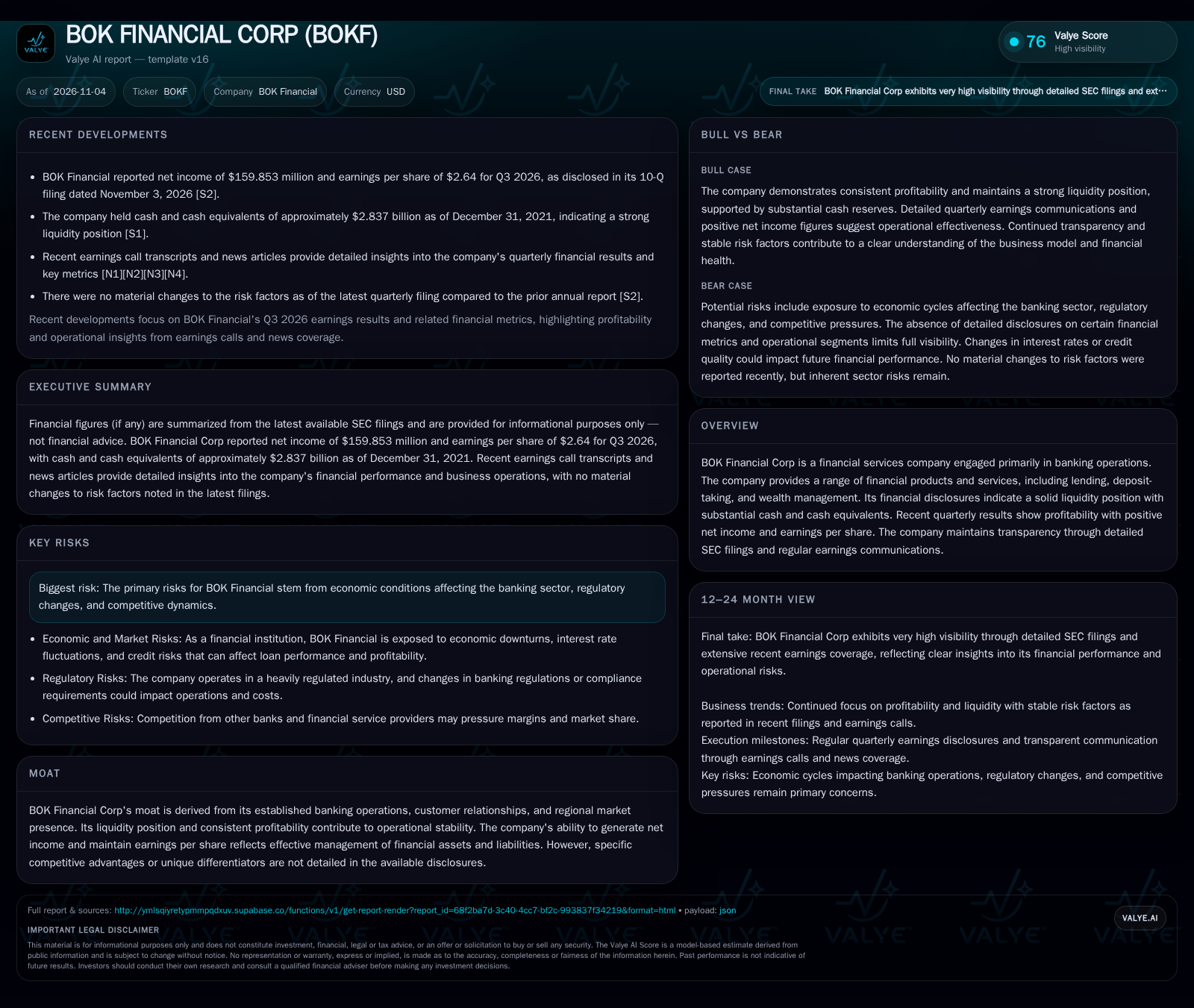
BOK Financial reported $159.85 million in net income for Q3 2026, reflecting ongoing profitability and operational stability. Monitoring the interplay between these external forces and internal execution will be critical to understanding BOK Financial’s ability to sustain earnings and defend its market position. [S2]
Yet, as with most financial institutions, the company’s future performance is inseparable from the broader economic and regulatory environment. Interest rate fluctuations, credit quality cycles, and evolving competition in the banking sector will drive both risk and opportunity. The next phase for BOK Financial will depend not only on macroeconomic conditions but also on its ability to leverage its operational platform and manage sector-specific headwinds.
Recent Profitability and Risk Stability Define the Current Snapshot
BOK Financial reported net income of $159.85 million and basic/diluted EPS of $2.64 for the quarter ended September 30, 2026, according to its most recent 10-Q filing. These results point to ongoing profitability, a core indicator of operating health for a regional banking institution. The company’s previous liquidity disclosure—$2.837 billion in cash and cash equivalents as of December 31, 2021—highlights a historically reported cash position, though more recent liquidity figures are not provided in the latest summary. Critically, the company’s risk disclosures indicate no material changes compared to the prior annual report, suggesting that management perceives the current risk environment as stable relative to recent history. Together, these facts frame BOK Financial as a consistently profitable, well-monitored institution, but one whose forward-looking thesis will ultimately hinge on sector-wide forces and execution. [S2] [S1]
How BOK Financial Generates Profits—and What Could Shift Its Economics
BOK Financial’s primary revenue streams are net interest income from lending and deposit-taking, supplemented by fee-based services such as wealth management and transaction banking. The company’s profitability is inherently tied to the spread between interest earned on loans and paid on deposits—the net interest margin (NIM)—which is highly sensitive to interest rate movements. In a rising rate environment, banks can often expand NIMs as loan yields outpace deposit costs, but competitive dynamics and deposit beta (the responsiveness of deposit rates to market rates) can compress these gains. Conversely, falling rates or an inverted yield curve may squeeze margins and slow earnings growth.
Operating leverage in banking comes from fixed costs in technology, compliance, and branch infrastructure, while variable costs are driven by loan provisioning and compensation. Growth in loan volume, deposit balances, and fee income can improve efficiency ratios, but credit losses and regulatory expenses present downside risks. Capital requirements—dictated by regulators—set boundaries on balance-sheet expansion, influencing both lending capacity and return on equity. In summary, BOK Financial’s ability to grow earnings will hinge on its management of rate sensitivity, credit risk, and operating efficiency amid evolving macro and regulatory pressures.
Assessing Moat and Market Position in a Crowded Regional Banking Landscape
BOK Financial’s competitive position is shaped by its established customer relationships, regional presence, and breadth of financial services. In regional banking, advantages often stem from local market knowledge, long-term customer ties, and tailored service—a formula that can drive sticky deposits and recurring business. However, these advantages are counterbalanced by intense competition from both traditional banks and non-bank financial service providers, including fintechs and large national banks expanding into regional markets.
Switching costs for customers in core banking services are moderate; while relationships and bundled accounts provide some stickiness, digital banking has lowered barriers to moving accounts and accessing alternative providers. The company’s ability to defend or expand market share may depend on its investment in technology, quality of service, and capacity to offer competitive rates and fees. Regulatory compliance and risk management are necessary but not differentiators unless they enable BOK Financial to operate more efficiently or respond more nimbly to shocks. Thus, while the company enjoys some moat from incumbency and relationships, the absence of unique scale or proprietary technology suggests its competitive position remains vulnerable to sector-wide shifts.
Interest Rate Tailwinds and Credit Quality Could Unlock Earnings Upside
A favorable outcome for BOK Financial would stem from a combination of rising or stable interest rates, benign credit conditions, and steady regional economic activity. In this scenario, the company could expand net interest margins as loan yields climb faster than deposit costs, while low credit losses preserve more of that spread as net income. Growth in fee-based services, such as wealth management or treasury services, would further diversify revenue and reduce reliance on interest-driven income.
Evidence confirming this scenario would include sustained NIM expansion, low non-performing asset ratios, and growth in non-interest income lines. If BOK Financial demonstrates improved efficiency ratios (expenses as a percentage of revenue) and limited loan loss provisioning, it would suggest the company is capturing operating leverage and benefiting from a favorable macro backdrop. Conversely, a rapid rise in deposit betas or a spike in credit losses would challenge this scenario and likely cap earnings upside.
Sector Realities Anchor Expectations for Steady, If Unremarkable, Performance
The most plausible trajectory for BOK Financial is continued profitability with moderate earnings variability, reflecting the realities of regional banking in a mature, competitive sector. Macroeconomic conditions will likely remain the primary driver: modest economic growth and a stable rate environment would support steady loan demand and manageable credit risk. Competitive pressures—particularly from larger banks and fintechs—may limit the company’s ability to materially expand margins or accelerate growth.
In this scenario, BOK Financial would be expected to report consistent net income and maintain its risk profile, barring a significant external shock. Confirmation would come from stable quarterly earnings, unchanged risk disclosures, and efficiency ratios in line with historical norms. Any material deviation in non-performing loans, regulatory capital ratios, or sustained margin compression would challenge the base case and signal a shift in sector dynamics or company execution.
Adverse Credit Cycles or Regulatory Shocks Could Pressure Earnings and Capital
The primary threat to BOK Financial’s outlook lies in adverse credit cycles, sharp interest rate moves, or unforeseen regulatory burdens. A regional or national economic downturn could trigger higher loan defaults, forcing the company to increase loan loss provisions and eroding net income. Simultaneously, a flattening or inverted yield curve may compress net interest margins, while competition for deposits could drive up funding costs.
Regulatory changes—such as heightened capital requirements or new compliance mandates—could further weigh on profitability by increasing costs or constraining balance sheet growth. Evidence that would confirm a downside scenario includes a spike in non-performing assets, rising loan loss provisions, negative NIM trends, or worsening efficiency ratios. Should these metrics deteriorate meaningfully, BOK Financial could face pressure on both earnings and capital, potentially requiring defensive measures such as cost cuts or capital raises.
Milestones That Will Test BOK Financial’s Resilience and Earnings Power
Net interest margin (NIM) trends: Sustained growth or compression in NIM would provide insight into rate sensitivity and competitive dynamics.
Loan loss provisions and non-performing asset ratios: Rising provisions or asset quality deterioration would signal mounting credit risk.
Deposit growth and composition: Monitoring changes in core versus non-core deposits, if disclosed, would clarify funding stability and cost trends.
Efficiency ratio performance: Improvements or slippage would indicate how well the company is managing its cost base relative to revenue.
Growth in non-interest income: Expansion in fee-based services would suggest diversification and reduced reliance on lending.
Regulatory capital ratios: Any movement toward minimum thresholds would raise questions about balance sheet resilience.
Segment-level or geographic performance, if disclosed: Greater granularity would help assess diversification and vulnerability to localized shocks.
Management commentary on economic outlook and loan demand: Forward-looking statements would provide early signals on risk appetite and growth potential.
Disclaimer: This is research-only, informational analysis and not investment advice. It may include AI-generated interpretation and general industry context. Always verify important details using primary sources.

Comments