
Healthpeak Properties: Profitability Returns, but Sector Volatility and Funding Costs Shape the Next Phase
Healthpeak Properties posted a profitable Q3 2026, buoyed by leasing and senior housing, and maintains substantial cash reserves. Yet, the company faces rising sector and macroeconomic headwinds, with interest rates, tenant health, and real estate demand all critical to its trajectory.
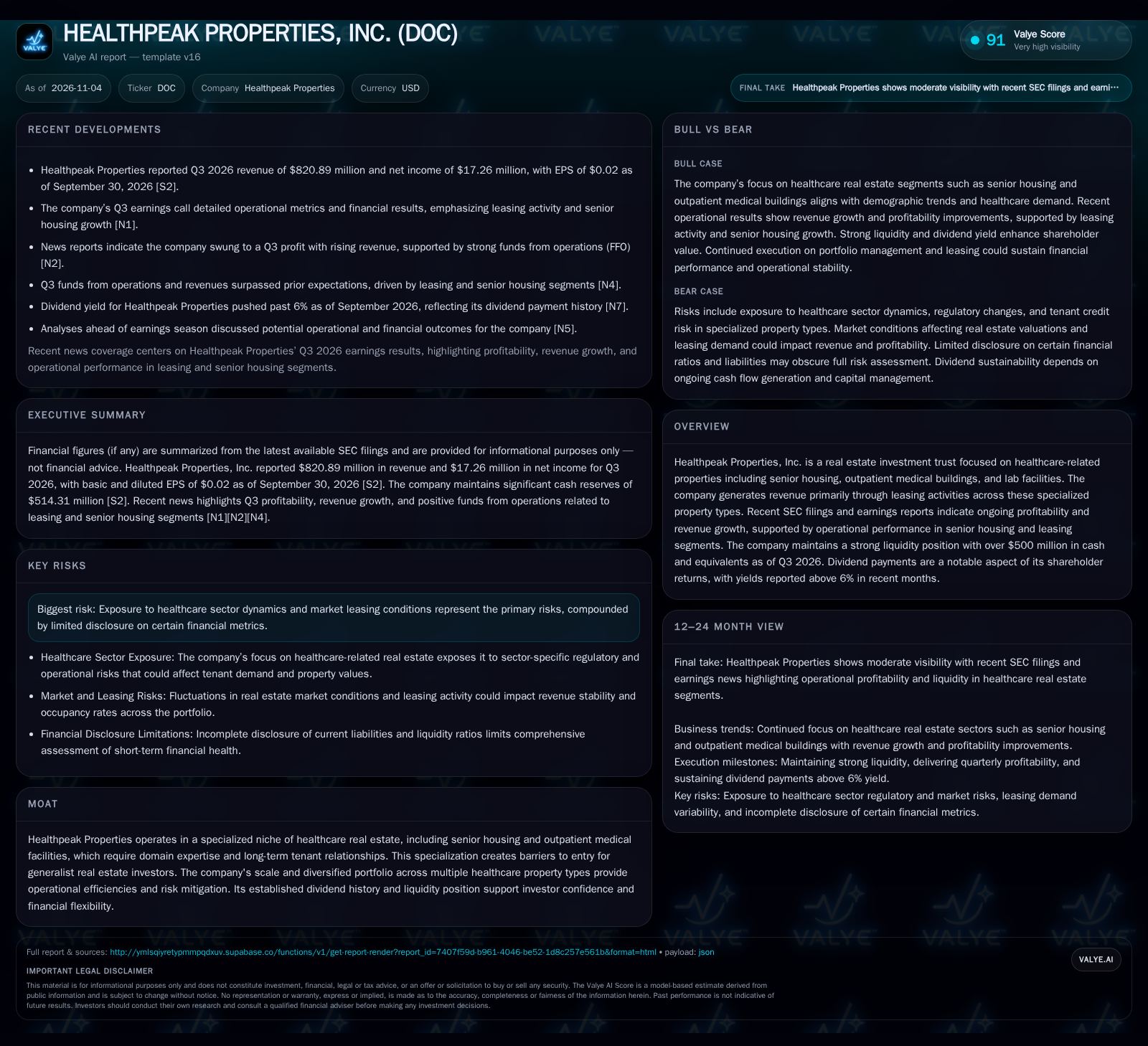
Healthpeak Properties delivered positive Q3 2026 results with $820.89 million in revenue and a return to profitability, underpinned by growth in leasing and senior housing. The cited source reports dividend-related activity; that disclosure alone does not establish dividend-policy continuity, management confidence, or a material constraint on capital flexibility. [S2] [N1] [N4] [N7]
Healthpeak Properties, a major REIT specializing in healthcare real estate, delivered a profitable third quarter in 2026, supported by robust leasing and senior housing trends. With over $500 million in cash, the company appears well-positioned to withstand short-term shocks. However, its future performance will hinge on navigating sector-specific risks, managing higher borrowing costs amid persistent inflation, and sustaining operational momentum in a dynamic healthcare landscape. The company’s ability to balance dividend commitments, tenant credit health, and capital allocation will define its resilience as economic and regulatory uncertainties continue.
Q3 Profitability Returns, but Macro and Sector Risks Loom
Healthpeak Properties reported $820.89 million in revenue and $17.26 million in net income for the third quarter of 2026, achieving basic and diluted EPS of $0.02. This marks a return to profitability, with strong leasing activity and growth in senior housing highlighted as key contributors in recent earnings commentary. However, rising interest rates and persistent inflation—cited in recent SEC filings—have increased borrowing costs and placed pressure on both tenants and the company’s own capital structure. The cited source reports dividend-related activity; that disclosure alone does not establish dividend-policy continuity, management confidence, or a material constraint on capital flexibility. [S2] [N1] [N4] [N7]
How Healthpeak’s Portfolio Mix and Funding Costs Shape Earnings Power
Healthpeak’s revenue model relies primarily on rental income from a diversified portfolio of senior housing, outpatient medical, and laboratory buildings. Lease structures in these segments often involve long-term agreements, providing some visibility into cash flows, but also exposing the company to tenant credit risk and regulatory shifts unique to healthcare real estate. The fixed-cost nature of property ownership and management can create operating leverage: incremental occupancy gains or rental rate increases may disproportionately benefit margins, while vacancies or rent concessions can quickly erode profitability.
Capital intensity remains high, both for property acquisition and ongoing maintenance, and the ability to finance growth or refinance maturing debt at attractive rates is a structural variable for all REITs. With over $500 million in cash as of Q3 2026, Healthpeak has near-term flexibility, but the absence of detail on current liabilities or upcoming maturities means it is difficult to assess true short-term runway. Rising interest rates, referenced in recent filings, threaten to compress spreads and reduce the attractiveness of new investments, while also raising the hurdle for dividend coverage. The cited source reports dividend-related activity; that disclosure alone does not establish dividend-policy continuity, management confidence, or a material constraint on capital flexibility.
Specialization, Scale, and the Challenge from Generalist and Specialist Rivals
Healthpeak’s focus on healthcare real estate—especially senior housing, outpatient medical, and lab facilities—creates a degree of insulation from broader commercial real estate cycles, but also exposes it to sector-specific volatility. Its relationships with healthcare providers and operators, and the specialized nature of its assets, can deter generalist REITs from direct competition, supporting a modest moat. Scale allows for operational efficiencies and risk diversification across property types and geographies.
However, the competitive landscape includes both large diversified REITs with healthcare exposure and specialist peers focused on life sciences or senior care. Private equity and institutional investors have also targeted healthcare real estate, attracted by demographic tailwinds and perceived resilience. Substitution risk arises if healthcare delivery models shift (e.g., more telemedicine, home care), potentially reducing demand for physical outpatient or senior living space. The company’s ability to maintain high occupancy, renew leases, and selectively expand or rotate the portfolio will determine whether it can sustain its relative advantage.
Demographic Tailwinds and Lease Execution Could Unlock Sustained Growth
The most favorable path for Healthpeak involves continued strong demand for senior housing and outpatient medical properties as the U.S. population ages and healthcare utilization rises. If the company capitalizes on these demographic trends with disciplined acquisitions, high occupancy rates, and successful lease renewals or rent escalations, it could drive steady revenue growth and margin expansion. The ability to pass through inflation-linked rent increases or secure long-term leases with creditworthy healthcare tenants would further stabilize cash flows.
Confirmation of this scenario would include sequential FFO growth, rising occupancy rates (if disclosed), and evidence of rental rate increases or successful new project leasing. Falsification would come from stagnating or declining FFO, a spike in vacancies, or evidence that higher rates are eroding acquisition economics.
Navigating Rate Pressures and Sector Volatility While Maintaining Dividends
A plausible middle path for Healthpeak is one of stable but modest growth, with the company managing through interest rate headwinds and sector-specific uncertainties. Leasing activity and senior housing demand may remain healthy but face occasional disruptions from regulatory changes, tenant financial stress, or shifts in healthcare delivery.
In this scenario, Healthpeak maintains its dividend, but payout growth is constrained by tighter FFO margins. Operating leverage is moderate: incremental gains in occupancy or rent can offset some rate pressure, but cost escalation and episodic vacancies test management’s ability to sustain profitability. Falsification would involve dividend cuts, a negative FFO trend, or a marked deterioration in leasing metrics.
Interest Rate Spikes, Tenant Stress, and the Risk of Dividend Retrenchment
The adverse scenario for Healthpeak centers on persistent or rising interest rates, which could materially increase borrowing costs and compress investment yields. If inflation remains high and capital markets tighten, refinancing risk grows, potentially forcing asset sales or dilutive financings to cover obligations. Healthcare sector volatility—such as regulatory changes, reimbursement cuts, or tenant bankruptcies—could drive vacancies and erode rental income, especially if operators face liquidity constraints.
In this environment, FFO could decline, jeopardizing dividend coverage and leading to payout reductions. Negative occupancy trends, tenant defaults, or unanticipated capital expenditures would further weaken financial resilience. Confirmation of this scenario would include declining FFO, rising vacancy rates (if disclosed), dividend reductions, or evidence of forced asset divestitures. Falsification would require demonstration of stable or improving FFO and dividend coverage, despite macro stress.
Testing the Resilience of Healthpeak’s Healthcare Real Estate Thesis
Sequential trends in funds from operations (FFO): Are FFO and cash flow metrics demonstrating stability or improvement quarter-over-quarter?
Occupancy rates across senior housing, outpatient medical, and lab portfolios: If disclosed, are occupancy levels holding steady, improving, or deteriorating?
Average lease duration and renewal rates: Is the company successfully renewing leases at similar or higher rates, or facing turnover and concessions?
Changes in borrowing costs and weighted average interest rates: How are rising rates affecting Healthpeak’s debt service and acquisition economics?
Net asset sales or acquisitions: Is Healthpeak expanding its portfolio, rotating out of underperforming assets, or being forced to sell to meet obligations?
Tenant default rates and credit health: Are there signs of rising tenant distress or payment delays, especially among senior housing operators?
Capital allocation discipline: Is management prioritizing high-return investments and maintaining flexibility, or stretching the balance sheet in pursuit of growth?
Disclaimer: This is research-only, informational analysis and not investment advice. It may include AI-generated interpretation and general industry context. Always verify important details using primary sources.

Comments