
Block, Inc.: Ecosystem Ambition, Product Breadth, and the Moving Parts of Profitability
Block’s latest quarter underscores the scale and complexity of its dual consumer-seller ecosystems. While Q3 2026 brought strong top-line and profit metrics, the company’s future will hinge on its ability to deepen ecosystem engagement, manage operational complexity, and navigate both competitive and regulatory crosscurrents.
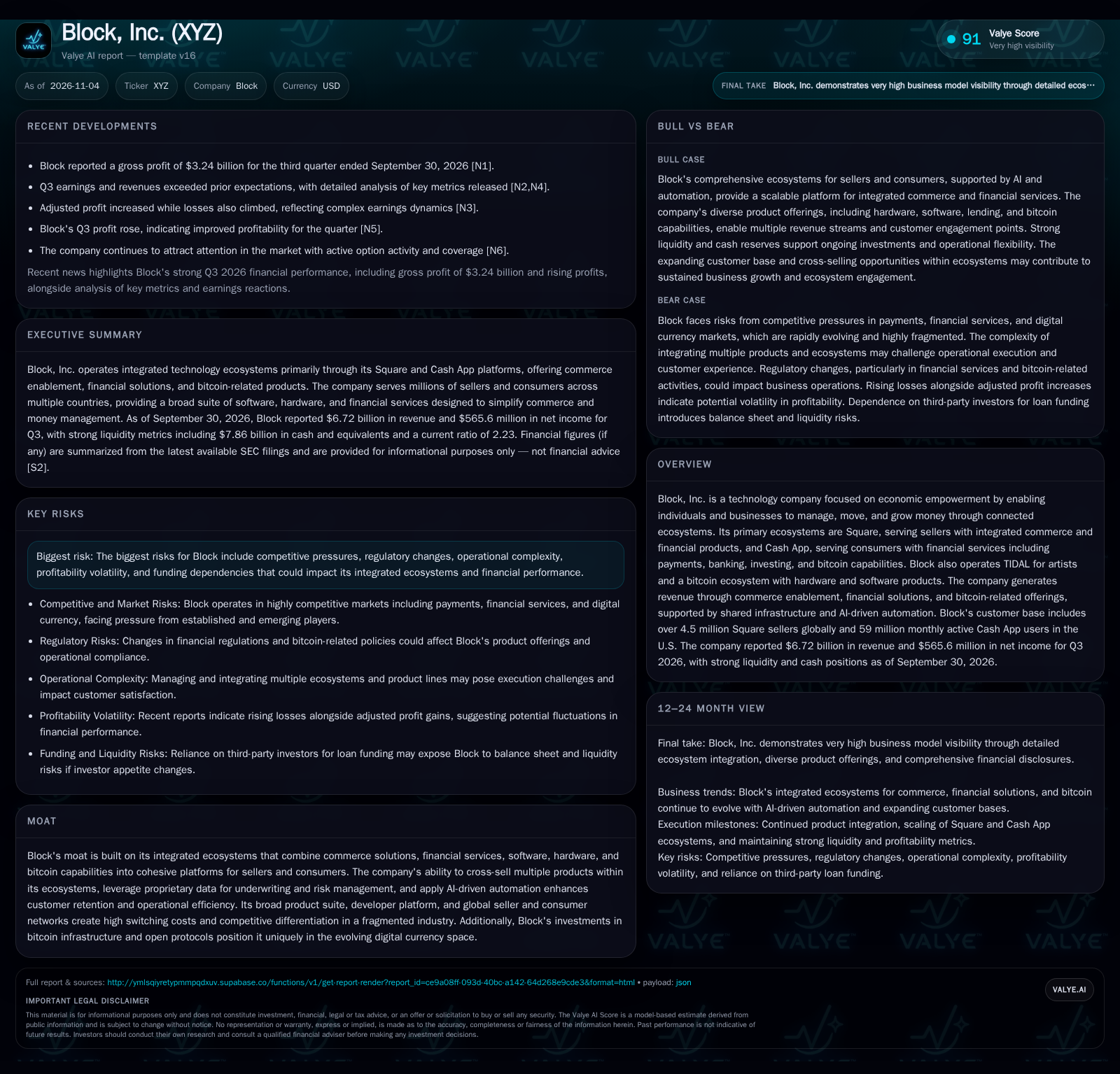
Block, Inc. posted $6.72B in Q3 2026 revenue and $565.6M net income, with notable gross profit growth and a large cash position [S2] [N1]. The Square and Cash App ecosystems have broad reach, serving over 4.5M sellers and 59M monthly active users, but rising losses amid strong adjusted profit signal underlying complexity [S1] [N3]. The company’s long-term trajectory will be shaped by its ability to cross-sell, maintain ecosystem stickiness, and manage risks from competition, regulation, and funding dependencies.
Block, Inc. continues to exemplify the ambition and complexity of a modern fintech platform, weaving together ecosystems for both businesses and consumers through Square and Cash App. The company’s Q3 2026 results highlight robust revenue and profit growth, but also reveal the tension between scale, product breadth, and the operational intricacies of serving millions of sellers and users. As Block presses forward with AI-driven automation, bitcoin integration, and a deepening suite of financial services, its ability to balance ecosystem growth with risk management and profitability will be decisive for its next phase.
Q3 2026: Scale, Profitability, and the Complex Earnings Mix
Block reported $6.72 billion in revenue and $565.6 million in net income for Q3 2026, with gross profit reaching $3.24 billion—outperforming expectations and marking a period of strong financial performance [S2] [N1] [N4]. Cash App’s base grew to 59 million monthly active users in the U.S. with $316 billion in inflows in 2025, while the Square ecosystem processed $250 billion for 4.5 million sellers globally [S1]. These metrics confirm Block’s scale on both the consumer and business sides.
Despite headline profit growth, news coverage notes that adjusted profit increases were accompanied by rising losses, suggesting a mixed profitability picture and underlying cost pressures [N3]. Block also ended Q3 with $7.86 billion in cash and equivalents and a current ratio of 2.23 [S2]. The company reported cash and liquidity metrics for the period; these figures do not by themselves establish operating runway, investment capacity, financial flexibility, or financing capacity.
How Block’s Ecosystem Model Drives Revenue—and Challenges Margin Expansion
Block’s economics are built around three main revenue streams: Commerce Enablement (payments, software, hardware, BNPL, TIDAL), Financial Solutions (lending, deposits, savings, payment acceleration), and the Bitcoin Ecosystem (bitcoin buy/sell and related products) [S1]. The Square platform generates revenue from transaction fees, hardware sales, and software subscriptions, while Cash App primarily monetizes through transaction fees, banking-related spreads, investing, and bitcoin trading.
The business model is characterized by high transaction volumes and a mix of fixed and variable costs. Payments and bitcoin trading are typically lower-margin, high-volume businesses, while software subscriptions, lending, and value-added services can carry higher margins but require ongoing investment in technology, compliance, and customer support. Notably, Square Lending is largely funded by third-party investors, which allows Block to scale credit offerings with less direct balance sheet risk, but exposes the company to shifts in investor appetite [S1].
Operating leverage is plausible as the ecosystem scales, particularly if Block can cross-sell multiple services to the same user or seller, thereby increasing ARPU and reducing customer acquisition costs over time. However, the complexity of integrating new products, maintaining regulatory compliance, and supporting bitcoin-related infrastructure could temper margin expansion, especially if loss rates in lending or other risk-based products rise.
Defensible Ecosystem or Commodity Platform? The Competitive Landscape for Block
Block’s main competitive advantage lies in its integrated ecosystems for sellers (Square) and consumers (Cash App), where multi-product offerings, cross-platform data, and embedded financial services create customer stickiness and higher switching costs. The breadth of its product suite—spanning hardware, software, payments, banking, and even music (TIDAL)—differentiates Block from single-point solutions or niche fintechs.
However, the payments and financial services markets remain highly fragmented and fiercely competitive, with incumbent banks, payment processors, neobanks, and large tech companies all vying for similar customers. Each of Block’s key verticals faces credible substitutes: traditional banks for lending and deposits, other payment networks for transaction processing, and alternative digital wallets for peer-to-peer transfers.
A potential source of defensibility is Block’s use of proprietary transaction data for underwriting and product personalization, which could improve risk management and enable more targeted cross-selling. Nevertheless, as new entrants leverage open banking, embedded finance, and AI-driven personalization, Block will need to continually invest to preserve its edge. Regulatory scrutiny, especially around bitcoin and lending, adds another layer of competitive complexity.
Deepening Ecosystem Engagement Unlocks Durable Growth
The most favorable scenario is one where Block succeeds in driving deeper engagement across both the Square and Cash App ecosystems. This would manifest as higher ARPU, increased cross-sell rates, and improved retention among both sellers and consumers. If the company can leverage AI-driven automation to streamline onboarding, underwriting, and customer support, operating costs per user could fall and margins expand.
Confirmation would come from sustained gross profit growth outpacing revenue, evidence of rising multi-product adoption rates, and declining customer acquisition costs. Additional signals would include growth in high-margin software and lending products, and continued expansion of the Cash App user base beyond its current demographic stronghold. If Block can maintain or accelerate net income growth even as it invests in bitcoin infrastructure and new product lines, this would further validate the upside case.
Falsification would be evident if ecosystem engagement metrics stagnate, if cross-sell rates fail to rise, or if margins compress due to competitive pricing and elevated risk costs.
Product Breadth Delivers Scale, but Margins Remain Under Pressure
The most plausible forward path is one where Block maintains strong top-line growth and ecosystem scale, but faces continued margin pressure due to the operational costs of supporting diverse product lines and the need to compete aggressively on price and innovation. The company is likely to see steady expansion in both Square and Cash App, with incremental ARPU gains and modest improvements in ecosystem engagement.
This scenario would be confirmed by ongoing revenue and gross profit growth, with net income fluctuating as Block invests in new capabilities and responds to regulatory or competitive shifts. Margins may remain volatile, reflecting the balance between high-volume, low-margin products (payments, bitcoin trading) and more profitable but riskier offerings (lending, software).
If Block’s losses continue to rise faster than gross profit or if liquidity begins to erode, this would signal downside risk to the base scenario.
Operational Complexity, Competitive Pressure, and Funding Risks Erode Profitability
A negative scenario could emerge if Block’s operational complexity outpaces its ability to integrate and manage its diverse platforms. Rising losses, as noted in recent quarters, may signal that the cost structure is becoming unwieldy, especially if competitive pricing compresses transaction margins or if risk costs in lending escalate.
Funding risk is a material concern: Square Lending is funded largely by third-party investors, and a pullback in investor appetite could constrain lending growth or force Block to take on more balance-sheet risk [S1]. Regulatory changes—particularly in crypto, lending, or payments—could also raise compliance costs or restrict product offerings.
Downside confirmation would come from a sustained rise in net losses, deterioration in liquidity metrics, or evidence of seller/consumer churn. A sharp slowdown in ecosystem growth or a regulatory action affecting core products would further validate the bear case.
Milestones and Metrics That Will Shape Block’s Ecosystem Thesis
Trends in gross profit and net income growth relative to revenue—sustained margin expansion would support the upside scenario.
ARPU and cross-sell rates within both Square and Cash App ecosystems, if disclosed, as evidence of deepening engagement and monetization.
Seller and consumer churn or retention rates, as these would indicate the stickiness and health of each ecosystem.
Growth and risk metrics for Square Lending, including loss rates and changes in third-party funding appetite, which would clarify funding and credit risk exposure.
Mix shift toward higher-margin software, lending, or subscription products versus lower-margin payments and bitcoin trading.
Regulatory developments affecting payments, lending, or bitcoin operations, and their impact on Block’s ability to launch or maintain products.
Liquidity and current asset trends, especially if net losses accelerate or if working capital needs rise materially.
Expansion or contraction of the Cash App user base beyond its core demographic, and penetration of new geographies or income segments, if disclosed.
Disclaimer: This is research-only, informational analysis and not investment advice. It may include AI-generated interpretation and general industry context. Always verify important details using primary sources.

Comments