
Transocean in Late 2026: Profitability Returns, Contract Awards Strengthen Outlook, and the Stakes of Offshore Scale
Transocean’s swing back to profitability and major new contract awards signal operational momentum in a volatile offshore drilling market. With a $5.8 billion merger pending and regulatory risks ever-present, the company’s economics and competitive dynamics hinge on contract execution, integration discipline, and the durability of offshore demand.
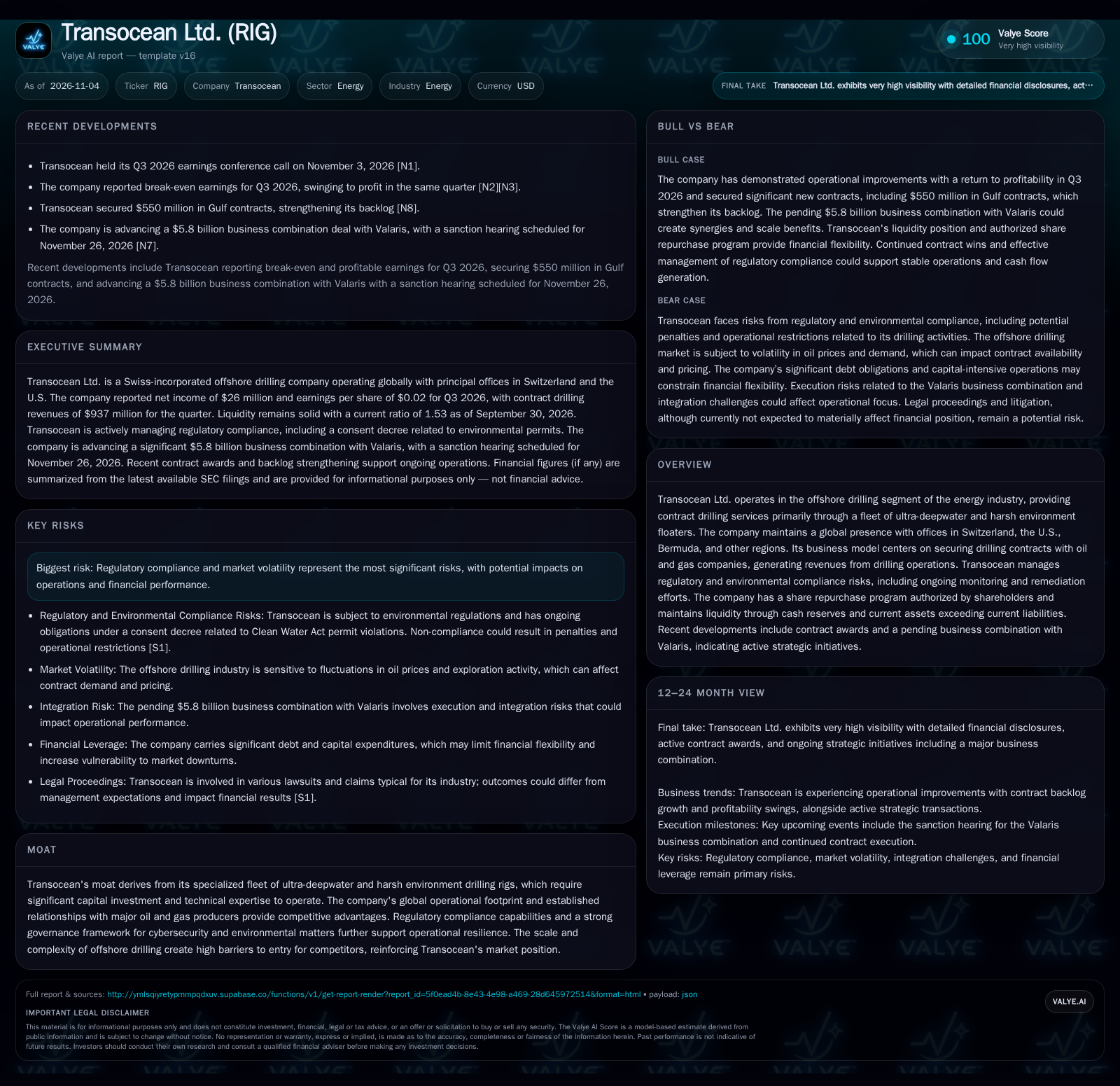
Transocean reported a return to profit in Q3 2026, secured $550 million in new Gulf contracts, and recent awards support near-term revenue potential. The pending $5.8 billion Valaris merger could reshape the offshore drilling landscape. Regulatory compliance, integration risks, and market volatility remain central to the company’s outlook. [S2] [N2] [N3] [N8]
Transocean’s Q3 2026 results mark a pivotal moment for the offshore drilling giant: a swing back to profitability after prior losses, underpinned by a surge in contract awards totaling $550 million in the Gulf. With the offshore drilling market still sensitive to oil price swings and regulatory scrutiny, Transocean’s pending $5.8 billion merger with Valaris could redefine its scale and economics—but only if integration hurdles are navigated successfully. The company’s near-term outlook now balances operational improvements, award-driven revenue potential, and persistent risks tied to compliance, leverage, and market demand.
Profitability Returns and Major Contract Awards Reshape Transocean’s Near-Term Outlook
Transocean swung to a net profit of $26 million in Q3 2026, reversing prior period losses and signaling an improvement in operating performance. Contract drilling revenues reached $937 million for the quarter, and operating income rose to $143 million. This positive inflection was complemented by the award of $550 million in new Gulf contracts, materially supporting the company’s revenue potential and demand visibility. The company’s liquidity profile remains stable, with $499 million in cash and a current ratio of 1.53 as of September 30, 2026. Most notably, a $5.8 billion business combination with Valaris is pending, with a sanction hearing scheduled for late November 2026, representing a potential strategic leap in fleet scale and market positioning. [S2] [N2] [N3] [N8] [N7]
How Transocean’s Contract Model Drives Cash Flow and Exposure
Transocean’s core business is providing offshore drilling services, typically through contracts with oil and gas producers. Revenue is primarily driven by dayrate agreements, where the company is paid a set fee per day of rig operation. This model can offer a degree of revenue visibility when the company secures significant new awards, such as the recent $550 million in Gulf contracts. However, the economics are capital-intensive: operating and maintenance costs for Q3 2026 totaled $589 million, with $146 million in depreciation and $62 million in G&A, underscoring the high fixed-cost base of maintaining and deploying a specialized rig fleet. [S2]
Operating leverage is significant—incremental revenue from higher utilization or improved dayrates can flow disproportionately to operating income once fixed costs are covered. Conversely, underutilization or contract gaps can quickly erode profitability. The company reported cash and liquidity metrics for the period; these figures do not by themselves establish operating runway, investment capacity, financial flexibility, or financing capacity.
Scale, Specialization, and Barriers to Entry in Offshore Drilling
Transocean’s competitive position is anchored in its fleet of ultra-deepwater and harsh environment floaters—assets that require significant capital, technical expertise, and operational track record to deploy efficiently. In the offshore drilling space, barriers to entry are high, as new entrants must invest billions to build or acquire comparable rigs and secure the trust of major oil companies.
The pending Valaris merger, if consummated, would create a combined entity with greater fleet scale, potentially improving contract leverage, operational synergies, and negotiating power with customers. However, the competitive landscape remains dynamic, with other global offshore drillers and regional players vying for contracts. Substitution risk from onshore or alternative energy sources is present but limited for deepwater projects, where technical complexity and resource size favor established offshore specialists.
Transocean’s established compliance protocols and global footprint also provide some insulation, but ongoing regulatory scrutiny and environmental risk could erode these advantages if not actively managed.
If Dayrates Rise and Integration Succeeds, Profits Could Compound
A favorable scenario for Transocean would see offshore oil and gas demand remain robust, supporting higher rig utilization and rising dayrates. If the company continues to secure large, multi-year contracts—like the recent $550 million Gulf awards—award momentum could underpin multi-quarter revenue potential and margin expansion. Successful completion and integration of the Valaris merger would be a catalyst for fleet optimization, cost synergies, and improved pricing power, especially if the combined company can rationalize underutilized assets and leverage operational best practices.
Evidence that would confirm this scenario includes a sustained increase in contract awards, rising average dayrates disclosed in future filings, margin improvement in subsequent quarters, and early progress on merger integration milestones. Signs of customer contract renewals at improved terms or new awards in premium markets would further support the bull case.
Offshore Recovery Is Uneven, but Contract Awards Provide a Buffer
The most plausible trajectory for Transocean over the next 12–24 months is one of cautious improvement: a solid pace of contract awards provides some earnings visibility, but the pace of offshore market recovery remains uneven and sensitive to oil price volatility and operator capital discipline. Operating margins may gradually improve as legacy contracts roll off and new awards (potentially at higher rates) are executed. However, cost inflation, maintenance downtime, and intermittent regulatory or legal headwinds could temper upside.
Evidence confirming this scenario would include steady but moderate revenue and margin growth, continued contract award momentum, and incremental progress on the Valaris integration. Conversely, a stall in contract awards, unexpected cost spikes, or delays in merger execution would suggest a bumpier path.
Regulatory Shocks or Demand Slumps Could Undercut Gains
A negative scenario would unfold if new regulatory penalties, operational incidents, or compliance failures trigger costly downtime or restrict drilling activity. Similarly, a sharp downturn in oil prices or a pullback in offshore project investment by oil majors could lead to underutilization of rigs, lower dayrates, and reduced contract awards. Integration missteps with Valaris—such as cultural clashes, system incompatibilities, or customer disruption—could further erode profitability and distract management.
Downside evidence would include a drop in contract awards, declining dayrates, unexpected legal or remediation expenses, or any disclosure of delays or cost overruns in the Valaris integration process. Liquidity strain or asset impairments would also signal that the adverse case is materializing.
Factors That Will Shape Transocean’s Post-Merger Economics
Contract award evolution: Quarterly updates on total contract awards, new awards, and contract renewals will reveal whether revenue visibility is improving or eroding.
Average dayrate trends: If disclosed, monitoring changes in average dayrates for new and existing contracts will help gauge pricing power and market tightness.
Integration milestones: Progress on the Valaris merger—such as announced cost synergies, fleet rationalization, and cultural integration—will be critical to realizing deal value.
Operating and maintenance cost trajectory: Trends in opex and maintenance spending, especially relative to revenue, will indicate whether operating leverage is improving.
Regulatory and legal developments: Any new fines, consent decrees, or compliance issues could impact operations and investor confidence.
Utilization rates: If disclosed, fleet utilization metrics will help test whether Transocean is maximizing asset deployment or facing idle capacity.
Customer concentration: Updates on major customer exposures or changes in the mix of counterparties would help assess revenue risk and negotiating leverage.
Disclaimer: This is research-only, informational analysis and not investment advice. It may include AI-generated interpretation and general industry context. Always verify important details using primary sources.

Comments