
Angel Oak Mortgage REIT After Brookfield: Securitization Flexibility Meets Non-QM Headwinds
A net loss and earnings miss in Q3 2026 highlight the challenge of generating risk-adjusted returns from non-QM mortgages—even with proprietary loan access and a new strategic backer. The durability of Angel Oak Mortgage REIT’s strategy now turns on portfolio adaptation, cost of funds, and credit performance in a volatile housing finance landscape.
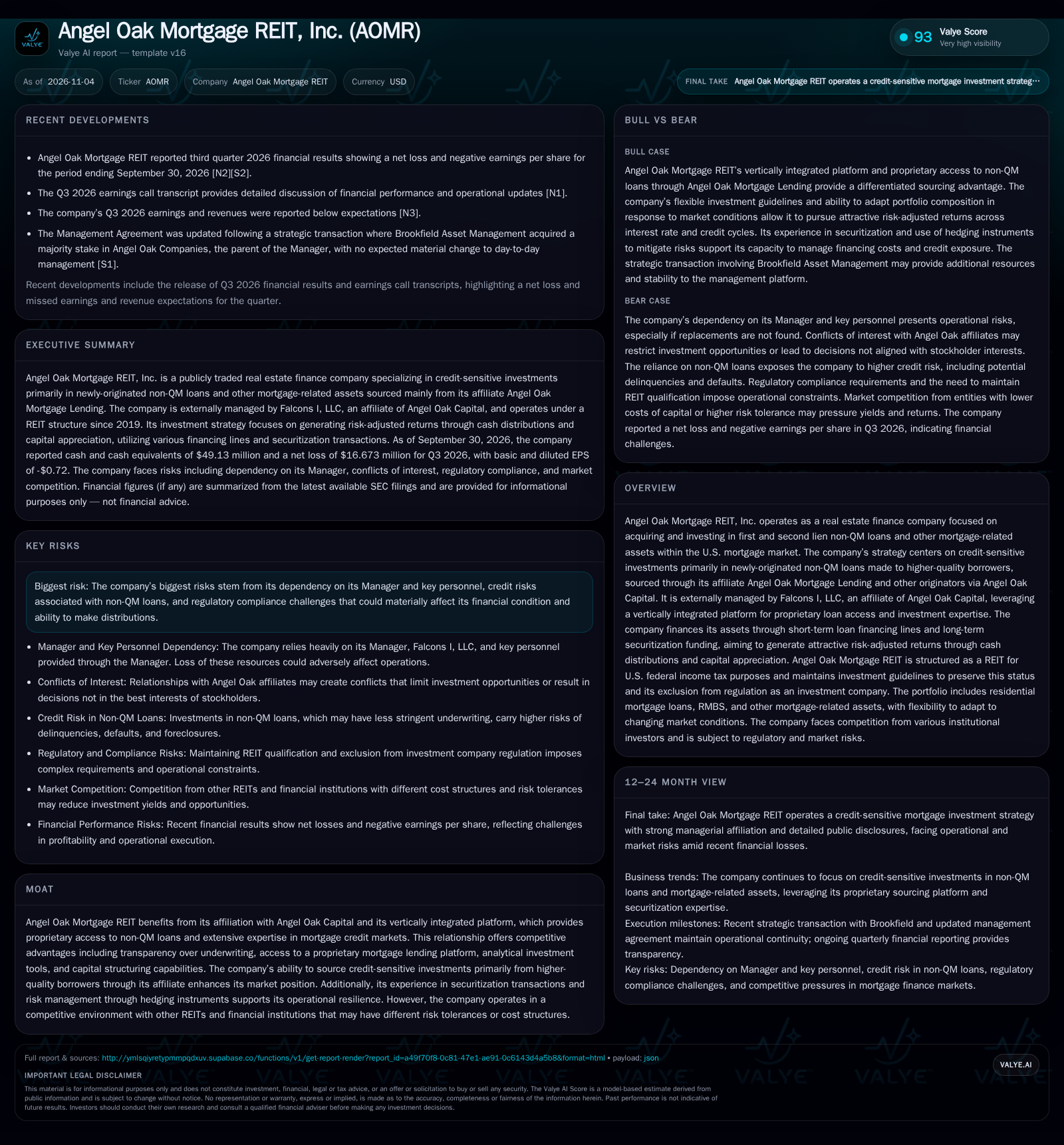
Angel Oak Mortgage REIT reported a net loss and missed Q3 2026 earnings estimates, despite maintaining proprietary access to non-QM loans and completing a strategic transaction bringing Brookfield Asset Management as majority owner of its manager’s parent. The company’s ability to generate attractive risk-adjusted returns hinges on managing credit risk, funding costs, and operational execution amid market competition and regulatory constraints. Near-term prospects depend on portfolio adaptation, cost control, and credit outcomes.
Angel Oak Mortgage REIT’s latest quarter underscores the inherent volatility in credit-sensitive mortgage investing. Despite proprietary access to non-QM loans and a vertically integrated platform, the company posted a sizable net loss and missed earnings targets in Q3 2026. The recent acquisition of a majority interest in its manager’s parent by Brookfield Asset Management signals potential strategic support, but the core challenge remains: can Angel Oak drive attractive risk-adjusted returns from non-QM mortgages in the face of rising competition, funding costs, and credit risks? The next phase will hinge on portfolio adaptation, execution discipline, and resilience through the cycle.
Recent Losses and Strategic Shifts Reshape the Investment Landscape
In Q3 2026, Angel Oak Mortgage REIT reported a net loss of $16.673 million and basic and diluted EPS of -$0.72, with earnings and revenues falling short of analyst expectations [N2] [N3] [S2]. This follows a period where the company’s $2.7 billion portfolio remained heavily weighted toward newly originated non-QM residential loans and RMBS as of December 2025. Financial results highlight the difficulty of extracting consistent returns from credit-sensitive mortgage assets amid volatile market conditions.
On the strategic front, Brookfield Asset Management completed its acquisition of a 51% stake in Angel Oak Companies, the parent of the REIT’s external manager, Falcons I, LLC, in October 2025. While management continuity is expected, this transaction introduces a new backer with substantial resources and scale [S1]. The immediate impact on day-to-day operations appears limited, but the Brookfield relationship could shape future funding, risk appetite, and portfolio strategy.
How Angel Oak Mortgage REIT Attempts to Generate Yield in a Non-QM World
Angel Oak Mortgage REIT’s business model is predicated on acquiring and holding first and second lien non-QM loans—mortgages that do not meet the Qualified Mortgage criteria but are often made to borrowers with strong credit profiles. The company sources these loans primarily through its affiliate, Angel Oak Mortgage Lending, leveraging its vertically integrated structure for proprietary access and, potentially, favorable pricing.
Revenue is driven by the interest earned on mortgage loans and RMBS, offset by funding costs, credit losses, and management/advisory fees. The company finances its assets through a mix of short-term warehouse lines and long-term securitizations. Securitization allows for non-recourse, fixed-rate funding, but exposes the company to market appetite for non-QM bonds and the risk of mark-to-market volatility.
Operating leverage is limited by the externally managed REIT structure: Angel Oak has no direct employees, and management fees are paid to its external manager, potentially capping margin expansion in strong markets. The company’s ability to deploy capital quickly into high-yielding assets is balanced by the need to maintain REIT status, manage complex regulatory constraints, and hedge interest rate and credit risk through derivatives.
Capital needs are ongoing: the company must continually access warehouse financing, execute securitizations, and manage liquidity for loan purchases and distributions. Credit losses on non-QM loans, especially in a housing downturn, can rapidly erode returns, while funding costs are sensitive to both interest rate and credit spread movements.
Proprietary Sourcing vs. Intense Competition: Where Angel Oak Stands
Angel Oak’s principal competitive advantage lies in its proprietary loan sourcing pipeline via Angel Oak Mortgage Lending and Angel Oak Capital. This vertical integration may provide access to higher-quality non-QM loans and deeper data on borrower profiles, potentially improving underwriting precision and portfolio performance.
However, the non-QM mortgage space is crowded. The company competes with other externally and internally managed mortgage REITs, specialty finance companies, private credit funds, and banks—some of which have access to cheaper funding or are willing to accept higher risk for yield. Larger peers may also have more diversified portfolios, greater scale in securitization, and better cost of capital.
Switching frictions for borrowers are low in a commoditized mortgage market, limiting pricing power. On the asset side, Angel Oak’s ability to source loans directly from affiliates could provide some protection against adverse selection, but conflicts of interest and regulatory scrutiny may constrain flexibility. The Brookfield tie-up could help with capital access and credibility, but does not alter the basic economics of credit risk and funding competition.
Technology substitution risk is modest for now: the core business remains mortgage origination and structuring, though digital underwriting and alternative credit models could alter sourcing and pricing dynamics over time.
If Portfolio Quality Holds and Brookfield Accelerates Scale
The most favorable scenario for Angel Oak Mortgage REIT would see credit performance stabilizing or improving, with delinquencies and defaults on non-QM loans remaining low. This outcome could be supported by disciplined underwriting, resilient housing prices, and a benign macroeconomic backdrop. Portfolio adaptation—shifting to higher-quality or better-priced loans as the market evolves—would also bolster returns.
Brookfield’s ownership of the manager’s parent could facilitate access to lower-cost capital, broader distribution for securitizations, and enhanced risk management infrastructure. If Angel Oak can leverage these advantages to expand its portfolio at attractive spreads while containing credit losses and funding costs, distributable income and book value could recover.
Confirmation would come from a return to positive net income, narrowing losses, and evidence of stable or improving credit metrics (e.g., low non-performing loan ratios, steady realized losses, favorable securitization execution). Falsification would be signaled by persistent losses, rising credit costs, or an inability to scale despite the Brookfield platform.
Navigating Credit Headwinds and Funding Costs: A Volatile Status Quo
The most plausible scenario is one of continued volatility in financial performance driven by fluctuating credit costs and funding expenses. Angel Oak is likely to remain dependent on its proprietary sourcing pipeline for deal flow, but faces ongoing pressure from market competition and regulatory constraints.
Book value may see gradual erosion if credit losses on non-QM loans remain elevated or if funding costs rise faster than asset yields. Securitization markets may remain open but at less favorable terms, compressing net interest margins. While Brookfield’s involvement could provide incremental strategic support, it may not fundamentally alter the company’s risk/return profile in the absence of a material shift in portfolio quality or market conditions.
Evidence for this scenario includes continued quarterly earnings volatility, moderate portfolio turnover, and only incremental improvement or deterioration in credit metrics. Falsification would require a sustained return to profitability and/or a step change in portfolio economics that outpaces sector peers.
When Credit Losses and Rising Funding Costs Collide
In an adverse scenario, credit performance deteriorates sharply—possibly due to a housing correction, rising borrower delinquencies, or a recessionary environment. Non-QM loans, by definition, carry higher risk, and even with proprietary sourcing, Angel Oak could face a spike in defaults and realized losses.
Simultaneously, if warehouse lenders or securitization buyers grow more risk-averse, funding costs could rise or access could tighten, forcing the company to sell assets at a loss or curtail new loan purchases. The externally managed structure could exacerbate margin pressure, as management fees remain fixed or rise even as distributable income falls.
Confirmation would come from further widening net losses, a sharp drop in book value, rising non-performing loan ratios, or a reduction in portfolio size due to asset sales or funding constraints. Falsification would require evidence of credit resilience and stable funding access even in a broader mortgage downturn.
What Will Prove Angel Oak’s Strategy: Portfolio, Credit, and Funding Levers
Quarterly net income (or loss) and EPS trends: A sustained return to positive earnings would support a recovery thesis.
Non-performing loan ratios and realized credit losses: If disclosed, these would clarify the true credit risk in the non-QM portfolio.
Cost of funds versus asset yield spread: Compression here would signal margin pressure; widening would suggest improved economics.
Securitization execution and proceeds: The frequency, size, and pricing of new securitizations will reveal both asset demand and funding health.
Portfolio composition shifts: Changes in loan type, geography, or borrower profile could indicate management’s adaptation to market risks.
Book value per share: Serves as a proxy for the underlying asset value and loss absorption capacity.
Impact from Brookfield relationship: Any disclosed changes in capital structure, funding access, or strategic initiatives tied to Brookfield would test the value-add of the new majority owner.
Management/advisory fee structure: If adjusted, this could affect operating leverage and alignment with shareholders.
Disclaimer: This is research-only, informational analysis and not investment advice. It may include AI-generated interpretation and general industry context. Always verify important details using primary sources.

Comments