
Community Healthcare Trust: Disciplined Acquisition, Tenant Diversification, and the Levers of Healthcare REIT Sustainability
Community Healthcare Trust’s disciplined off-market acquisition strategy, diversified tenant base, and conservative balance sheet underlie its recent operational outperformance. The challenge: balancing geographic concentration and tenant credit risk with continued accretive growth in an evolving healthcare landscape.
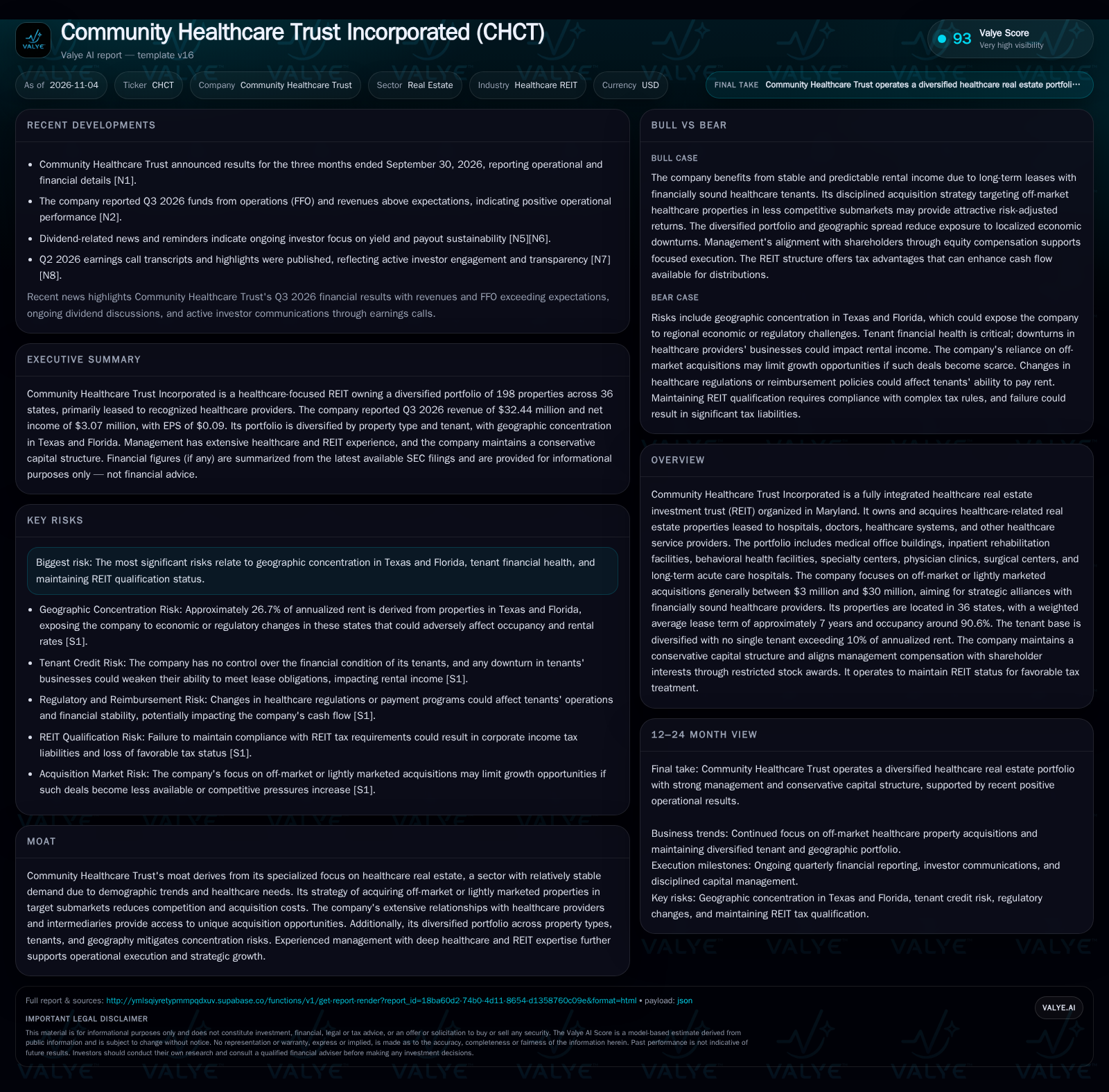
Community Healthcare Trust (CHCT) delivered Q3 2026 revenues and FFO above expectations, supported by a diversified healthcare real estate portfolio of 198 properties across 36 states and a conservative capital structure. The company’s focus on off-market acquisitions and long-term leases with well-known healthcare providers creates stable cash flows, but geographic concentration in Texas and Florida and tenant health remain central risks. The company’s ability to source accretive deals and maintain high occupancy will determine its long-term resilience and distribution sustainability. [S1] [S2] [N1] [N2]
Community Healthcare Trust Incorporated (CHCT) stands out in the healthcare REIT sector for its disciplined off-market acquisition strategy and its commitment to tenant and property-type diversification. The company’s Q3 2026 results—surpassing revenue and FFO expectations—underscore the resilience of its model, even as geographic concentration in Texas and Florida and the evolving fortunes of healthcare tenants introduce persistent risks. The central question for investors is whether CHCT can continue to source accretive deals and sustain high occupancy in an environment where competition for quality healthcare assets is rising and regulatory, reimbursement, and tenant pressures remain in flux.
Recent Performance: Surpassing Expectations on Revenue and FFO
Community Healthcare Trust reported Q3 2026 revenues of $32.44 million and net income of $3.07 million, with basic and diluted EPS of $0.09 per share. Both revenue and funds from operations (FFO) exceeded consensus expectations, reinforcing the company’s operational momentum. The portfolio as of December 31, 2025, consisted of 198 healthcare real estate properties across 36 states, totaling approximately 4.5 million square feet, with a weighted average lease term of about 7 years and occupancy of approximately 90.6% (excluding assets held for sale) [S1] [S2] [N1] [N2].
The tenant roster is both broad and deep, with no single tenant accounting for more than 10% of annualized rent; the largest tenant, US Healthvest, represents 7.3%. Despite this diversification, geographic concentration remains a factor, with Texas and Florida together accounting for 26.7% of annualized rent [S1]. The company’s capital structure remains conservative, with a debt-to-total capitalization ratio of 42.9% and over $500 million in revolving credit and term loans as of year-end 2025 [S1].
How CHCT’s Acquisition and Lease Model Shapes Its Cash Flow Profile
Community Healthcare Trust’s core business model relies on acquiring healthcare-related real estate properties and leasing them to hospitals, clinics, and healthcare service providers—often under long-term, triple-net or modified gross leases. These contracts typically shift most property-level expenses (taxes, insurance, maintenance) to tenants, resulting in predictable, annuity-like cash flows and limiting variable cost exposure.
The company targets acquisitions primarily through off-market or lightly marketed deals in the $3 million to $30 million range, aiming to avoid competitive bidding and thus potentially securing higher yields. This strategy may allow CHCT to acquire properties at cap rates above those available in auction-driven processes, though the availability of such deals is inherently cyclical and can be constrained by rising competition or market froth.
Revenue mix is diversified by property type: medical office buildings (36% of annualized rent), inpatient rehabilitation (21.2%), acute inpatient behavioral (12.6%), and other specialty assets. This diversity can help balance exposure to individual healthcare subsectors, but each asset type’s economics are ultimately tied to the financial strength and reimbursement environment of its tenant base.
Operating leverage in the REIT model is typically limited, as property-level NOI growth depends on contractual rent escalations and periodic acquisition activity. The cited source reports dividend-related activity; that disclosure alone does not establish dividend-policy continuity, management confidence, or a material constraint on capital flexibility. The company’s conservative leverage profile may support future acquisition capacity but can also limit aggressive expansion relative to more levered peers.
Tenant Diversification, Off-Market Sourcing, and the Shifting Healthcare REIT Landscape
CHCT’s primary competitive advantage stems from its focus on off-market acquisitions and its relationships with established healthcare providers. By targeting less competitive transaction channels, the company may secure favorable pricing and reduce the risk of overpaying for assets. Its tenant diversification—no single tenant above 10% of rent and a broad mix of property types—reduces dependence on any one operator or sector.
However, these advantages are counterbalanced by several forces. First, geographic concentration in Texas and Florida exposes the portfolio to regional regulatory or economic shocks. Second, the broader healthcare REIT sector is crowded, with larger players (such as Welltower, Ventas, and Healthcare Realty Trust) able to access cheaper capital and sometimes willing to accept lower yields for scale or strategic reasons. Third, the rise of value-based care and outpatient migration could shift demand across asset types, potentially impacting legacy portfolios.
Switching costs for tenants are moderate—relocation is expensive and disruptive for healthcare facilities, but not impossible. Retention is generally high, but tenant credit quality and reimbursement risk are critical underwriting variables, particularly as healthcare providers themselves face margin and policy pressures.
If Off-Market Acquisitions Remain Robust and Tenant Health Holds, Growth Could Compound
The most favorable scenario for CHCT is one in which the company continues to source a steady stream of accretive, off-market healthcare property deals, maintaining a portfolio occupancy above 90% and benefiting from stable or growing rent rolls. This outcome would likely require that competitive intensity for its target deal size remains manageable, and that healthcare providers—especially its largest tenants—retain financial strength.
Evidence that would confirm this scenario includes consistent quarterly revenue and FFO outperformance, high tenant retention rates, and the announcement of new acquisitions at attractive cap rates relative to sector averages. Additionally, limited tenant defaults and continued geographic diversification would be strong positive signals.
Sustained Portfolio Performance Amid Competitive and Regulatory Headwinds
The most plausible mid-term scenario is continued stable performance, with modest net portfolio growth as CHCT balances acquisition opportunities against rising competition and periodic tenant or regulatory stress. Occupancy may fluctuate within a narrow band around 90%, with contractual rent escalations supporting low- to mid-single-digit NOI growth. Dividend payouts likely remain steady, but upside is limited by the pace of new accretive deals and the need to avoid tenant concentration.
Confirmation of this scenario would come from quarterly results showing steady revenues and FFO, acquisition activity consistent with historical levels, and a lack of major tenant credit events or regulatory disruptions. Signs of increased acquisition competition, more selective dealmaking, or slower portfolio growth would further support the base case.
Acquisition Pipeline Dries Up or Tenant/Geographic Exposures Trigger Earnings Volatility
A negative scenario could unfold if CHCT’s off-market acquisition pipeline shrinks—either because competitors move down-market, asset owners shift to auctions, or cap rates compress to unattractive levels.
Alternatively, a material tenant default—particularly among top tenants—or a regional economic or regulatory event in Texas or Florida could reduce occupancy, increase bad debt, or force rent concessions. Signs that would confirm this scenario include a shrinking deal pipeline, declining occupancy, tenant payment issues, or a dividend cut. Additionally, heightened leverage in the absence of FFO growth could signal mounting risk.
Validating the Sustainability of CHCT’s Growth and Distribution Model
Quarterly acquisition volume and average cap rates on new deals—if disclosed—would help assess whether CHCT can continue to source attractive off-market opportunities.
Occupancy rate trends, especially any sustained move below 90%, would signal shifts in underlying tenant demand or credit health.
Tenant payment status and any reported defaults or rent concessions, particularly among top five tenants, would provide early warning of credit deterioration.
Geographic rent concentration—changes in the percentage of rent derived from Texas and Florida—would help monitor concentration risk.
Dividend payout ratio relative to FFO and AFFO, and any management commentary on distribution sustainability, would be critical for evaluating long-term shareholder returns.
Balance sheet leverage metrics and liquidity capacity, especially if acquisition or tenant stress triggers higher debt usage.
Regulatory developments in key states or federal healthcare reimbursement policy changes that could impact tenant solvency or property demand.
Management’s disclosure on the competitive landscape for healthcare property acquisitions—greater detail on deal pipeline and sourcing channels would help test the resilience of the company’s strategy.
Disclaimer: This is research-only, informational analysis and not investment advice. It may include AI-generated interpretation and general industry context. Always verify important details using primary sources.

Comments