
Ibotta’s Performance Network: Data-Driven Promotions and the Stakes of Scaling CPG Incentive Platforms
Ibotta’s success-based digital promotions model connects CPG brands, major retailers, and consumers through its Ibotta Performance Network, leveraging real-time analytics and AI tools. The company’s network effects, integration breadth, and campaign measurement capabilities are critical to its value proposition, but execution risks around offer supply, partner retention, and sustained profitability remain central to its future trajectory.
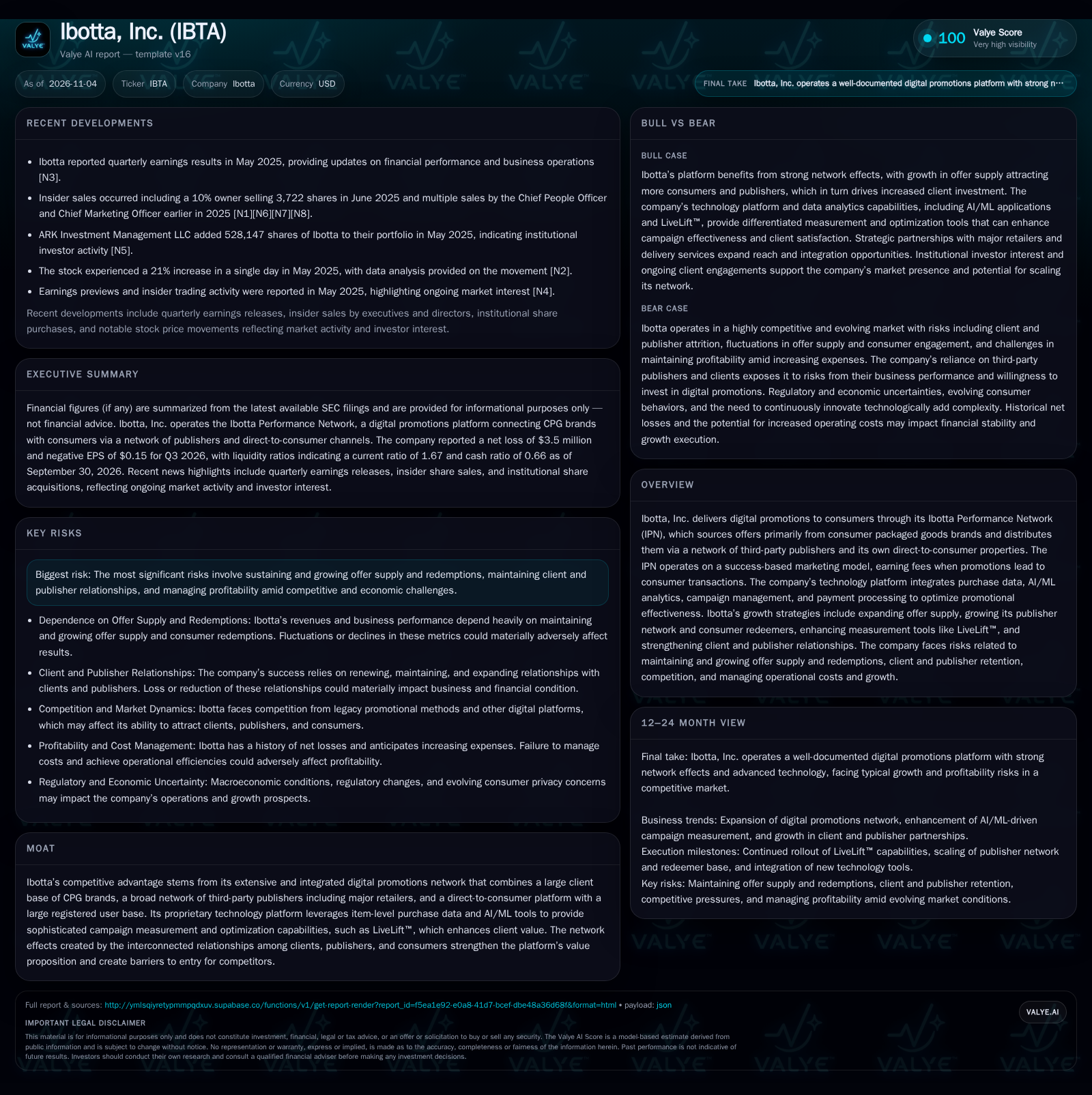
Ibotta operates a digital promotions platform linking CPG brands to consumers via a network of publishers and direct-to-consumer channels, earning fees when promotions drive transactions. As of late 2026, it served over 900 clients, including major retailers, and had launched advanced analytics like LiveLift™ to optimize campaign performance. Despite a robust technology stack and partnerships, Ibotta reported a net loss for Q3 2026 and faces competitive and cost-management risks even as it looks to scale its network and deepen data-driven value for clients. [S1] [S2]
Ibotta, Inc. sits at the intersection of consumer packaged goods (CPG) marketing and retail technology, orchestrating a digital promotions platform that connects brands, major retailers, and millions of consumers through its Ibotta Performance Network (IPN). Its business hinges on delivering measurable, data-driven incentives—transforming traditional couponing into a dynamic, success-based digital channel. While the company’s technology stack and publisher reach offer the potential for network effects and scalable economics, recent financials show ongoing net losses, spotlighting the challenge of balancing growth, client retention, and cost discipline in a fiercely competitive landscape. The next phase for Ibotta will test whether its integration advantages and analytics capabilities can translate into durable profitability and deeper client reliance.
Recent Performance and Network Expansion: Where Ibotta Stands Now
As of December 31, 2025, Ibotta worked with over 900 clients representing more than 3,100 CPG brands, distributing digital offers through a broad publisher network that includes retail giants like Walmart, Dollar General, Instacart, and DoorDash. The company’s Ibotta Performance Network (IPN) operates on a success-based model: Ibotta earns fees only when a promotion leads to a consumer transaction, aligning incentives with client outcomes. In 2025, the company introduced LiveLift™, an analytics suite providing clients with incremental sales and cost-per-incremental-dollar insights to optimize campaign spend. Despite these platform advances, Ibotta reported a net loss of $3.5 million for Q3 2026, with $149.9 million in cash and a current ratio of 1.67 as of September 30, 2026. These facts highlight a business with considerable network scale and technology investment, but one still contending with negative earnings and the need to demonstrate sustainable operating leverage. [S1] [S2]
How Ibotta’s Digital Promotions Model Could Scale Profitability
Ibotta’s core economics rest on a performance-based marketing model: CPG brands pay Ibotta when a digital promotion drives a verified consumer purchase, rather than for impressions or clicks. This success-based structure may attract brands seeking ROI accountability and could lead to higher client loyalty if incremental sales are clearly demonstrated. Revenue growth, therefore, depends on expanding both the volume of offers (supply) and the rate of consumer redemptions (demand), as well as optimizing the economics per transaction.
The platform’s cost structure is likely characterized by significant fixed costs—technology development, data processing, campaign management, and compliance—while variable costs scale with redemption volume (e.g., cash-back payouts, transaction processing, and publisher revenue shares). As the network scales, operating leverage could emerge if incremental revenue outpaces the growth in variable and overhead costs.
LiveLift™ and the broader analytics stack are intended to drive higher campaign conversion rates and justify premium pricing or higher client spend per promotion. If client brands perceive measurable, incremental sales lift, they may allocate larger budgets to Ibotta versus legacy couponing or less transparent digital channels. However, the company’s history of net losses and anticipated expense growth suggest that reaching breakeven will require not only network expansion but also disciplined cost management and improving unit margins. [S1] [S2]
Capital needs are moderate for a digital platform of this type, but growth ambitions—whether through additional publisher integrations, international expansion, or deeper AI/ML investment—could require periodic capital infusions or reinvestment of operating cash flows.
Network Effects, Technology Differentiation, and the Battle for CPG Brand Loyalty
Ibotta competes in a crowded and rapidly evolving promotions market, facing direct competition from other digital rebate platforms, retailer-integrated rewards programs, and legacy coupon providers. Its most defensible asset is the breadth and integration of the Ibotta Performance Network, which links a large pool of CPG clients with major retail and e-commerce publishers—creating two-sided network effects. The more brands and offers on the platform, the more valuable it becomes for publishers and consumers, and vice versa.
The company’s proprietary technology stack, including item-level purchase tracking, AI/ML-driven campaign optimization, and real-time analytics (e.g., LiveLift™), could provide a measurement advantage over less sophisticated rivals. If these tools consistently deliver actionable insights and prove incremental sales, Ibotta can strengthen client relationships and potentially justify a pricing premium.
However, counterforces are significant. CPG brands and retailers can test multiple digital promotions partners or develop in-house solutions, limiting lock-in. Publisher partners—especially large retailers—may also have bargaining power, given their own data assets and consumer reach. Substitutes abound, from digital circulars and retailer apps to social media-driven promotions. Ultimately, Ibotta’s moat depends on sustaining differentiated analytics, seamless integrations, and a critical mass of both offer supply and publisher reach. [S1]
If Data-Driven Value Unlocks Brand Spend and Expands the Platform
The most favorable scenario for Ibotta is one in which its analytics and network effects drive a virtuous cycle: measurable incremental sales from LiveLift™ and similar tools convince more CPG brands to increase promotional budgets, which in turn attracts additional publishers and consumers. As the offer supply and redeemer base grow, the platform’s value proposition is reinforced, making it harder for brands or publishers to switch.
Confirmation of this scenario would come from sustained revenue growth outpacing expense growth, improved gross and operating margins, and clear evidence of rising client spend per brand or campaign. Additional signals would include new major publisher integrations, expanded categories beyond grocery and general merchandise, and public endorsements or case studies from leading CPG brands highlighting measurable ROI from Ibotta campaigns.
Falsification would be indicated by stagnant or declining offer supply, client churn, or if incremental sales lift metrics fail to drive higher brand spend. A lack of new publisher partnerships or the launch of competitive in-house retailer platforms could also undermine the upside thesis.
Platform Growth Continues, but Profitability Remains a Moving Target
The most plausible trajectory for Ibotta is moderate network expansion—steady growth in both CPG brand participation and publisher reach—paired with incremental improvements in analytics and campaign measurement. The company may continue to grow its top line as more brands and retailers adopt digital promotions and seek measurable marketing spend, particularly as legacy couponing methods decline in relevance.
However, operating losses may persist in the near term, given ongoing investments in technology, data infrastructure, and publisher incentives. Margins may gradually improve if the company can drive higher offer redemption rates and increase the mix of higher-margin, data-rich campaigns, but competitive pricing pressure and the need to share economics with large publishers may cap near-term profitability.
Evidence confirming this base scenario would be continued (but not accelerating) growth in client and publisher numbers, modest improvement in net loss or operating margin, and periodic product enhancements. Falsification would come from a sudden reversal in client or publisher relationships, a noticeable deterioration in core redemption metrics, or a sharp spike in operating costs relative to revenue.
Attrition and Cost Pressures Threaten the Network’s Economics
A negative scenario for Ibotta would involve a combination of offer supply stagnation (or contraction), publisher or client attrition, and escalating costs. If large CPG brands reduce promotional budgets or shift spend to alternative channels—perhaps due to insufficient ROI evidence or better terms from rivals—Ibotta could see a decline in offer volume and redemptions. Simultaneously, if major publishers (especially retailers) demand higher revenue shares, develop competing platforms, or exit the network, the perceived value of the IPN could diminish rapidly.
On the cost side, rising expenses for technology, compliance, or publisher incentives—without a corresponding lift in revenue—would deepen operating losses. Regulatory changes (e.g., around data privacy or digital marketing) could introduce further compliance costs or restrict targeting capabilities.
Evidence confirming this scenario would include negative growth in offer supply or redeemers, high-profile client or publisher exits, widening net losses, and signs of price or margin erosion. Falsification would require stabilization or reversal of these trends, with renewed client and publisher engagement.
What Will Prove Whether Ibotta’s Platform Can Scale and Sustain Profits?
Quarterly growth in total offer supply and redemption rates—if disclosed—would help test the thesis that Ibotta is successfully scaling both sides of its network.
Client retention and expansion rates among CPG brands, particularly in terms of average spend per brand or per campaign.
The number and breadth of active publisher integrations, including the addition (or loss) of major retail or delivery partners.
Adoption and measured impact of LiveLift™ and related analytics tools—evidence of incremental sales lift translating to higher client budgets.
Gross and operating margin trends, especially the relationship between revenue growth and operating expense growth.
Any regulatory or contractual developments that could affect data access, consumer privacy, or digital promotion economics.
Competitive launches or changes in publisher partner strategies that could signal shifts in bargaining power or platform relevance.
Disclaimer: This is research-only, informational analysis and not investment advice. It may include AI-generated interpretation and general industry context. Always verify important details using primary sources.

Comments