
PACS Group’s Acquisition Playbook: Integration, Quality, and the Stakes of Scale in Skilled Nursing
PACS Group, Inc. is leveraging disciplined acquisitions and a locally empowered operating model to drive above-industry occupancy and quality in the fragmented US skilled nursing sector. Sustaining this outperformance will hinge on integration execution, regulatory navigation, and the evolving economics of government reimbursement.
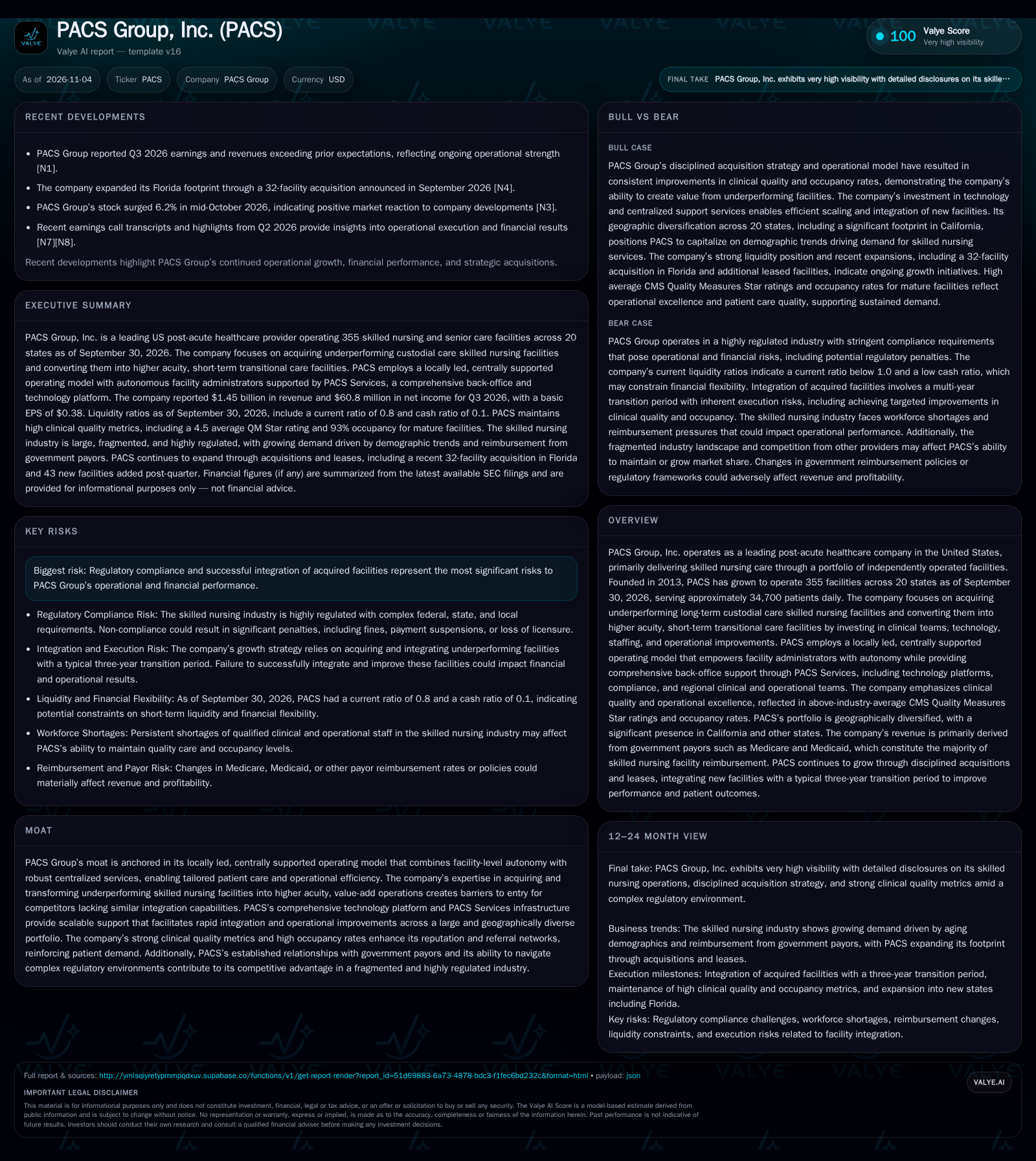
PACS Group, Inc. operates 355 post-acute care, assisted living, and independent living facilities across 20 states, reporting Q3 2026 revenue of $1.45 billion and net income of $60.8 million. Its strategy centers on acquiring and transforming underperforming facilities, supported by a distinctive blend of local autonomy and centralized services. The company’s high occupancy and clinical quality ratings outpace industry averages, but future performance will depend on integration of recent acquisitions, reimbursement stability, and management of regulatory and workforce risks. [S2] [N1] [N4]
PACS Group, Inc. stands out as one of the largest and most operationally ambitious players in the US skilled nursing sector, having built a 355-facility portfolio spanning 20 states by September 2026. Its strategy is rooted in acquiring underperforming long-term care sites, elevating them to higher-acuity, short-stay transitional care operations, and driving operational improvement through a balance of local autonomy and centralized support. The company’s above-average occupancy and clinical quality ratings underscore its ability to add value post-acquisition, but rapid portfolio expansion and heavy reliance on government payors bring execution, regulatory, and reimbursement risks into sharp focus. PACS’s future will depend on its integration discipline, ability to maintain quality at scale, and the evolution of healthcare funding and compliance landscapes. [S2] [N4]
Recent Expansion, Quality Metrics, and the Balance Sheet: What’s Changed for PACS Group
As of September 30, 2026, PACS Group operated 355 facilities serving about 34,700 patients daily, having recently completed a 32-facility acquisition in Florida and added 43 additional facilities through leases. This expansion materially increases the company’s geographic reach and revenue base, with Q3 2026 revenue at $1.45 billion and net income of $60.8 million. Occupancy rates for mature facilities reached 93%, while average CMS Quality Measures Star ratings hit 4.5, both well above industry norms. These facts matter because they underscore PACS’s ongoing growth and operational outperformance, but also raise questions about integration risk and potential financial flexibility as the company absorbs a larger, more complex portfolio. [S2] [N1] [N4]
How PACS Converts Underperformance into Value: Economics of Acquisition-Led Growth
PACS’s business model is predicated on acquiring underperforming skilled nursing facilities—often with low occupancy and subpar quality scores—and transforming them into higher-acuity, short-stay transitional care centers. This conversion, if successful, allows PACS to drive both higher revenue per bed and improved operating margins, as short-term, higher-acuity stays typically command better reimbursement rates than long-term custodial care. The company’s locally led, centrally supported model delegates operational autonomy to facility administrators, incentivized through compensation tied to quality and financial outcomes, while leveraging centralized back-office functions and technology to manage compliance, procurement, and analytics.
The economics are shaped by several forces: (1) pricing is largely dictated by government payors (about 72% of revenue from Medicare/Medicaid), so volume and acuity mix are key levers; (2) fixed costs are substantial, including facility leases, staffing, and compliance, but operational leverage can be realized as occupancy and acuity improve; (3) working capital intensity is high, with a need to manage receivables from government programs and pay suppliers; (4) capital needs are ongoing for facility upgrades, technology investment, and acquisition outlays. While margin expansion is possible through successful turnarounds, the multi-year integration period (typically three years per facility) means that returns are delayed and subject to execution risk.
Fragmented Industry, Regulatory Barriers, and What Sets PACS Apart
The US skilled nursing sector remains highly fragmented, with roughly 15,000 facilities nationwide and many small, single-site operators. PACS’s scale—now among the largest by facility count—offers potential advantages in procurement, technology deployment, and negotiating with payors, but does not guarantee pricing power given the dominance of government reimbursement. The company’s locally led, centrally supported model, with regional vice presidents overseeing clusters of facilities, is designed to balance local responsiveness with system-wide best practices and compliance.
Barriers to entry in the industry are significant due to regulatory complexity, capital requirements, and the need for clinical quality to secure referrals and maintain occupancy. PACS’s strong average CMS QM Star ratings and 93% occupancy for mature facilities suggest it is outperforming the typical operator. However, competitive threats remain from regional chains, hospital-owned post-acute networks, and emerging models such as home health and outpatient rehabilitation, which could divert patient volume away from traditional SNFs.
PACS’s moat is arguably its integration playbook and ability to rapidly uplift underperforming assets, but this advantage is only durable if the company can replicate clinical and operational improvements at scale without diluting quality or running afoul of compliance requirements.
If Integration and Quality Hold, PACS Could Redefine Scale Economics in Skilled Nursing
The most favorable scenario for PACS hinges on its ability to consistently execute its acquisition and integration strategy, rapidly improving clinical outcomes and occupancy at newly acquired sites while maintaining high standards in its mature portfolio. If the company can compress the typical three-year transition period, or achieve greater-than-expected improvements in reimbursement mix (for example, increasing the share of higher-paying short-term stays), operating margins could expand meaningfully.
Further, if PACS’s technology platform and back-office services drive measurable reductions in administrative costs or compliance incidents, the company could realize both cost and risk advantages over smaller peers. Evidence that would confirm this scenario includes sustained or rising occupancy and CMS Star ratings across both mature and recently acquired facilities, improving margins, and operating cash flow outpacing acquisition spending. Additional signs would include successful integration of the 32 Florida acquisitions and the 43 leased facilities with minimal disruption or regulatory setbacks. [S2] [N4]
Maintaining Outperformance Amid Expansion and Industry Headwinds
The most plausible trajectory is that PACS continues to grow through acquisitions, but faces periodic integration challenges as it absorbs a larger and more complex portfolio. Occupancy and quality metrics for mature facilities are likely to remain above industry averages, but new acquisitions may lag during the initial transition phase, keeping blended margins only modestly above sector norms.
Revenue growth should track portfolio expansion—especially as demographic trends drive demand—but margin improvement may be offset by rising labor costs, regulatory compliance expenses, and occasional reimbursement headwinds.
Evidence supporting this scenario would include stable or slightly improving blended occupancy and quality metrics, continued but decelerating margin gains, and regular incremental integration milestones. Early warning signs would be significant slippage in new facility performance, regulatory citations, or a need to slow acquisition activity to preserve cash. [S2]
Where Integration Falters or Funding Tightens: The Risks of Overreach
A negative scenario could develop if PACS’s rapid expansion outpaces its ability to integrate new facilities, leading to declining quality scores, regulatory penalties, or occupancy erosion—particularly in recently acquired or leased properties. If workforce shortages intensify or if the company fails to recruit and retain skilled administrators and clinical staff, the local empowerment model could break down, eroding both performance and reputation.
On the financial side, a significant reimbursement policy change or payment delay from government payors could stress the company’s already thin liquidity, forcing asset sales, acquisition pauses, or emergency financing on unfavorable terms. Evidence supporting this scenario would include a drop in CMS Star ratings, occupancy falling below industry benchmarks, restatements or regulatory fines, or public disclosure of cash flow shortfalls. [S2]
Milestones That Will Reveal Whether PACS Can Sustain Its Skilled Nursing Edge
Occupancy rates for both mature and newly acquired facilities—particularly in Florida and among the 43 recently leased sites—would help test whether PACS can replicate its outperformance at scale.
Average CMS Quality Measures (QM) Star ratings by facility cohort (mature vs. new) would clarify if the integration playbook sustains clinical quality.
Operating and free cash flow relative to acquisition and capital expenditure outlays would indicate whether the business is self-funding its growth.
Turnaround timelines for newly acquired facilities—if disclosed—would show if PACS is compressing the typical three-year improvement cycle.
Staff turnover and administrator retention rates, especially at new sites, would reveal the resilience of the local empowerment model.
Incidence and severity of regulatory citations or fines would be a leading indicator of compliance execution and risk.
Blended reimbursement mix (Medicare vs. Medicaid vs. private pay) and any shifts in payor policy or rate changes would help assess exposure to external shocks.
Facility-level margin and contribution data—if disclosed—would allow assessment of whether operational improvements are translating into sustainable economics.
Disclaimer: This is research-only, informational analysis and not investment advice. It may include AI-generated interpretation and general industry context. Always verify important details using primary sources.

Comments