
Columbus McKinnon in 2026: Operational Momentum, Profitability Hurdles, and the Stakes of Integration
Columbus McKinnon’s recent quarter delivered revenue and earnings above expectations with raised guidance, but a net loss and integration demands highlight the tension between operational progress and profitability.
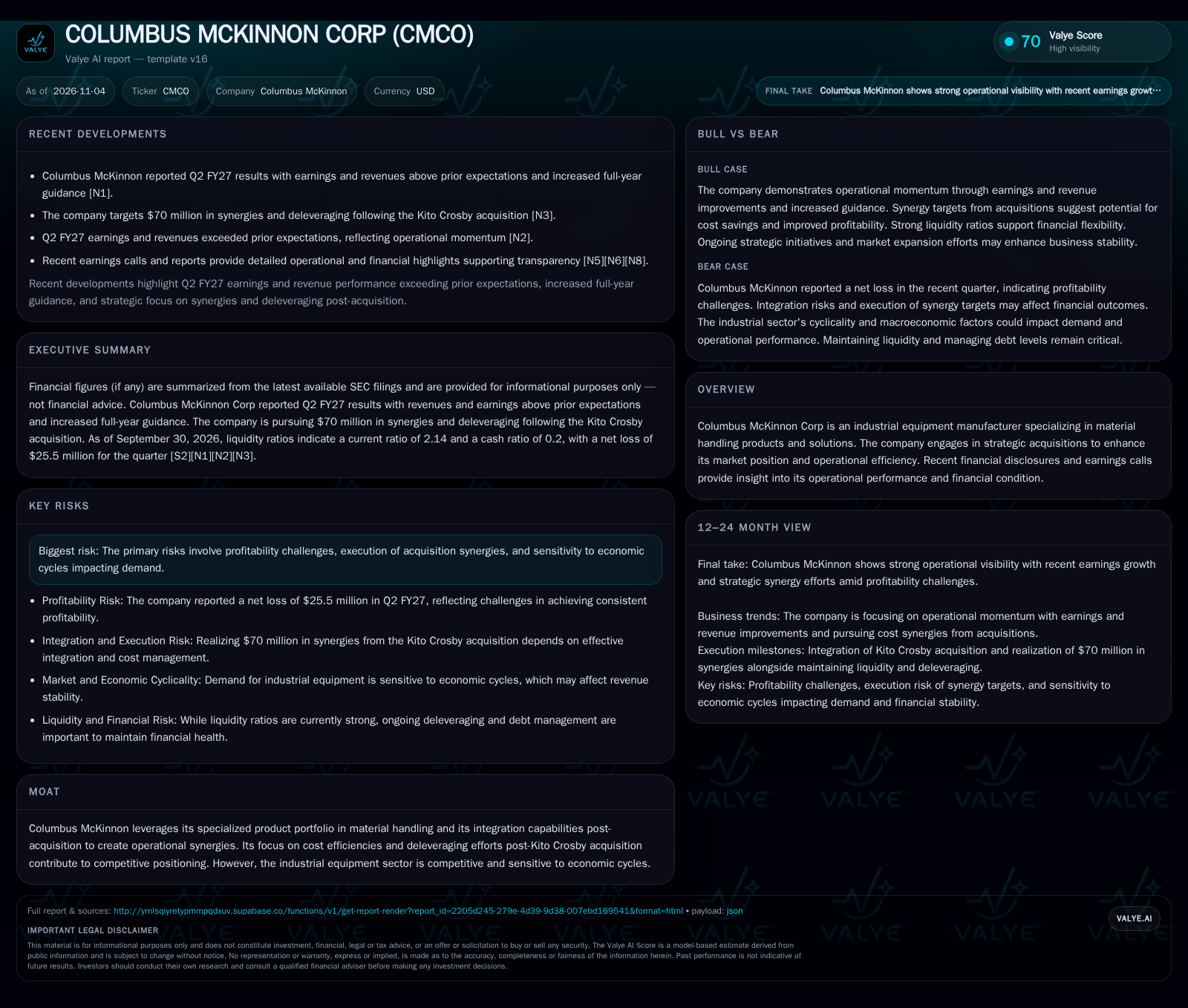
Columbus McKinnon reported Q2 FY27 revenues and earnings ahead of expectations, raising full-year guidance. Despite this momentum, the company posted a net loss and continues to pursue significant synergies from recent acquisitions. Reported liquidity position, but profitability and integration execution are the focal points for the next phase. [S2] [N1] [N2] [N3]
Columbus McKinnon, a long-standing player in industrial material handling, is at a strategic crossroads. Its Q2 FY27 results showed operational momentum with earnings and revenues surpassing expectations and management raising guidance for the full year. However, the company remains in the red, reporting a net loss, and faces the complex task of extracting promised synergies from its recent Kito Crosby acquisition. With a reported liquidity position but persistent profitability headwinds, Columbus McKinnon’s next phase will hinge on successful integration and navigating the cyclical dynamics of the industrial equipment market. [S2] [N1] [N2] [N3]
Recent Performance: Momentum Meets Margin Pressure
Columbus McKinnon’s Q2 FY27 earnings and revenues came in above prior expectations, prompting management to raise full-year guidance. This operational momentum suggests effective execution on the top line and possibly early benefits from strategic initiatives. The company reported cash and liquidity metrics for the period; these figures do not by themselves establish operating runway, investment capacity, financial flexibility, or financing capacity. The company is also targeting $70 million in synergies and deleveraging following the Kito Crosby deal, making integration and cost capture a central theme for the coming quarters. [S2] [N1] [N2] [N3]
Beyond headline revenue and earnings beats, it is critical to analyze the underlying quality of this operational momentum. For instance, the sustainability of revenue growth depends on whether it stems from recurring maintenance contracts versus one-off project wins, which carry different risk profiles and margin implications. Additionally, the timing and magnitude of integration-related expenses can create volatility in quarterly results, obscuring the true trajectory of profitability improvements. A granular view of segment-level performance and cost trends would help clarify if the momentum is broad-based or concentrated in specific product lines or geographies, which in turn informs the durability of the raised guidance.
Material Handling Economics: Volume, Mix, and Integration Leverage
Columbus McKinnon operates in a business where revenue is largely driven by industrial capex cycles, customer project timing, and ongoing maintenance demand. Pricing power is typically modest in the industrial equipment sector, with some ability to pass through inflationary costs depending on customer relationships and product differentiation. The company’s efforts to pursue synergies—targeting $70 million post-Kito Crosby—are aimed at improving operating leverage by consolidating procurement, optimizing manufacturing footprints, and reducing overlapping SG&A. Fixed-cost absorption is crucial: higher volumes can translate into substantial incremental margin if integration is successful and cost structures are streamlined. However, the reported net loss underscores that, at present, variable cost pressure or integration expenses may be outpacing realized savings. The capital needs for such a business are moderate but persistent, with ongoing investment required to maintain manufacturing assets, pursue automation, and fund working capital swings typical of industrial cycles. [S2] [N3]
The interplay between volume growth and margin expansion is particularly nuanced in industrial equipment manufacturing. While higher volumes typically enable better fixed-cost absorption, the degree to which this translates into profit depends on the efficiency of the production footprint and the success of supply chain consolidation. Integration efforts that disrupt manufacturing continuity or supplier relationships can temporarily inflate costs and erode margins. Moreover, the ability to leverage pricing power amid inflationary pressures is often contingent on differentiated product offerings and long-term customer contracts, which reduce sensitivity to commodity price swings. Thus, synergy realization is not merely a function of cost cutting but also hinges on sustaining or enhancing value propositions that justify stable or improved pricing.
Navigating a Crowded and Cyclical Market Landscape
Columbus McKinnon competes in a global market for material handling solutions, facing rivals ranging from diversified industrial conglomerates to specialized lifting and motion control firms. Key competitive levers include breadth of product portfolio, reliability and safety reputation, distribution reach, and ability to deliver integrated solutions. While acquisitions can deliver scale and broaden the offering, integration risk is high, and customer switching costs are often modest unless proprietary systems or long-term service contracts are involved. The sector is also exposed to substitute technologies (e.g., automation, robotics, advanced logistics systems), which could change demand patterns or compress margins if Columbus McKinnon fails to innovate. Cyclicality remains a structural headwind—capital spending by industrial customers can fall sharply in downturns, impacting both volumes and pricing across the sector.
In a market characterized by modest customer switching costs, Columbus McKinnon’s ability to deepen customer relationships through integrated solutions and service offerings becomes a critical competitive advantage. This requires not only product innovation but also investments in after-sales service infrastructure and digital capabilities that enhance customer experience and lock in recurring revenue streams. Furthermore, the threat of substitution by automation and robotics technologies underscores the need for proactive R&D and strategic partnerships. Failure to adapt could lead to margin compression and loss of market share, especially if competitors offer more technologically advanced or cost-effective alternatives. Hence, the company’s competitive positioning depends on balancing scale benefits from acquisitions with agility in innovation and customer engagement.
If Integration Delivers: Synergies Translate to Margin Expansion
The most favorable scenario for Columbus McKinnon involves successful realization of the targeted $70 million in synergies from the Kito Crosby acquisition, leading to material improvement in operating margins. This would require disciplined execution on procurement savings, efficient plant integration, and minimization of one-time costs. If revenue momentum continues, incremental sales could be absorbed with limited additional fixed cost, further enhancing profitability. Signs confirming this scenario would include a return to positive net income, improvement in gross and operating margins, and clear management commentary on synergy capture progress. Accelerated deleveraging, as cash flow improves, would also support the bull case. Evidence that would falsify this scenario includes persistent net losses, missed synergy targets, or cost overruns related to the integration process. [N3]
Managing Through Cyclicality While Chasing Efficiency Gains
The most plausible path forward is one where Columbus McKinnon achieves partial synergy realization, with integration benefits offsetting some, but not all, of the sector’s margin pressures. Revenue could remain resilient if industrial demand holds, but the company may continue to post modest or breakeven profitability as integration costs, competitive pricing, and input inflation weigh on results. Confirmation of this scenario would be continued revenue growth or stability, gradual margin improvement, and stable or slightly positive earnings per share. Falsifying evidence would include a reversal in revenue trends, worsening operating margins, or negative surprises in integration costs.
Integration Stumbles and Industrial Slowdown Trigger Profit Strain
A negative scenario materializes if integration efforts falter—leading to missed synergy targets, operational disruptions, or unexpected costs—and if industrial demand weakens due to macroeconomic headwinds. In this case, operating leverage works against the company, with fixed costs weighing heavily as volumes decline. Persistent net losses could erode liquidity over time, potentially forcing asset sales, restructuring, or dilutive capital raises. Early warning signs would be a sharp drop in revenues, rising SG&A as a percentage of sales, delayed synergy updates, or guidance cuts. This scenario would be confirmed by continued negative EPS, declining cash balances, or increased leverage metrics.
Milestones That Will Shape Columbus McKinnon’s Next Chapter
Progress toward the $70 million synergy target from the Kito Crosby acquisition—timing, magnitude, and management updates—would help test the thesis. [N3]
Quarterly trends in gross margin and operating margin, particularly as integration progresses, will reveal if cost savings are being realized.
Net income and EPS trajectory: a return to profitability would be a strong confirming signal, while persistent losses would be a red flag. [S2]
Revenue growth or stability in the face of macroeconomic uncertainty will indicate end-market demand resilience.
Working capital swings and cash flow from operations—if disclosed—would clarify whether reported liquidity is translating into sustainable potential financial flexibility.
Updates on deleveraging progress and any changes to debt covenants or refinancing activity would show how financial risk is evolving.
Management commentary on order backlog, pipeline visibility, and customer retention—if disclosed—would help assess forward demand and competitive stickiness.
Disclaimer: This is research-only, informational analysis and not investment advice. It may include AI-generated interpretation and general industry context. Always verify important details using primary sources.

Comments