
Astera Labs’ Cloud and AI Connectivity Platform: Profitability, Customer Concentration, and the Stakes of Scaling in a Competitive Semiconductor Market
Astera Labs has posted strong profitability and liquidity as hyperscaler and AI connectivity demand accelerates, but concentrated customer exposure, supply chain dependencies, and fierce competition shape the next phase. The company’s ability to sustain growth hinges on deepening its customer base and maintaining technology leadership amid rapid infrastructure cycles.
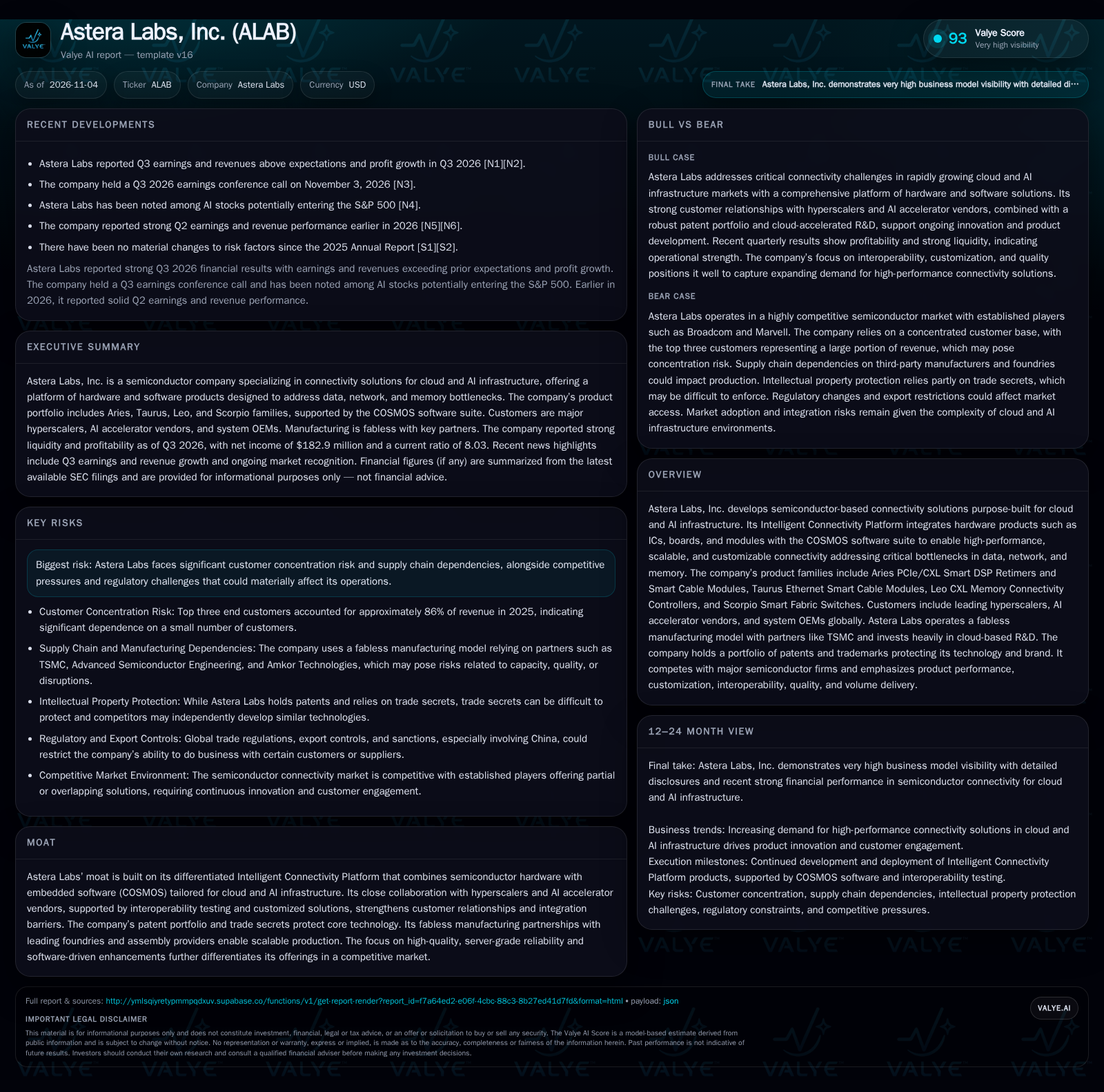
Astera Labs reported strong Q3 2026 profitability and liquidity, driven by its Intelligent Connectivity Platform for cloud and AI infrastructure. The company’s reliance on a small group of hyperscaler and OEM customers presents concentration risk, while competition from established semiconductor vendors remains intense. The next phase depends on expanding customer adoption, continued product innovation, and managing manufacturing dependencies, with execution on integration and ecosystem partnerships as key levers for sustained growth. [S2] [N1] [N2]
Astera Labs, Inc. has emerged as a key player in the race to solve cloud and AI infrastructure bottlenecks, offering a suite of high-speed connectivity solutions that blend semiconductor hardware with embedded software. Its recent financial results underscore robust operational execution, but the company’s heavy reliance on a handful of hyperscaler and OEM customers, coupled with the capital intensity and volatility of the semiconductor industry, leaves open questions about the durability of its growth trajectory. As hyperscale data center and AI adoption accelerate, Astera Labs’ challenge will be to translate its current momentum into a broader and more resilient market position.
Profitability Surges, but Customer and Supply Chain Risks Loom Large
As of September 30, 2026, Astera Labs reported net income of $182.9 million for the quarter, with basic EPS of $1.05 and diluted EPS of $0.99. The company ended the quarter with $209.4 million in cash and equivalents, current assets of $1.955 billion, and a current ratio of 8.03. These figures reflect a period of strong financial performance and liquidity, supported by Q3 and earlier Q2 results that exceeded market expectations. However, the company’s customer base remains highly concentrated among hyperscalers and leading AI accelerator vendors, and it continues to rely on a fabless manufacturing model with key partners such as TSMC. There have been no material changes to risk factors since the last annual report, but the persistent concentration and supply chain dependencies are material to the company’s risk profile. [S2] [N1] [N2]
Revenue Drivers and the Economics of Cloud Connectivity Solutions
Astera Labs generates revenue by selling high-speed mixed-signal connectivity products—integrated circuits, modules, and boards—along with embedded software (COSMOS) that enables configuration, management, and optimization. The company’s platform addresses data, network, and memory bottlenecks in cloud and AI infrastructure, targeting hyperscaler and OEM demand for scalable, high-performance, and interoperable solutions. Pricing in this segment is typically driven by value delivered (performance, reliability, and integration ease) rather than pure commodity cost, and the company’s ability to command premium pricing likely depends on differentiation, customization, and interoperability.
The fabless model allows Astera Labs to scale production without the capital burden of owning fabrication facilities, but exposes it to foundry pricing, capacity allocation, and supply chain volatility. Variable costs are dominated by silicon procurement and assembly/testing, while R&D and sales investments are largely fixed, creating potential for operating leverage as volumes grow. The integration of embedded software may enable additional service or subscription revenues, but the commercial structure is not fully disclosed; future recurring revenue could hinge on the adoption and monetization of software-enabled features. Capital needs are focused on product development, ecosystem integration, and working capital for inventory, rather than heavy manufacturing investment.
Differentiation in a Crowded Semiconductor Connectivity Market
Astera Labs faces competition from large, entrenched connectivity and semiconductor players, including Broadcom, Marvell, Credo Technology, Microchip, Montage Technology, Parade Technologies, and Rambus. The competitive landscape is shaped by the need for platform completeness, performance, interoperability, customization, and deep integration with hyperscaler and OEM customer systems. With its Intelligent Connectivity Platform, Astera Labs seeks to differentiate through close collaboration with leading cloud and AI players, interoperability testing in its own labs, and a patent portfolio covering interconnect and memory control technologies.
However, the barriers to entry in connectivity are not absolute—incumbents have significant resources, broad portfolios, and established customer relationships. Switching costs for customers may be elevated by integration and validation processes, but hyperscalers are known for dual-sourcing and pressing for cost and performance improvements. The company’s success will depend on both sustaining technical leadership and deepening customer lock-in via software, ecosystem partnerships, and proprietary features that are not easily replicated.
Sustained Hyperscaler Expansion Drives Outpaced Growth
In a favorable scenario, cloud and AI infrastructure spend accelerates, and Astera Labs leverages its differentiated platform to become an integral supplier to a wider set of hyperscalers and AI accelerator vendors. The company’s close customer collaboration translates into long-term design wins, with its COSMOS software suite embedded as a critical layer for configuration, monitoring, and optimization. As new AI and memory-intensive workloads proliferate, demand for advanced connectivity grows, expanding Astera Labs’ addressable market and enabling continued premium pricing.
Confirmation of this scenario would come from disclosures of new customer wins beyond the current top three, a rising portion of revenue from software or service components, and evidence of multi-year supply agreements or ecosystem partnerships. Gross margin expansion and increasing R&D productivity would further support the thesis that Astera Labs’ solutions are sticky and valued by customers. Falsification would be visible in stagnating customer concentration metrics, signs of pricing pressure, or a slowdown in design win momentum.
Incremental Adoption Amid Customer Concentration and Execution Risks
The most plausible near-term outcome is that Astera Labs continues to benefit from robust cloud and AI infrastructure investment, but revenue growth remains closely tied to a handful of hyperscaler and OEM customers. The company maintains strong profitability and liquidity, reinvesting in R&D and ecosystem integration to keep pace with evolving standards and customer requirements. Customer concentration risk persists, but is partially mitigated by deepening engagement with existing accounts and gradual expansion into adjacent workloads and geographies.
In this scenario, gross margins remain healthy but are pressured by supply chain costs and periodic pricing negotiations with large customers. Confirmation would come from stable or improving profitability, steady customer retention, and incremental disclosures of new product launches or customer pilots. Falsification would be seen in a sharp reversal of earnings momentum, major customer loss, or significant supply chain disruptions that impact delivery and reputation.
Customer Loss or Supply Chain Disruption Derails Momentum
A negative scenario would be triggered if one or more of Astera Labs’ major customers reduces orders, either due to internal technology shifts, insourcing, or competitive displacement. Given the high customer concentration, a single hyperscaler or AI accelerator vendor pivot could materially impact revenue and profitability. Supply chain shocks—such as foundry allocation cuts, assembly issues, or geopolitical disruptions—could further exacerbate volatility, leading to delivery delays, lost design wins, or forced price concessions.
This scenario would be confirmed by a meaningful decline in revenue concentration metrics, missed revenue or margin guidance, or disclosures of lost design wins and order reductions. Early warning signs would include increased inventory, rising days sales outstanding, or public comments from major customers regarding supplier diversification.
Testing Astera Labs’ Growth Durability: What Investors Should Track
Track the proportion of revenue derived from the top three customers; a decrease would indicate customer diversification and reduced concentration risk.
Monitor disclosures or commentary regarding new hyperscaler, AI accelerator, or OEM design wins, especially outside the current core customer group.
Observe gross margin trends for signs of pricing pressure, supply chain cost increases, or improved product mix.
Watch for product launch cadence and the adoption of new connectivity standards (e.g., PCIe, CXL, Ethernet) in Astera Labs’ offerings.
Evaluate updates on COSMOS software adoption—metrics on software-enabled revenue or attach rates, if disclosed, would help test the stickiness of the platform.
Scrutinize any supply chain disruptions, foundry allocation issues, or geopolitical developments that could impact manufacturing partners.
Look for evidence of multi-year supply agreements, ecosystem partnerships, or integration into customer roadmaps as signals of long-term customer commitment.
Assess R&D intensity and patent portfolio growth as indicators of sustained innovation and technology leadership.
Disclaimer: This is research-only, informational analysis and not investment advice. It may include AI-generated interpretation and general industry context. Always verify important details using primary sources.

Comments