
Blackstone Secured Lending Fund in 2026: Credit Discipline, Market Cycles, and the Stakes of Scale
BXSL’s recent financial results highlight the fund’s ability to deliver consistent earnings amid volatile credit markets. Its Blackstone affiliation, secured lending focus, and capital structure flexibility shape both the opportunity and the risks as credit conditions evolve.
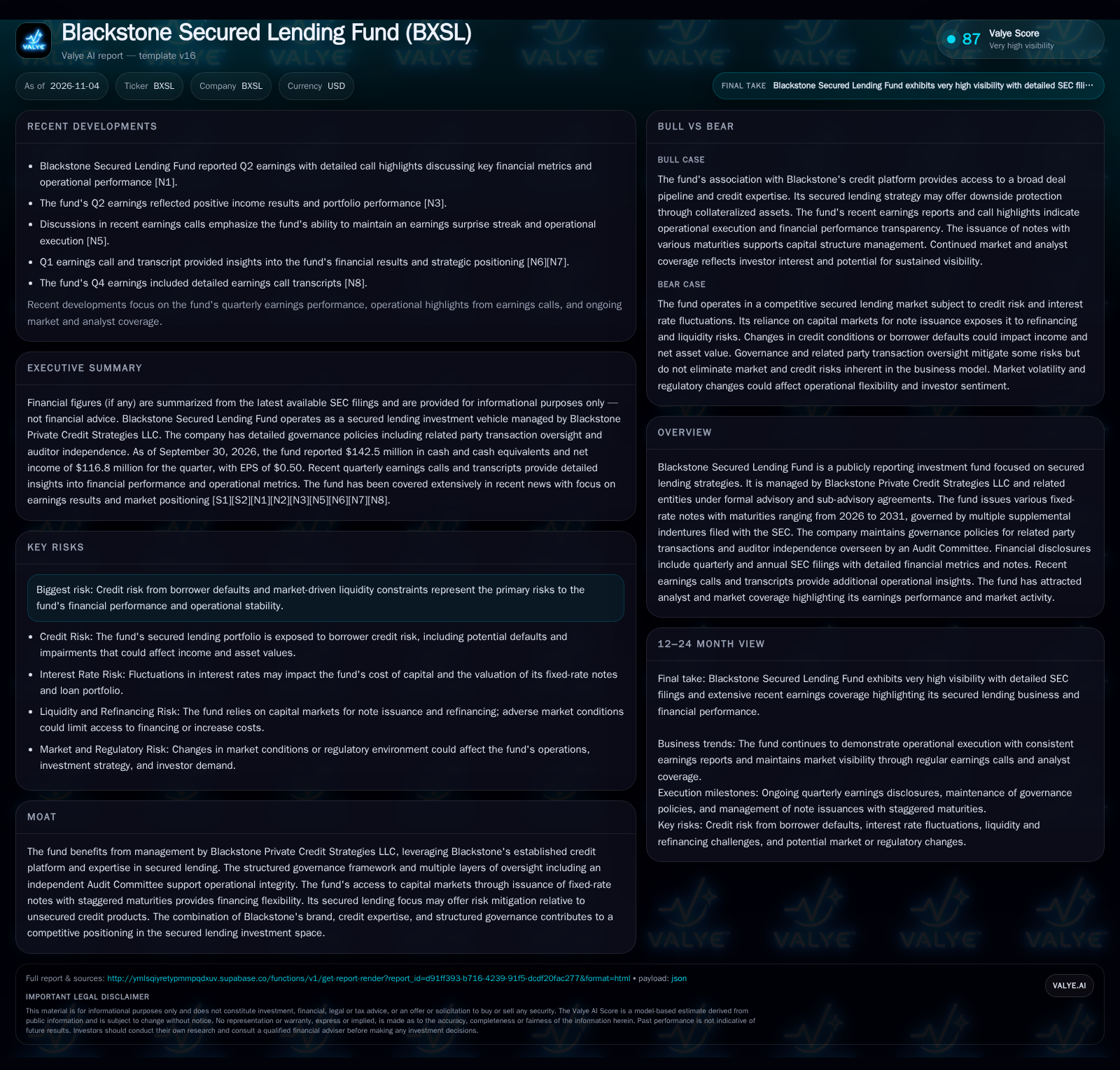
Blackstone Secured Lending Fund (BXSL) reported $116.8 million in net income and $142.5 million in cash as of September 30, 2026, continuing its earnings surprise streak and attracting market attention. The fund’s secured lending strategy, backed by Blackstone’s credit expertise and governance, aims to balance yield and risk in a competitive market. Its ability to manage credit quality, refinancing, and interest rate sensitivity will determine how it weathers future cycles. [S2] [N3] [N5]
Blackstone Secured Lending Fund (BXSL) has established itself as a visible and closely analyzed player in the secured lending market, consistently surpassing earnings expectations and maintaining robust governance under Blackstone’s stewardship. Yet the real test for BXSL lies not just in headline results but in its ability to manage credit risk, capital costs, and competitive dynamics as market cycles shift and refinancing needs come due. The next phase will likely hinge on whether the fund’s structural advantages can offset rising sector headwinds and the inherent risks of leveraged credit portfolios. [S2] [N3] [N5]
Recent Results Highlight Earnings Stability and Market Clarity
As of September 30, 2026, Blackstone Secured Lending Fund reported net income of $116.8 million for the quarter, with basic and diluted EPS of $0.50 and cash and cash equivalents of $142.5 million [S2]. This earnings performance extended an ongoing streak of positive earnings surprises, drawing repeated attention from market analysts and financial media [N3] [N5]. Regular quarterly earnings calls and detailed SEC filings provide transparency and have reinforced the fund’s profile as a disciplined operator within the secured lending space [N1] [N2] [N3] [N5] [N6] [N7] [N8]. These facts matter because they signal operational stability and investor engagement, but they also raise questions about the durability of outperformance if credit conditions tighten or refinancing costs rise.
BXSL’s Lending Approach Converts Market Risks into Investor Value
BXSL’s business model centers on originating and managing a portfolio of secured loans, typically to middle-market companies, with the goal of earning attractive yields while mitigating credit losses through collateralization. The fund’s net investment income is driven by the spread between interest income from its loan portfolio and its cost of capital, which includes interest paid on issued notes and other financing arrangements. The use of fixed-rate notes with staggered maturities provides some predictability in funding costs, but also exposes the fund to interest rate risk and refinancing pressure as notes mature [S1] [S2].
Operating leverage in this model is modest: while incremental scale can improve efficiency in sourcing and monitoring loans, credit risk management remains resource-intensive and losses can quickly erode gains. Capital needs are ongoing, as repayments and prepayments must be recycled into new loans to maintain portfolio yield. The company reported cash and liquidity metrics for the period; these figures do not by themselves establish operating runway, investment capacity, financial flexibility, or financing capacity. If credit spreads widen or defaults increase, the economics can deteriorate rapidly, making credit selection and portfolio monitoring central to long-term returns.
Blackstone’s Platform Strength Amid Industry Challenges and Rival Pressures
BXSL’s most significant potential advantage comes from its affiliation with Blackstone Private Credit Strategies, which provides deal flow, sector expertise, and risk management processes often unavailable to smaller or less experienced competitors. This can translate into better access to high-quality borrowers, more rigorous underwriting, and portfolio diversification. The fund’s focus on secured lending—loans backed by collateral—offers some insulation compared to unsecured lenders, as recoveries in the event of default may be higher.
However, the competitive landscape is intense. Other large asset managers and business development companies (BDCs) also target the secured lending segment, driving competition for attractive credits and pressuring spreads. In addition, non-bank lenders, private credit funds, and even direct lending arms of traditional banks represent formidable substitutes. If capital floods into the sector, underwriting standards may weaken and returns compress. Conversely, in times of market stress, Blackstone’s scale and reputation could help BXSL defend or even expand its position as weaker peers retreat.
Sustained Credit Market Stability Could Enable BXSL to Grow via Scale and Selectivity
In a favorable scenario, credit conditions remain benign and BXSL leverages its Blackstone affiliation to source high-quality, collateralized loans at attractive yields. The fund’s disciplined underwriting and active management limit credit losses, while its capital structure—anchored by staggered, fixed-rate note issuances—keeps funding costs predictable even if market rates fluctuate. Continued earnings beats and analyst coverage reinforce investor demand, enabling the fund to access new capital efficiently and scale the portfolio without diluting returns.
Evidence confirming this scenario would include a sustained low level of loan impairments, maintenance or expansion of net interest margins, and continued outperformance versus sector benchmarks. Additional signs would be successful refinancing of maturing notes at favorable rates and robust origination volumes without a material increase in risk profile. Regular positive earnings surprises and strong demand for new note issuances would further validate the ability to compound shareholder value in a stable or improving market environment. [N3] [N5]
Projected Outcomes: Strong Returns Offset by Margin Pressure from Competition and Rate Normalization
The most plausible trajectory for BXSL is steady portfolio growth with moderate returns, as competition in secured lending intensifies and interest rates normalize or remain volatile. While the fund continues to benefit from Blackstone’s resources and disciplined credit processes, incremental yield opportunities diminish as new capital chases the same high-quality borrowers. Margins may compress as spreads tighten and refinancing costs rise on maturing notes.
Portfolio credit quality remains generally stable, but isolated impairments or defaults increase, requiring active management and occasional portfolio repositioning. The fund’s governance and transparency maintain investor confidence, but earnings surprises become less frequent as performance converges with sector norms. This scenario would be confirmed by gradual declines in net interest margins, a modest uptick in loan loss provisions, and competitive pressure visible in quarterly disclosures and earnings calls [N1] [N2] [N7].
Potential Default Surges or Liquidity Strains May Reveal Underlying Weaknesses
In an adverse environment, a deterioration in credit conditions—driven by economic slowdown, sector-specific stress, or rising borrower defaults—could materially impact BXSL’s income and asset values. If loan impairments and defaults accelerate, recovery rates even on secured loans may fall short of expectations, eroding net asset value and distributable income. Simultaneously, the fund’s reliance on capital markets for refinancing could be tested if credit spreads widen or investor risk appetite contracts, potentially forcing BXSL to refinance maturing notes at punitive rates or reduce leverage to preserve liquidity.
This scenario would be confirmed by a spike in non-performing loans, sharp increases in loan loss provisions, and negative earnings surprises. Difficulty in rolling over or issuing new notes at reasonable terms would signal liquidity stress, while negative analyst commentary and price underperformance could follow. Governance structures may mitigate, but not eliminate, the impact of a systemic credit event or market dislocation.
Factors Influencing BXSL’s Ability to Sustain Growth and Withstand Market Shifts
Quarterly trends in non-performing loans and realized credit losses—if disclosed—will be critical to evaluating credit risk management and the underlying health of the loan book.
Net interest margin trends, as reported in earnings calls and filings, will reveal the fund’s ability to maintain profitability as funding costs and competition evolve.
Refinancing activity and the terms of new note issuances—such as coupon rates and investor demand—will indicate capital market access and cost of funds under changing conditions.
Origination volumes and portfolio growth rates, including sector and borrower diversification, would help gauge the sustainability of current earnings momentum.
Earnings call commentary on market conditions, pipeline quality, and competitive dynamics will provide early signals of shifting risk/reward tradeoffs.
Changes in regulatory or tax environment affecting BDCs or secured lending funds could alter the fund’s operating economics and capital allocation options.
Disclaimer: This is research-only, informational analysis and not investment advice. It may include AI-generated interpretation and general industry context. Always verify important details using primary sources.

Comments