
Option Care Health in Late 2026: Home Infusion at Scale, Margin Leverage, and the Regulatory Balancing Act
Option Care Health’s $1.35B quarterly revenue and steady profitability highlight the scaling potential of home infusion services. As payers and patients push for care outside hospitals, the company’s operational leverage, regulatory exposure, and competitive positioning will determine whether it can translate industry tailwinds into durable margin expansion.
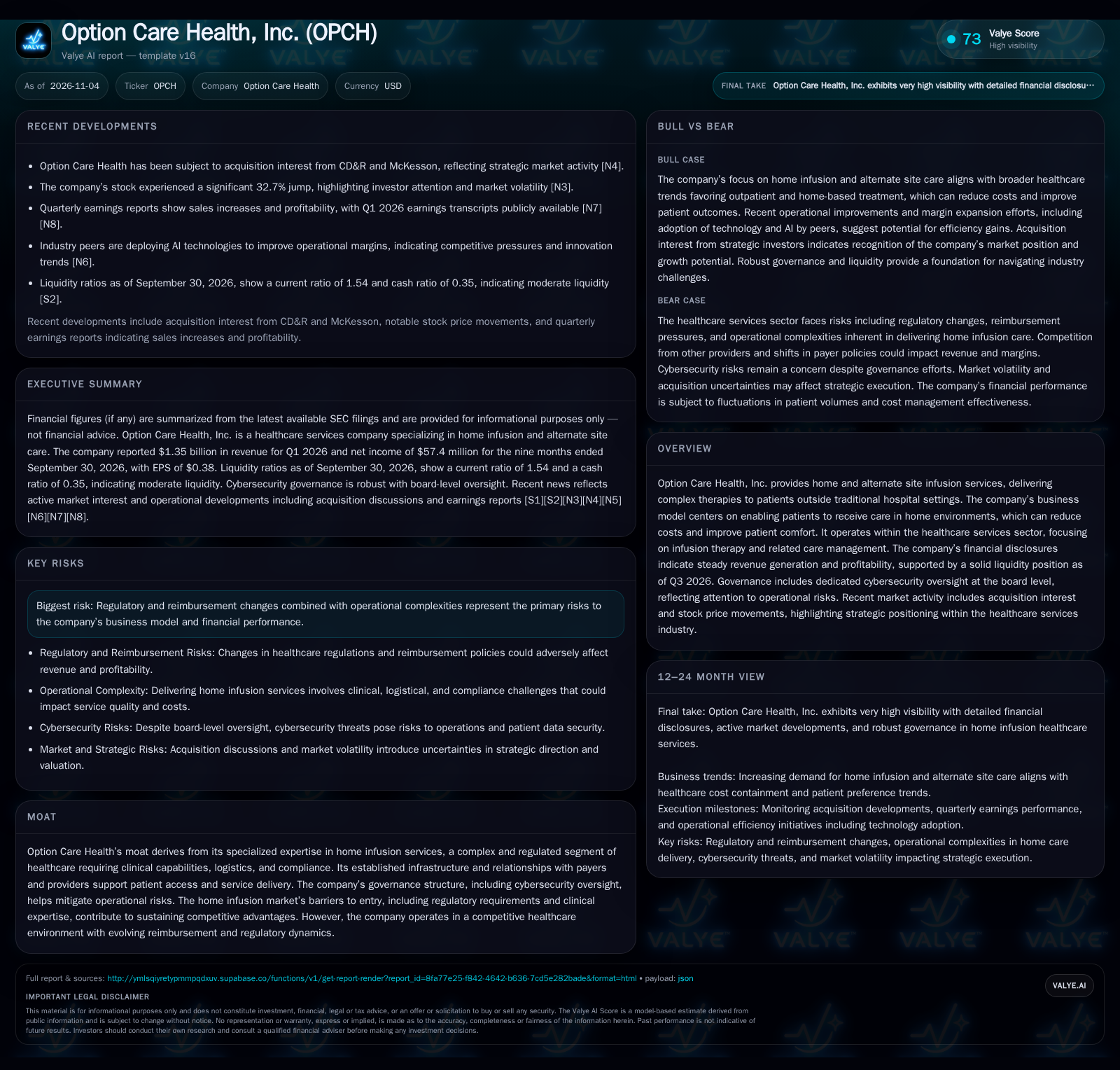
Option Care Health reported $1.35B in Q1 2026 revenue and $57.4M in net income over nine months, reflecting steady growth in home and alternate site infusion. The business model depends on navigating reimbursement risk and operational complexity to sustain profitability as demand for outpatient care rises. Future performance hinges on payer dynamics, cost control, and the ability to defend share in a competitive, regulated market. [S2] [S1]
Option Care Health, Inc. stands at the intersection of two powerful trends in healthcare: the shift toward home-based care and the ongoing battle to control system costs. With $1.35 billion in revenue for Q1 2026 and continued profitability, the company has established itself as a scaled provider in the complex, regulated market of home and alternate site infusions. Yet, as reimbursement models shift and operational complexity grows, Option Care Health’s ability to leverage its infrastructure and defend margins will be tested by competitive and regulatory forces. The next phase will require not just growth, but disciplined execution and risk management to sustain its position.
Recent Financial Performance and Governance: A Snapshot of Scale and Oversight
Option Care Health recorded $1.35 billion in revenue for Q1 2026, underlining its position as a major provider in the home and alternate site infusion sector [S2]. For the nine months ended September 30, 2026, the company generated $57.4 million in net income, translating to basic and diluted EPS of $0.38 [S2]. As of September 30, 2026, the company reported $299 million in cash and cash equivalents, with a current ratio of 1.54 and a cash ratio of 0.35, indicating moderate but not extraordinary liquidity [S2]. The company’s cybersecurity risk management is overseen by a dedicated board committee and led by a seasoned Chief Information Security Officer, reflecting robust governance mechanisms [S1]. These data points together suggest a business with meaningful scale, operational profitability, and active risk oversight, but also one navigating the demands of a capital- and compliance-intensive sector.
How Home Infusion Economics Can Drive Margin Expansion—or Compression
Option Care Health’s core business model is predicated on delivering complex infusion therapies outside the hospital, where payers are incentivized to reduce costs and patients generally prefer care at home. Revenue is typically generated through reimbursement from commercial insurers, government programs, and sometimes direct patient payments. Gross margins in infusion services can be attractive due to lower facility overhead compared to hospitals, but are heavily dependent on negotiated rates, drug acquisition costs, and the mix of high- vs. low-margin therapies.
The company’s scale allows for some fixed-cost leverage, particularly in logistics, pharmacy operations, and IT infrastructure. However, variable costs—especially specialty drug procurement—remain significant and can be subject to pricing pressure from both suppliers and payers. Operating leverage is achievable as patient volumes increase and as more therapies shift to the home, but this is offset by regulatory costs, compliance requirements, and the need for ongoing investments in clinical and cybersecurity capabilities.
Capital needs are moderate but persistent; working capital is required to manage drug inventories, receivables from payers, and investment in technology for care coordination and compliance. The company reported cash and liquidity metrics for the period; these figures do not by themselves establish operating runway, investment capacity, financial flexibility, or financing capacity.
Defending Share in a Fragmented but Crowded Infusion Landscape
Option Care Health operates in a market characterized by both high barriers to entry—due to regulatory, clinical, and logistical complexity—and intense competition from hospital systems, specialty pharmacies, and regional providers. Its competitive advantages likely derive from national scale, established relationships with payers and referral sources, and the operational know-how required to deliver complex therapies in the home. Still, the threat of substitution from hospital outpatient departments, vertically integrated payers or PBMs, and emerging digital health models remains real.
Reimbursement policy is both a moat and a vulnerability: favorable trends toward home-based care support volume growth, but any shift in payer policy or government reimbursement can rapidly compress margins or shift patient mix. Competitors may seek to undercut pricing, offer bundled services, or leverage technology to streamline care management, all of which could erode Option Care Health’s share or force margin concessions. Sustained differentiation will likely depend on clinical outcomes, service reliability, and the ability to partner with payers on value-based arrangements.
If Payers Accelerate the Shift to Home: Margin and Volume Tailwinds
A favorable scenario for Option Care Health hinges on continued payer and patient momentum toward home-based infusion, coupled with operational execution that captures both share and margin. If insurers and government programs expand coverage for home infusion and push more therapies out of hospitals, the company could see accelerating volume growth. With scale, incremental patients could drive operating leverage, particularly if fixed costs are held in check and technology investments yield efficiency gains.
Confirmation would come from sustained revenue growth above sector averages, improved gross and operating margins, and evidence of new payer contracts or expanded therapy offerings. Margin expansion would also be supported by successful renegotiation of drug acquisition costs and favorable reimbursement mix. Falsification would be evident if revenue growth stalls despite industry tailwinds, or if incremental volume fails to translate into higher profitability.
Steady Growth Amid Reimbursement Uncertainty and Operational Complexity
The most plausible scenario is one of steady, modest growth as Option Care Health manages the dual challenges of reimbursement volatility and rising operational complexity. The company is likely to maintain its core business through incremental patient growth and careful cost management, but faces periodic pressure on margins from shifts in payer policy, drug pricing, or regulatory burden.
This scenario would be confirmed by continued profitability, stable or slightly improving margins, and regular renewal or expansion of payer relationships. Evidence against this path would include unexpected reimbursement cuts, significant operational setbacks (such as compliance failures or cybersecurity incidents), or a material decline in patient volumes relative to industry trends.
Margin Compression from Adverse Payer Policy or Operational Missteps
The primary downside risk is a combination of reimbursement pressure and operational misexecution. If major payers reduce rates for home infusion, limit covered therapies, or shift patients back to institutional settings, Option Care Health could face abrupt revenue and margin contraction. Similarly, cost overruns in drug procurement, logistics, or compliance could outpace revenue gains, especially if patient volumes stagnate or decline.
A downside scenario would be confirmed by a drop in revenue or net income, deteriorating margins, and possibly negative cash flow. Early warning signs could include public payer policy changes, adverse regulatory actions, or a spike in operating costs (for instance, due to cybersecurity breaches or compliance penalties). Falsification would require evidence of resilient margins and volume growth even in the face of industry headwinds.
What Will Determine Option Care Health’s Long-Term Value Creation?
Payer reimbursement rates for home and alternate site infusion, especially any major changes in Medicare, Medicaid, or large commercial contracts.
Gross margin trends and operating leverage metrics—if disclosed—which would indicate whether volume growth is translating into improved profitability.
Patient volume and therapy mix evolution, particularly the proportion of high-margin specialty infusions versus lower-margin therapies.
Renewal or expansion of payer and provider relationships, including any new value-based contracting arrangements.
Incidence and impact of cybersecurity or compliance incidents, considering the company’s board-level oversight but also sector-wide risk.
Trends in drug acquisition costs and supplier negotiations, given the importance of managing input costs to defend margins.
Investment in and adoption of technology platforms for care coordination, logistics, and compliance—a useful metric would be IT spend as a percentage of revenue, if disclosed.
Any large-scale capital allocation decisions, such as acquisitions or major strategic investments, that could alter the company’s risk or growth profile.
Disclaimer: This is research-only, informational analysis and not investment advice. It may include AI-generated interpretation and general industry context. Always verify important details using primary sources.

Comments