
Palmer Square Capital BDC: Regulatory Discipline, Earnings Variability, and the Realities of Private Credit Investing
Recent results underscore Palmer Square Capital BDC’s strengths in capital management and regulatory compliance, but also highlight the structural complexities and cyclical risks inherent in the BDC model. The company’s share repurchase activity, earnings volatility, and focus on private company lending create both opportunity and constraint as market conditions evolve.
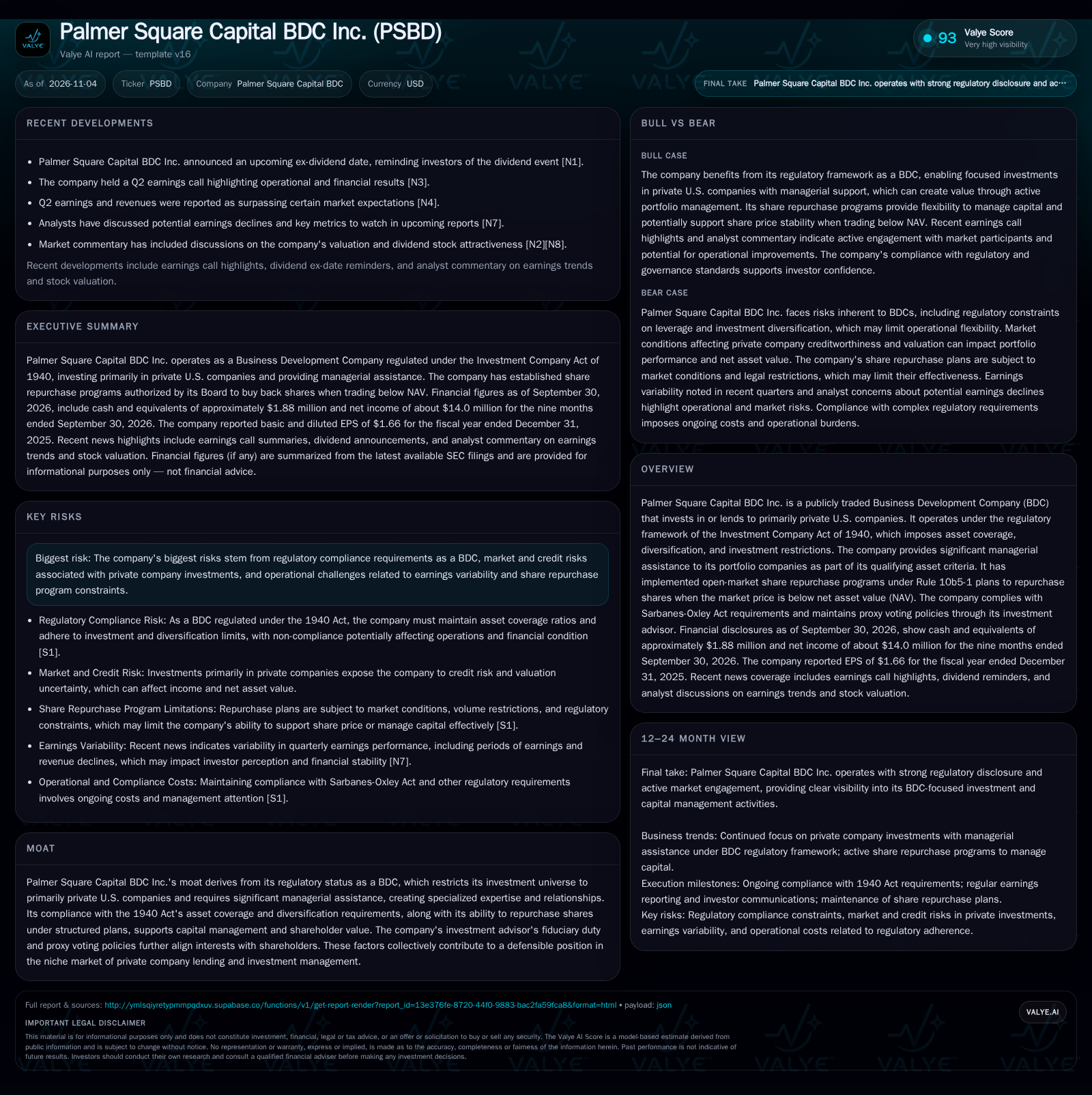
Palmer Square Capital BDC Inc. combines disciplined regulatory adherence and active capital return with the inherent unpredictability of private credit markets. Despite strong net income and ongoing buybacks, earnings remain volatile, and the effectiveness of repurchase programs is bounded by regulatory and market constraints. Future performance will hinge on credit quality, portfolio management, and the company’s ability to navigate shifting economic and regulatory pressures. [S1] [S2] [N4] [N7]
Palmer Square Capital BDC Inc. is emblematic of the modern BDC landscape: it operates within a rigorous regulatory framework, seeks value through private company lending, and manages capital dynamically via share repurchases. Recent financial disclosures highlight robust net income and active buyback activity, but also reveal the persistent challenge of earnings variability and the limitations imposed by both regulation and market realities. As private credit markets evolve, Palmer Square’s ability to balance regulatory discipline, portfolio risk, and shareholder returns will define its trajectory.
Earnings Strength, Buybacks, and Regulatory Anchors: The Present State of Play
Palmer Square Capital BDC reported net income of approximately $14.0 million for the nine months ended September 30, 2026, demonstrating continued profitability in its core private lending activities. The company reported cash and liquidity metrics for the period; these figures do not by themselves establish operating runway, investment capacity, financial flexibility, or financing capacity. Notably, Palmer Square executed open-market share repurchases exceeding 1.3 million shares in 2025, focusing on buying back shares when the market price fell below net asset value (NAV). These buybacks were conducted under Rule 10b5-1 plans, with the investment advisor PSCM participating in a parallel stock purchase program. The company’s basic and diluted EPS for fiscal 2025 reached $1.66. Despite these positive indicators, recent quarters have seen earnings variability, with some periods surpassing and others missing analyst expectations. [S1] [S2] [N4] [N7]
How Palmer Square Capital BDC Generates Value: Portfolio Economics and Capital Dynamics
As a BDC, Palmer Square primarily earns money through interest and fee income from debt and equity investments in private U.S. companies. The regulatory framework of the Investment Company Act of 1940 constrains leverage (requiring at least 150% asset coverage after issuing senior securities) and enforces diversification, pushing the company toward a portfolio approach rather than concentrated bets. This creates a largely fixed cost base (management fees, regulatory compliance, managerial assistance) layered over a variable revenue stream tied to loan yields, origination fees, and performance on equity positions.
Share repurchase programs add a layer of capital return, theoretically accretive when shares trade below NAV. However, the effectiveness of these programs is inherently limited by legal restrictions, liquidity, and available capital. Unlike open-ended funds, BDCs cannot easily issue or redeem shares, so buybacks must be carefully timed and financed. Operating leverage is present but not extreme; fee and compliance costs create a floor, while portfolio returns can swing with credit cycles and market conditions.
Specialization and Constraints: Where Palmer Square Sits in the Private Credit Ecosystem
Palmer Square’s competitive position is defined by its regulatory niche: it targets private U.S. companies, often underserved by traditional banks, and provides not just capital but mandated managerial assistance. This specialization can create stickier relationships and differentiated underwriting insights. However, the BDC sector is crowded, with direct lending funds, institutional credit platforms, and other BDCs all vying for deal flow. The requirement to maintain asset coverage and diversification, while protecting against outsized risk, can also blunt the ability to pursue the highest-yielding (but riskiest) opportunities.
Substitutes include private credit funds not subject to BDC constraints (with potentially greater leverage and risk appetite), as well as traditional bank lending for the highest-quality credits. Regulatory compliance—while a moat against undisciplined capital—also limits return potential in frothy or highly competitive markets. The share repurchase feature is a tactical advantage when shares trade at a discount, but its impact is episodic and cannot compensate for sustained portfolio underperformance.
When Credit Quality Holds and Buybacks Are Accretive: The Path to Outperformance
The most favorable outcome for Palmer Square Capital BDC occurs if private credit markets remain benign—default rates stay low, credit spreads remain attractive, and portfolio companies continue to generate cash. In this scenario, net investment income remains robust, and accretive buybacks (at prices below NAV) enhance per-share metrics for remaining shareholders. Regulatory compliance, combined with effective managerial assistance, could further reduce realized credit losses relative to peers.
Confirmation would come from sequential net income growth, stable or improving NAV per share, and continued execution of buybacks without impairing liquidity or regulatory flexibility. If portfolio yields hold up and credit costs remain contained, Palmer Square could deliver both regular dividends and NAV accretion, supporting a premium valuation. A key falsification would be a spike in non-accruals, rising realized losses, or inability to maintain buyback activity due to liquidity or coverage constraints.
Navigating Cyclical Credit Markets Under Regulatory Guardrails
The most plausible trajectory for Palmer Square Capital BDC is continued cyclical movement in earnings and NAV, reflecting the ebb and flow of private credit markets. Management will likely balance portfolio risk—avoiding concentrated exposures or speculative credits—with the need to generate sufficient net investment income to cover dividends and selective buybacks. Regulatory constraints will keep leverage and risk within prescribed limits, limiting both upside and downside extremes.
In this scenario, quarterly earnings will fluctuate based on credit quality, origination volumes, and market spreads. Share repurchases may continue opportunistically but will not be the dominant driver of long-term value. Confirmation would be a pattern of moderate but variable net income, stable compliance ratios, and disciplined capital management.
Portfolio Stress, Regulatory Constraints, and the Limits of Capital Flexibility
If macroeconomic or sector-specific shocks lead to increased defaults among portfolio companies, Palmer Square’s earnings and NAV could deteriorate rapidly. Credit losses would erode income, potentially forcing asset sales or dividend reductions to maintain asset coverage ratios. Share repurchase programs would likely be curtailed or suspended to preserve liquidity and regulatory compliance.
The downside is exacerbated by the BDC structure: leverage is capped, so there is limited ability to borrow through a downturn, and the illiquid nature of private loans can make portfolio repositioning slow or costly. Confirmation would be a sharp increase in non-accrual assets, reductions in NAV per share, missed or lowered dividends, and disclosure of regulatory compliance challenges. Falsification would require evidence of credit resilience—stable or improving asset quality—even as broader market conditions weaken.
Testing the Thesis: Concrete Markers for Palmer Square’s Resilience and Value Creation
Quarterly net investment income trends, particularly in relation to dividend coverage and historical averages, would help test the sustainability of earnings.
NAV per share evolution—especially after periods of market stress or credit events—would indicate the true economic impact of portfolio performance and buybacks.
Disclosure of non-accrual assets or realized credit losses, if provided, would offer early warning of credit deterioration.
Share repurchase activity relative to NAV discount and available liquidity should be tracked for signs of capital management discipline versus constraint.
Asset coverage ratio disclosures (if provided) would confirm regulatory headroom and the ability to absorb shocks or pursue new investments.
Changes in portfolio composition—sector, maturity, and credit quality mix—would illuminate shifts in risk appetite or management strategy.
External credit market indicators, such as spreads and private loan default rates, will provide context for Palmer Square’s portfolio risk and potential earnings volatility.
Management commentary on upcoming regulatory changes or compliance challenges would help gauge operational risk and future flexibility.
Disclaimer: This is research-only, informational analysis and not investment advice. It may include AI-generated interpretation and general industry context. Always verify important details using primary sources.

Comments