
ESAB Corporation in 2026: Acquisition-Driven Growth, Global Complexity, and the Stakes of Industrial Diversification
ESAB leans on acquisitions and operational discipline to expand its fabrication technology portfolio across mature and emerging markets, but faces cyclical demand, currency volatility, and geopolitical risk. The next phase depends on integration execution, innovation in automation and digital, and navigating a fragmented global landscape.
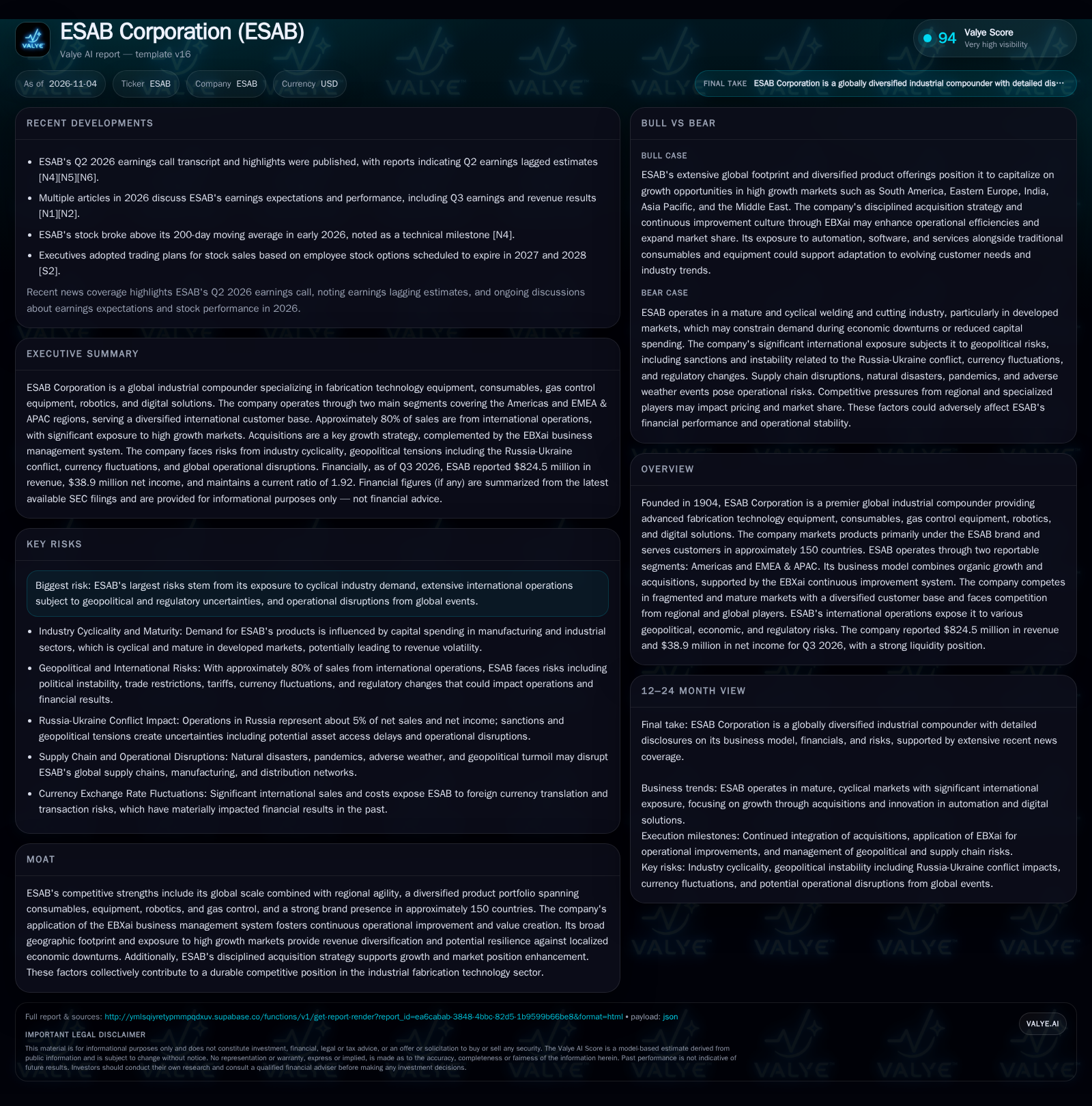
ESAB reported Q3 2026 revenues of $824.5 million and net income of $38.9 million, with 80% of sales from international markets and a strategic focus on high-growth regions and acquisitions. Its diversified industrial portfolio and global reach offer resilience, but cyclical demand, foreign exchange exposures, and geopolitical instability—especially related to Russia—remain persistent challenges. The company’s path forward hinges on acquisition integration, operational improvement through EBXai, and adaptation to automation and digital trends. [S1] [S2]
ESAB Corporation’s 2026 profile reflects a global industrial compounder balancing mature market cyclicality with aggressive expansion in high-growth regions. With over 80% of revenue generated outside the Americas and a portfolio spanning consumables, equipment, gas control, and digital solutions, ESAB is betting on acquisitions and operational improvement to fuel growth. Yet, the company’s exposure to global economic swings, currency risk, and geopolitical flashpoints—especially in Russia and Eastern Europe—means its future will be shaped as much by its ability to adapt as by its scale or product breadth.
Recent Performance Highlights Global Reach and Strategic Priorities
For the quarter ended October 2, 2026, ESAB reported revenue of $824.5 million and net income of $38.9 million, reflecting its scale as a global industrial compounder. The company reported liquidity-ratio trends of 1.92, with $188.6 million in cash and equivalents and $1.49 billion in current assets versus $776.6 million in current liabilities. The company reported cash and liquidity metrics for the period; these figures do not by themselves establish operating runway, investment capacity, financial flexibility, or financing capacity. [S2]
Approximately 80% of ESAB’s sales are generated internationally, with 52% of 2025 revenues from high-growth markets such as South America, Eastern Europe, India, Asia Pacific, and the Middle East. This diversified geographic footprint underpins both opportunity and complexity. [S1]
Acquisitions remain a central pillar of ESAB’s strategy, with four acquisitions completed in 2025 and more anticipated, emphasizing the company’s commitment to inorganic growth as a lever for expanding market reach and product capabilities. [S1]
Geopolitical risk is not abstract: Russia accounted for about 5% of net sales and net income in 2025, and the ongoing conflict and related sanctions have introduced meaningful uncertainty around asset access and operational continuity in the region. [S1]
How ESAB’s Business Model Converts Scale and Diversification into Earnings
ESAB’s revenue model is anchored in the sale of fabrication technology equipment, consumables, gas control systems, and increasingly, digital and automation solutions. The company’s product mix spans high-volume consumables (e.g., welding electrodes, wires, and gases) that typically provide recurring, margin-stable revenue, and capital equipment (e.g., welding machines, cutting systems, robotics) that are more cyclical and sensitive to industrial capital spending.
Pricing power in this sector is generally limited by the mature, fragmented nature of the market, with competition based on technical performance, reliability, brand, and total cost of ownership. Consumables may offer steadier margins due to their replenishment nature, while equipment and automation systems expose ESAB to higher gross margins but also to more volatile demand cycles.
Operating leverage is meaningful: as ESAB scales and integrates acquisitions, fixed costs (manufacturing footprint, R&D, distribution) are spread across a larger revenue base, potentially boosting profitability during upcycles. However, this also introduces risk if volumes decline, as high fixed costs can compress margins in downturns.
The company’s capital allocation is shaped by its acquisition strategy—recent years have seen a steady cadence of deals to broaden product scope and geographic access. Integration discipline and synergy realization are critical to translating deal activity into sustainable earnings growth.
Competitive Advantages and the Limits of Scale in Fragmented Global Markets
ESAB operates in a sector characterized by a handful of large global players—such as Lincoln Electric and the welding business within Illinois Tool Works—alongside numerous regional and niche competitors. The primary battlegrounds are technical capability, product quality, brand reputation, engineering support, and aftermarket service. [S1]
ESAB’s competitive strengths include its extensive global footprint (serving approximately 150 countries), a diversified portfolio spanning equipment, consumables, robotics, and gas control, and a strong brand with deep historical roots. The company’s EBXai business management system aims to institutionalize operational excellence and continuous improvement, which—if executed well—could drive relative cost and quality advantages.
However, ESAB’s international breadth also means exposure to highly variable regulatory, economic, and competitive environments. While scale can enable better procurement terms, broader service networks, and more robust R&D, local competitors may be more agile or cost-competitive in specific markets. The company’s acquisition strategy can supplement organic innovation but also poses integration and cultural risks that could erode intended synergies.
A key question is whether ESAB’s investments in automation, software, and digital solutions will yield differentiated customer value or simply match the evolving industry baseline. If these investments result in proprietary platforms or higher switching costs, ESAB could see improved retention and pricing. Otherwise, margins may remain pressured by the sector’s mature dynamics.
Acquisition Integration and Digital Expansion Unlock Margin and Share Gains
A favorable scenario for ESAB would see the company successfully integrating its recent and future acquisitions, realizing cost synergies, and cross-selling its broadened product suite into both mature and high-growth regions. Effective deployment of the EBXai system could drive manufacturing efficiency, improved working capital management, and better service delivery.
If ESAB’s push into automation, software, and digital solutions translates into higher-margin service offerings or proprietary platforms, the company could benefit from increased customer stickiness, recurring revenue streams, and pricing power. Penetration of high-growth markets—where infrastructure build-out and industrialization are accelerating—could further support above-market volume growth and dilute the impact of cyclical slowdowns in developed economies.
Confirmation of this scenario would include sustained improvement in gross and operating margins, rising revenue share from digital and automation solutions, and evidence of acquisition-related revenue and cost synergies. Additional markers would be continued market share gains in both traditional and emerging product categories, and resilience of earnings through cyclical downturns.
Diversification Balances Cyclical Headwinds with Emerging Market Growth
The most plausible near-term trajectory is that ESAB continues to deliver stable, if unspectacular, growth by balancing mature market cyclicality with incremental gains in high-growth geographies. Consumables and service revenues provide a recurring base, while capital equipment and automation cycles introduce earnings volatility tied to global industrial activity.
Acquisitions supplement organic growth but require ongoing integration focus to avoid margin dilution or operational distraction. The EBXai system may yield moderate efficiency gains, but industry pricing remains competitive and input cost inflation could pressure margins.
Currency headwinds and geopolitical disruptions—especially in Russia and adjacent markets—periodically impact reported results, but the diversified global footprint limits the impact of any single region. Margins and cash conversion remain within historical ranges, with free cash flow primarily allocated to bolt-on acquisitions and incremental innovation.
Evidence supporting this scenario would be continued revenue growth in high-single digits, stable or modestly improving operating margins, and no major swings in working capital or acquisition-related write-downs.
Cyclical Downturn, Currency Shocks, or Geopolitical Escalation Disrupt Progress
In a more adverse scenario, a global industrial slowdown or sharp contraction in capital spending—especially in developed markets—could drive down equipment sales and compress margins, with high fixed costs amplifying the impact on earnings. Currency devaluations in key international markets could further erode reported revenue and profit, particularly if cost structures are mismatched by region.
Geopolitical risks could escalate, especially if the Russia-Ukraine conflict disrupts supply chains, impairs asset access, or results in further sanctions. With Russia representing about 5% of net sales and net income as of 2025, a sudden loss or impairment of those operations would be a material drag. Broader instability in emerging markets could also disrupt growth trajectories.
If ESAB’s acquisitions underperform or integration falters—leading to cost overruns, customer attrition, or operational setbacks—expected synergies may not materialize, and goodwill write-downs or restructuring charges could follow.
Evidence for this scenario would include declining revenues and margins, adverse currency impacts, significant one-off charges related to geopolitical or integration issues, and negative free cash flow.
What Will Determine ESAB’s Ability to Sustain Compound Growth?
Progress on integrating recent acquisitions: Evidence of synergy realization, cost savings, and cross-selling would help test whether deal activity is translating into sustainable earnings growth.
Revenue share and margin contribution from automation, digital, and software solutions: If disclosed, this would clarify whether ESAB is successfully evolving beyond traditional hardware and consumables.
Trends in gross and operating margins: Persistent improvement would suggest operational discipline and pricing power, while margin compression could signal integration or competitive challenges.
Geographic revenue mix and growth in high-growth markets: Continued expansion in regions like India, Asia Pacific, and the Middle East would support the thesis of emerging-market-led diversification.
Exposure and resilience to currency fluctuations: Monitoring the impact of exchange rate movements on revenue and profit will be critical given the company’s international profile.
Developments related to Russian operations and broader geopolitical risks: Any impairment, asset write-down, or operational disruption in Russia and adjacent markets would be material.
Evidence of EBXai-driven operational improvements: Quantitative or qualitative updates on efficiency, lead times, or customer satisfaction would support the continuous improvement thesis.
Disclaimer: This is research-only, informational analysis and not investment advice. It may include AI-generated interpretation and general industry context. Always verify important details using primary sources.

Comments