
United Therapeutics in Late 2026: Rare Disease Leadership, Competitive Pressures, and the Road Ahead
United Therapeutics maintains a robust commercial portfolio in pulmonary hypertension and rare diseases, with reported liquidity position and ongoing clinical expansion. Yet, looming competitive, regulatory, and patent pressures—along with analyst expectations for earnings decline—raise questions about the durability and growth trajectory of its core franchises.
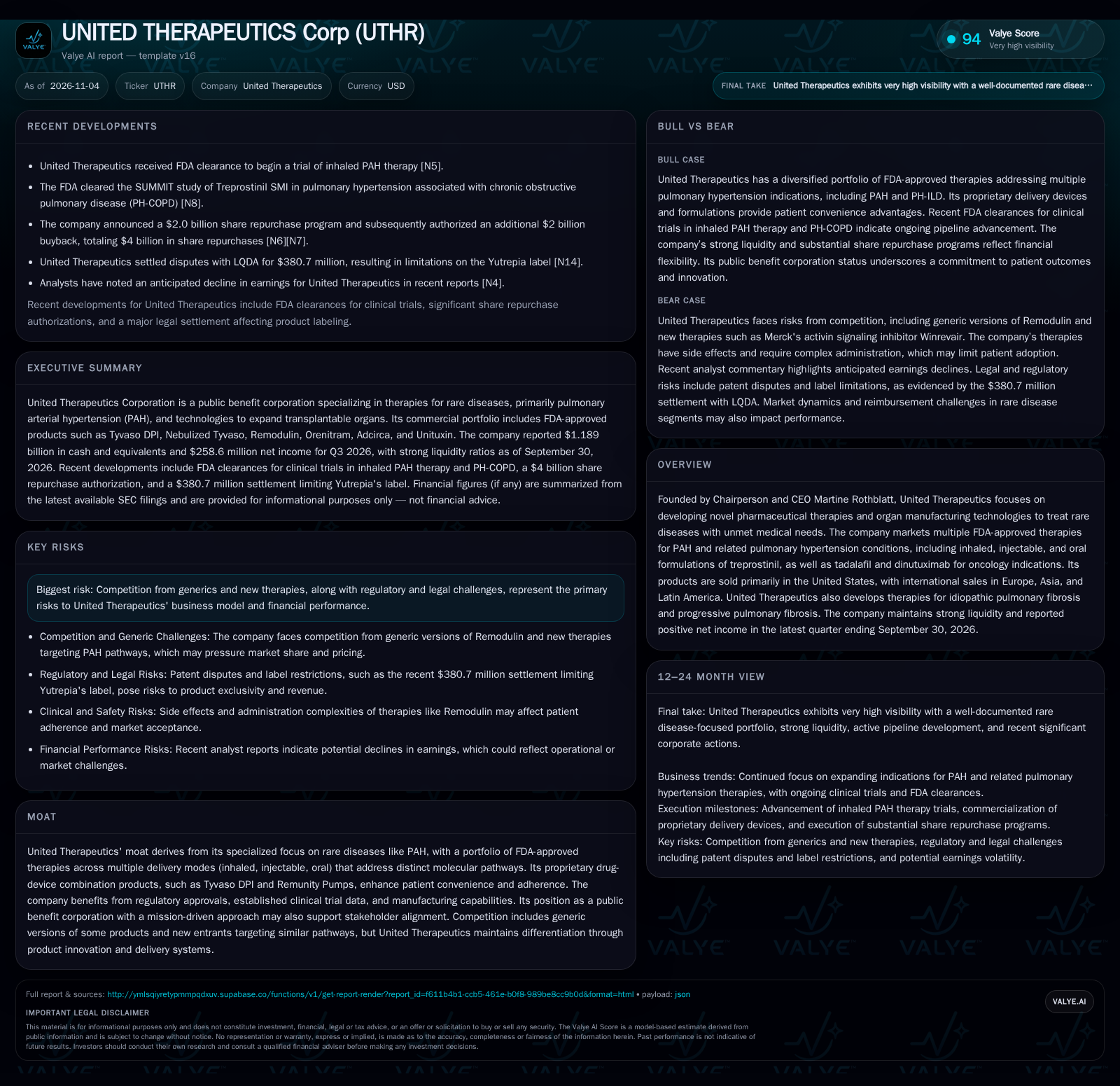
United Therapeutics continues to lead in rare disease therapies, especially for pulmonary arterial hypertension (PAH), leveraging multiple FDA-approved products and proprietary delivery systems. Ongoing clinical trial expansion into new indications and technologies to address organ shortages could provide future growth levers, but success hinges on navigating patent risks, regulatory hurdles, and evolving market dynamics. [S1] [S2] [N4] [N5] [N8]
United Therapeutics stands at a critical juncture in late 2026, balancing a well-established portfolio in pulmonary arterial hypertension and rare disease therapies with the realities of growing competition, patent challenges, and evolving reimbursement landscapes. The success of ongoing clinical expansion and the ability to defend and extend core franchises will determine whether United Therapeutics can sustain its leadership position in rare disease therapeutics.
Recent Performance, Legal Developments, and Pipeline Progress Shape the 2026 Outlook
United Therapeutics reported net income of $258.6 million for the quarter ending September 30, 2026, with basic and diluted EPS of $6.06 and $5.71, respectively. The company’s cash and equivalents stood at $1.189 billion, supplemented by $879 million in short-term investments, resulting in a current ratio of 4.61 and a cash ratio of 3.31. The company reported cash and liquidity metrics for the period; these figures do not by themselves establish operating runway, investment capacity, financial flexibility, or financing capacity. [S2]
On the legal front, United Therapeutics settled disputes with LQDA for $380.7 million, resulting in restrictions on the Yutrepia label—an important development in the competitive landscape for inhaled treprostinil products.
The company received FDA clearance to begin a trial of inhaled PAH therapy and to launch the SUMMIT study of Treprostinil SMI in PH-COPD, signaling ongoing clinical and regulatory momentum. [N5] [N8]
However, analyst reports now point to an anticipated decline in earnings, reflecting market concern over increasing competition and possible revenue pressures in core franchises. [N4]
Portfolio Economics: Specialty Drug Pricing, Delivery Innovation, and Scale
United Therapeutics’ revenue model relies on premium pricing for specialty therapies in rare diseases, particularly various formulations of treprostinil for PAH and PH-ILD. High unmet need and regulatory exclusivity historically enabled strong gross margins and pricing power, but these advantages face erosion as generics enter the market—especially for legacy products like Remodulin.
The company’s proprietary delivery systems, such as Tyvaso DPI and Remunity Pumps, may help sustain pricing and differentiate its offerings by improving patient adherence and convenience. If these devices are integrated as drug-device combinations, they could delay full generic substitution, but the margin impact depends on manufacturing costs, reimbursement practices, and uptake.
Operating leverage is plausible, as fixed R&D and SG&A expenses support a concentrated product portfolio and ongoing pipeline expansion. However, as top-line growth slows or contracts due to competition, margin compression could follow if fixed costs are not adjusted downward.
Capital needs remain moderate given strong cash balances and positive net income, but future outlays could increase if the company pursues additional settlements, acquisitions, or accelerated pipeline investments to offset loss of exclusivity in its core portfolio.
Differentiation Under Pressure: Brand, Device, and Pipeline Versus Generics and Innovators
United Therapeutics’ competitive moat historically rested on regulatory exclusivity, robust clinical data, and patient-centric delivery innovations. Its Tyvaso DPI and Remunity delivery systems distinguish its offerings from generic injectables and oral competitors, potentially supporting higher switching costs and retention in established patient populations.
The competitive landscape is intensifying. Generic versions of Remodulin and alternative PAH therapies, including new mechanisms of action (such as Merck’s Winrevair), threaten both volume and pricing. The $380.7 million Yutrepia settlement underscores the ongoing patent and label battles that define the specialty pharma landscape.
Beyond PAH, United Therapeutics is investing in pipeline programs for IPF, PPF, and organ manufacturing technologies. If successful, these could diversify revenue and reduce reliance on mature PAH assets. However, the commercial viability of new therapies and organ technologies is not yet proven, and competitors in rare disease and transplant innovation are also advancing rapidly.
Reimbursement dynamics and administration complexities (notably for infused therapies) remain potential friction points that could limit broader adoption or accelerate payer-driven switches to lower-cost alternatives.
Pipeline Success and Delivery System Adoption Could Offset Core Franchise Pressures
The most favorable scenario for United Therapeutics involves successful expansion of its clinical pipeline, particularly through the approval and broad adoption of new treprostinil indications (such as PH-COPD) and next-generation delivery systems that further differentiate its offerings. If the company can demonstrate superior outcomes or patient convenience with Tyvaso DPI, RemunityPRO, and future devices, it may sustain premium pricing and slow generic erosion.
Additionally, if pipeline assets in pulmonary fibrosis or organ manufacturing technologies deliver positive clinical results and clear regulatory hurdles, United Therapeutics could establish new high-margin franchises. Early commercial traction in these new indications—demonstrated by sales growth, formulary wins, or strong initial uptake—would confirm the upside thesis.
Key falsifiers would be regulatory setbacks, weak clinical results, or slow market adoption of pipeline assets, which would undermine the ability to offset declining legacy revenues.
Managing Maturity: Stable but Pressurized PAH Franchise With Gradual Diversification
The most plausible outcome is that United Therapeutics maintains stable but gradually declining revenues from its core PAH portfolio, as generic and branded competitors erode market share and pricing. The company’s delivery system innovations may slow, but not fully prevent, this erosion, while ongoing clinical expansion in adjacent indications (such as PH-ILD and PH-COPD) provides partial offsets.
Profitability remains positive, but earnings growth moderates or contracts as operating leverage declines and the company increases investment in pipeline assets to secure future growth. The impact of the Yutrepia settlement and any future legal/regulatory actions are absorbed but limit upside.
Confirmation would come from sequential revenue and earnings trends that reflect modest contraction, balanced by pipeline progress and sustained adoption of new delivery systems. Falsification would require either a sharp revenue cliff (from faster-than-expected generic penetration) or a breakthrough in new indications delivering outsized growth.
Accelerated Generic Erosion and Pipeline Setbacks Expose Earnings to Decline
A more adverse scenario unfolds if generic and innovative competitors more rapidly capture share in PAH, leading to a steeper drop in both price and volume for United Therapeutics’ core products. Should delivery innovations prove insufficient to defend against payer or physician-driven switches, or if reimbursement becomes more restrictive, the company’s economics could deteriorate quickly.
If pipeline programs for new indications or organ manufacturing fail to deliver positive clinical results or encounter regulatory delays, diversification efforts stall, and United Therapeutics becomes increasingly reliant on a shrinking mature franchise. Additional legal or settlement costs—similar to the recent Yutrepia action—could further strain financial performance.
Evidence for this downside would include sharper-than-expected revenue declines, negative earnings revisions, weak clinical trial updates, or additional settlements/legal setbacks.
Thesis Tests for United Therapeutics: Franchise Durability and New Growth Levers
Quarterly revenue growth or contraction in Tyvaso DPI, Nebulized Tyvaso, and Remodulin—especially the pace of erosion versus new product uptake.
Market share trends for inhaled and infused treprostinil products, including impact from generics and competitor launches if disclosed.
Pipeline milestones: clinical trial readouts and regulatory progress in PH-COPD, IPF, PPF, and organ manufacturing technologies.
Adoption rates and payer coverage for new delivery systems such as RemunityPRO and Tyvaso DPI (a useful metric would be device penetration among eligible patients).
Legal and regulatory developments, including patent litigation outcomes, label restrictions, and settlement costs.
Updates on reimbursement trends and payer pushback in core rare disease indications.
R&D spending trajectory and its alignment with pipeline progress and commercial launches.
If disclosed, international sales momentum and expansion into new geographies to offset U.S. franchise maturity.
Disclaimer: This is research-only, informational analysis and not investment advice. It may include AI-generated interpretation and general industry context. Always verify important details using primary sources.

Comments