
Brink's Co in 2026: Leveraged Growth, Infrastructure Investment, and the Stakes of Global Cash Management
Brink’s Co demonstrates rising operating income and robust cash flows, underpinned by significant infrastructure investments and a substantial international footprint. Yet, high leverage and exposure to macroeconomic and currency risks temper the outlook, making disciplined capital allocation and operational execution central to future value creation.
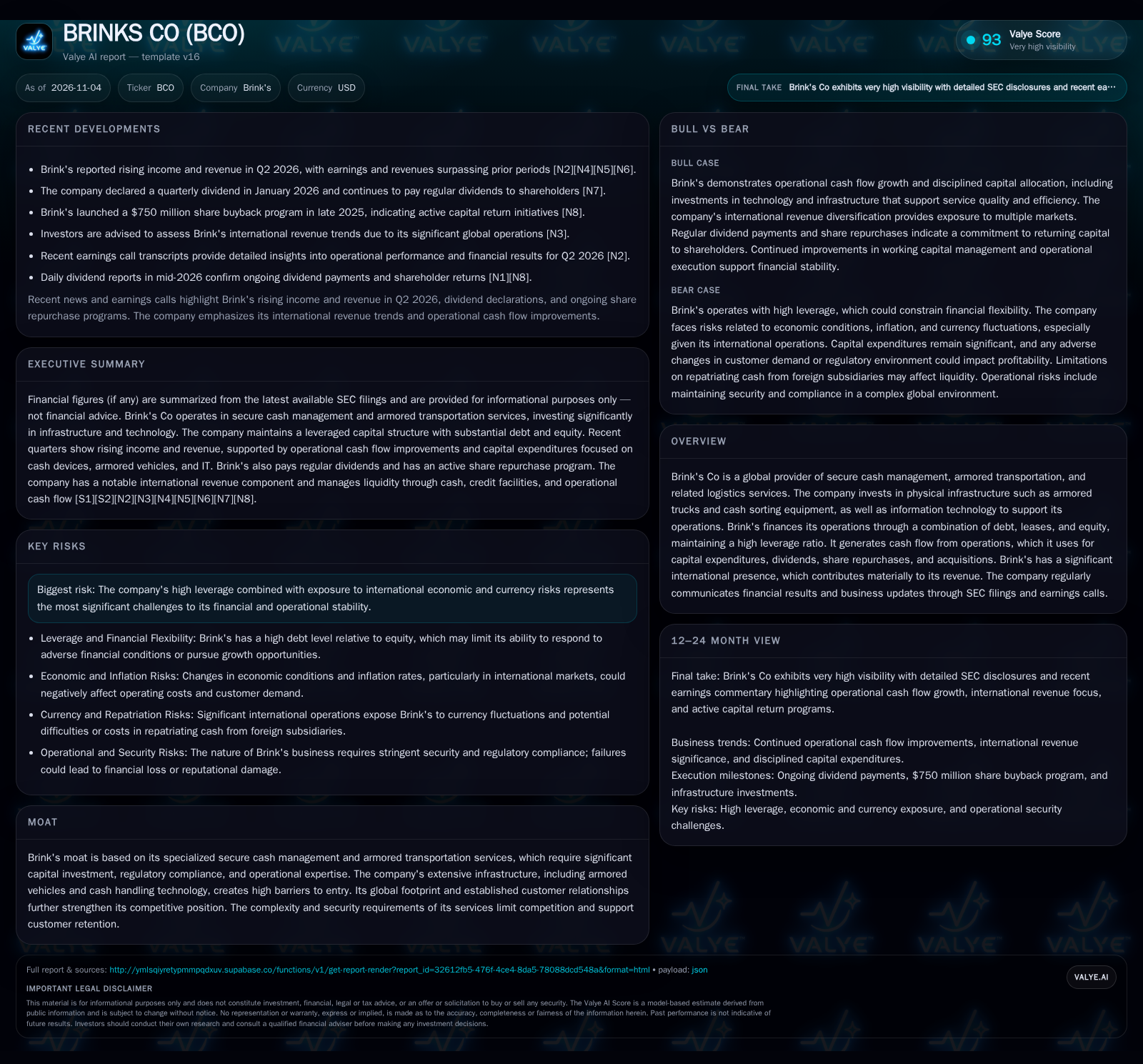
Brink’s Co has grown income and cash flow in 2026, with investments focused on physical and IT infrastructure and ongoing capital returns to shareholders. However, high leverage and global exposure introduce both opportunities and material risks. The business model’s resilience rests on operational discipline, capital allocation, and Brink’s ability to manage economic and currency volatility across diverse markets. [S1] [S2] [N2] [N3] [N6] [N7] [N8]
Brink’s Co, a global leader in secure cash management and armored transportation, enters late 2026 with rising operational income and strong cash generation, fueled by ongoing investments in infrastructure and technology. The company’s strategy of capital returns—via dividends and share repurchases—signals confidence in its core business. However, Brink’s substantial debt load and broad international exposure mean that execution risk, currency swings, and macroeconomic volatility remain central to the investment case. The coming quarters will test whether operational improvements and disciplined capital allocation can offset the inherent risks of a highly leveraged, globally diversified model.
Rising Earnings, High Leverage, and Global Reach Define Brink’s 2026 Landscape
Brink’s Co reported rising income and revenue in Q2 2026, with both metrics surpassing prior periods—an outcome attributed to improved operational execution and working capital management. Net income for the September 2026 quarter reached $14.5 million, with basic and diluted EPS of $0.35. [S2] [N2] [N6]
The company’s cash and cash equivalents stood at $1.563 billion as of September 30, 2026, supporting a current ratio of 1.55. However, Brink’s maintains a highly leveraged balance sheet, with $4.214 billion in debt and just $407 million in equity at the end of 2025. [S1] [S2]
Capital expenditures in 2025 remained substantial at $203.1 million, focused on cash devices, armored vehicles, and IT upgrades. [S1] International operations continue to be a meaningful source of revenue, increasing the company’s exposure to foreign currency and macroeconomic risks. [N3]
The company reported cash and liquidity metrics for the period; these figures do not by themselves establish operating runway, investment capacity, financial flexibility, or financing capacity. The ability to service debt without impairing capital investments or dividend distributions depends heavily on maintaining robust operating cash flows amid fluctuating economic conditions. Furthermore, the international footprint, while diversifying revenue streams, introduces complexity in managing currency mismatches on the balance sheet, potentially impacting reported equity and debt metrics through translation effects.
Cash Management Economics: Scale, Capital Intensity, and Operating Leverage
Brink’s business model revolves around secure cash logistics—bundling armored transportation, cash sorting, and related security services for banks, retailers, and governments. Revenue is primarily volume-driven, tied to the frequency and complexity of customer cash movements, with pricing reflecting risk, route density, and service level.
The economics are capital-intensive: recurring investment in armored vehicles, cash-handling technology, and IT systems is necessary to maintain service quality, regulatory compliance, and physical security. The company’s 2025 reinvestment ratio of 1.2 signals that capital expenditures slightly exceed depreciation, confirming ongoing infrastructure renewal. [S1]
Fixed costs—labor, fleet, facilities—are high, but the model offers operating leverage as route density and asset utilization improve. Variable costs (fuel, wages, insurance) can fluctuate with macro conditions, while pricing power is limited by contract durations and competitive bid processes.
Brink’s funds these investments through a mix of operating cash flow and significant leverage. [S1]
Barriers to Entry and the Realities of Secure Logistics Competition
Brink’s moat is rooted in the high capital and regulatory barriers inherent to secure cash management and armored transport. Building a comparable fleet, security infrastructure, and compliance capability requires significant upfront investment and deep operational expertise. This limits the number of credible global competitors.
Customer switching costs are substantial due to the mission-critical nature of secure transport and cash logistics—banks and retailers are reluctant to risk operational disruption or security lapses. However, price competition does occur, especially on large contracts, and alternative cashless payment models threaten long-term demand in some markets.
Competitors typically include other global cash management firms, regional security providers, and, in some cases, technology-driven entrants offering digital cash automation or cashless solutions. Brink’s international scale and established customer relationships provide some protection, but local incumbents and new fintech models remain persistent threats.
The company’s technology investments—such as DRS devices and IT integration—may support retention and differentiation if they deliver superior efficiency or security. However, sustained margin protection will likely depend on Brink’s ability to continually upgrade its service portfolio while managing cost inflation.
If Operational Leverage and International Execution Deliver, Cash Flow Could Outpace Debt Risk
A constructive scenario for Brink’s assumes that recent improvements in income and cash flow persist, driven by higher asset utilization, disciplined cost control, and successful international execution.
If international revenue growth offsets currency headwinds and inflation remains manageable, Brink’s could generate sufficient free cash flow to meaningfully deleverage over time.
Confirmation would come from sustained double-digit operating cash flow growth, stable or rising international margins, and a declining net leverage ratio. Evidence of successful contract renewals, new client wins, or expanded digital service offerings would further validate the thesis.
Stable Cash Generation Offsets Leverage, But Macro and Currency Risks Limit Upside
International diversification provides revenue stability, but also exposes the company to persistent currency swings and region-specific economic cycles.
Leverage remains elevated, constraining flexibility and making the company sensitive to interest rate volatility and refinancing risk. Capital intensity and competitive pricing pressures limit margin expansion, even as technology investments contain labor and security costs.
This scenario would be confirmed by consistent (but not accelerating) EPS and cash flow, a reported liquidity-ratio trends, and debt levels that do not materially decline. Evidence of margin resilience in the face of inflation or contract churn would strengthen the case for a stable, if unspectacular, cash management franchise.
If Economic Shocks or Currency Swings Hit, Leverage Magnifies Downside
A negative scenario unfolds if macroeconomic weakness, inflation, or currency devaluation erode international revenues and increase costs, particularly in emerging markets. If customer cash volumes decline or contract renewals falter, fixed costs could overwhelm operating leverage, compressing margins.
High debt service obligations would then constrain Brink’s ability to invest, adapt, or withstand shocks. Regulatory changes or security failures—especially in complex international markets—could compound operational risk, while cash repatriation issues might limit access to foreign earnings.
Downside confirmation would be visible in declining operating cash flow, rising debt-to-equity, and any suspension or reduction of dividends. Evidence of customer attrition, failed contract renewals, or escalating security incidents would further validate the risk case.
Testing Brink’s Thesis: Operating Metrics, Debt Trends, and International Outcomes to Track
Quarterly operating cash flow growth: Sustained increases would indicate successful operational execution; declines may signal margin or volume pressure.
Net leverage ratio (debt to EBITDA): A falling ratio would suggest deleveraging and lower financial risk; a rising ratio would raise concerns about flexibility and risk.
International revenue and margin trends: Detailed geographic breakdowns, if disclosed, would clarify the impact of currency swings and local economic cycles.
Capital expenditure discipline: Monitoring whether annual capex stays aligned with depreciation or escalates in response to competitive or regulatory pressures.
Contract renewal and customer retention rates: A useful metric, if disclosed, to test the stickiness of Brink’s client relationships and pricing discipline.
Security incident frequency or regulatory compliance disclosures: Would help assess operational risk and Brink’s ability to maintain its moat.
Disclaimer: This is research-only, informational analysis and not investment advice. It may include AI-generated interpretation and general industry context. Always verify important details using primary sources.

Comments