
Flutter Entertainment’s Restructuring Gamble: Efficiency Drive Meets Financial Tightrope
The company’s ability to translate operational reforms into sustainable margin improvement will be tested against execution risks, regulatory headwinds, and an intensely competitive betting landscape.
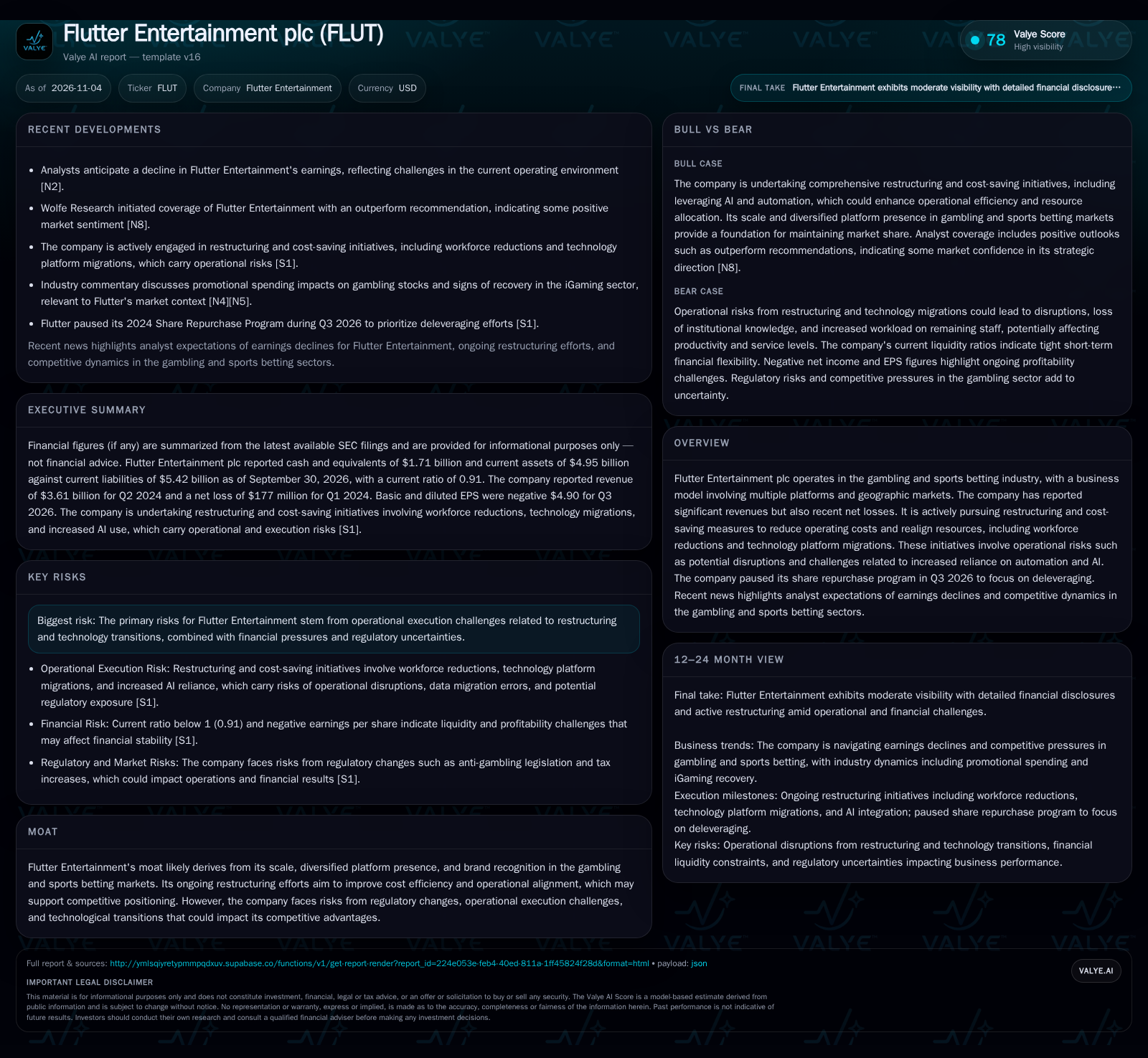
Flutter Entertainment is undertaking significant restructuring—including workforce reductions and technology migrations—to address ongoing net losses and a tight liquidity profile. The company’s near-term focus on deleveraging, combined with operational execution risks, sets the stage for a period of heightened volatility and uncertain margin recovery. Success will likely hinge on the effectiveness of its cost-saving initiatives and resilience against regulatory and market pressures [S1] [N2].
Flutter Entertainment plc is at a pivotal juncture, responding to mounting financial and operational pressures with an aggressive restructuring program that spans workforce reductions, platform overhauls, and a pivot toward automation and AI. With a current ratio below 1 and negative net income, the company’s liquidity and profitability are under scrutiny. The decision to pause its share repurchase program in favor of deleveraging signals a defensive posture, even as Flutter seeks to leverage its scale and platform breadth in a fiercely competitive gambling landscape. The coming quarters will test whether operational reforms can restore earnings momentum—or if execution risks and industry headwinds will deepen the company’s challenges.
Restructuring and Liquidity Constraints Shape Flutter’s Near-Term Outlook
Flutter Entertainment is in the midst of a comprehensive restructuring effort aimed at reducing operating costs and aligning resources with its strategic priorities. As of September 30, 2026, the company reported $1.71 billion in cash and cash equivalents, total current assets of $4.95 billion, and current liabilities of $5.42 billion, resulting in a current ratio of 0.91 and a cash ratio of 0.32 [S1]. These figures signal tight short-term liquidity, leaving little margin for operational missteps. The company posted negative net income for Q1 2024 and a negative EPS of $4.90 for Q3 2026, highlighting ongoing profitability issues [S1].
Flutter has paused its 2024 share repurchase program as of Q3 2026 to focus on deleveraging—a move that reflects both liquidity constraints and a shift in capital allocation priorities [S1]. The restructuring involves workforce reductions, cessation of certain operations, migration of technology platforms, and increased use of automation and AI, all of which introduce execution risks and the potential for operational disruptions [S1].
How Flutter’s Cost Base and Platform Scale Could Drive—or Limit—Margin Recovery
Flutter’s revenue engine is powered by a portfolio of gambling and sports betting platforms spanning multiple geographies. The business model typically combines high transaction volumes with relatively thin take rates, making operational efficiency and scale crucial for profitability. Fixed costs are elevated by technology infrastructure, regulatory compliance, and the need to invest in customer acquisition and retention, especially in newly liberalizing markets.
Recent net losses and curtailed buybacks suggest that, despite substantial revenue, Flutter’s cost base has outpaced its ability to generate free cash flow. The shift toward automation and AI, alongside workforce reductions, is designed to compress variable and fixed operating expenses. If successful, this could restore operating leverage—where incremental revenues drop more profitably to the bottom line. However, the upfront costs and risks of technology migrations, alongside the potential loss of institutional knowledge, could delay or dilute these benefits.
Capital needs remain material: ongoing technology upgrades, regulatory changes, and periodic spikes in promotional spending all require cash outlays. The company reported cash and liquidity metrics for the period; these figures do not by themselves establish operating runway, investment capacity, financial flexibility, or financing capacity.
Scale, Brand Breadth, and Technology—But Competitive Moats Are Under Pressure
Flutter’s competitive position historically rests on its scale, multi-platform presence, and brand recognition across global gambling and sports betting markets. These factors can confer advantages in marketing efficiency, cross-selling, and negotiating power with suppliers and leagues. However, competitive intensity remains high, with digital-native rivals, regional operators, and new entrants leveraging aggressive promotional spend and localized offerings.
Technology is a double-edged sword: While platform migration and AI adoption could lower costs and improve customer experience, they also introduce integration risks and could erode differentiation if competitors achieve similar automation. Regulatory volatility further complicates the landscape, as adverse legislation or tax increases can rapidly alter market dynamics and cost structures.
Switching frictions in online gambling are moderate at best: customers can often move between platforms with relative ease, especially when lured by promotions or superior product features. Retention, therefore, is not guaranteed by brand alone—making constant innovation and operational excellence critical to sustaining share.
If Restructuring Delivers: Margin Expansion and Strategic Flexibility
The best-case scenario for Flutter is that its restructuring and technology investments yield rapid, sustainable reductions in operating costs without significant disruption to customer experience or regulatory compliance. Automation and platform consolidation could enable the company to scale more efficiently, freeing up resources for targeted growth investments and potentially restoring positive net income.
If these savings are realized ahead of schedule, Flutter could regain the capacity to reinstate shareholder returns, invest in product innovation, or pursue selective geographic expansion. Evidence confirming this scenario would include a clear inflection in operating margins, a return to positive net income and EPS, and improved liquidity ratios (current ratio rising above 1). Additional signs would be stable or growing market share in core geographies, with no reported service outages or regulatory setbacks stemming from technology migrations.
Operational Reforms Meet Industry Headwinds: A Volatile Recovery
The most plausible trajectory is that Flutter’s restructuring delivers incremental, but not transformative, cost savings over the next several quarters. While automation and workforce reductions may eventually improve margins, initial progress could be uneven due to transition costs, potential operational hiccups, and the need to maintain promotional spending in a competitive environment. Revenue growth may remain muted if market share is stable but not expanding, and if regulatory constraints limit upside in key regions.
Under this scenario, profitability gradually improves but remains vulnerable to shocks—such as adverse regulatory events, technology integration failures, or renewed competitive escalation. Confirming evidence would include modest sequential improvement in operating margins, stabilization of net income (though possibly still negative), and no material deterioration in liquidity or customer metrics. Falsification would come from continued net losses, worsening liquidity ratios, or operational disruptions impacting customer retention.
Execution Failures and Market Shocks Amplify Financial Risk
A negative outcome could unfold if operational execution falters—such as technology migrations causing service failures, regulatory breaches, or loss of key personnel undermining business continuity. In this scenario, cost savings fail to materialize or are offset by unforeseen expenses and revenue attrition.
External shocks, such as new restrictive gambling regulations or a sharp increase in competitive promotional intensity, could exacerbate pressures. Evidence confirming this scenario would include operational disruptions, customer churn, further negative earnings surprises, downgrades in analyst coverage, or a marked decline in current and cash ratios. Falsification would require clear demonstration of operational stability and margin improvement, even amid external headwinds.
Thesis-Testing Developments to Track in Flutter’s Restructuring Phase
Sequential changes in operating margin and net income over the next several quarters, to determine if cost savings are translating into actual profitability improvements.
Updates on the status and impact of technology platform migrations, including any reported operational disruptions, customer complaints, or regulatory issues.
Movement in the current and cash ratios—evidence of improving or further tightening liquidity conditions.
Disclosure of workforce reduction progress and its impact on productivity, customer service, and employee turnover, if disclosed.
Market share trends in core geographies, especially in the face of continued competitive pressure and promotional intensity—a useful metric would be customer retention rates if disclosed.
Announcements regarding the resumption or further suspension of share repurchases, which would signal management’s confidence in potential financial flexibility.
Regulatory developments in major operating regions, including new legislation, tax changes, or enforcement actions that could impact business economics.
Incidents or commentary around the use of automation and AI in operations—both as a source of cost savings and as a potential operational risk.
Disclaimer: This is research-only, informational analysis and not investment advice. It may include AI-generated interpretation and general industry context. Always verify important details using primary sources.

Comments