
uniQure in 2026: Huntington’s Gene Therapy at an FDA Crossroads
With ifezuntirgene inilparvovec under FDA priority review and clinical data raising questions about efficacy, uniQure faces a pivotal year.
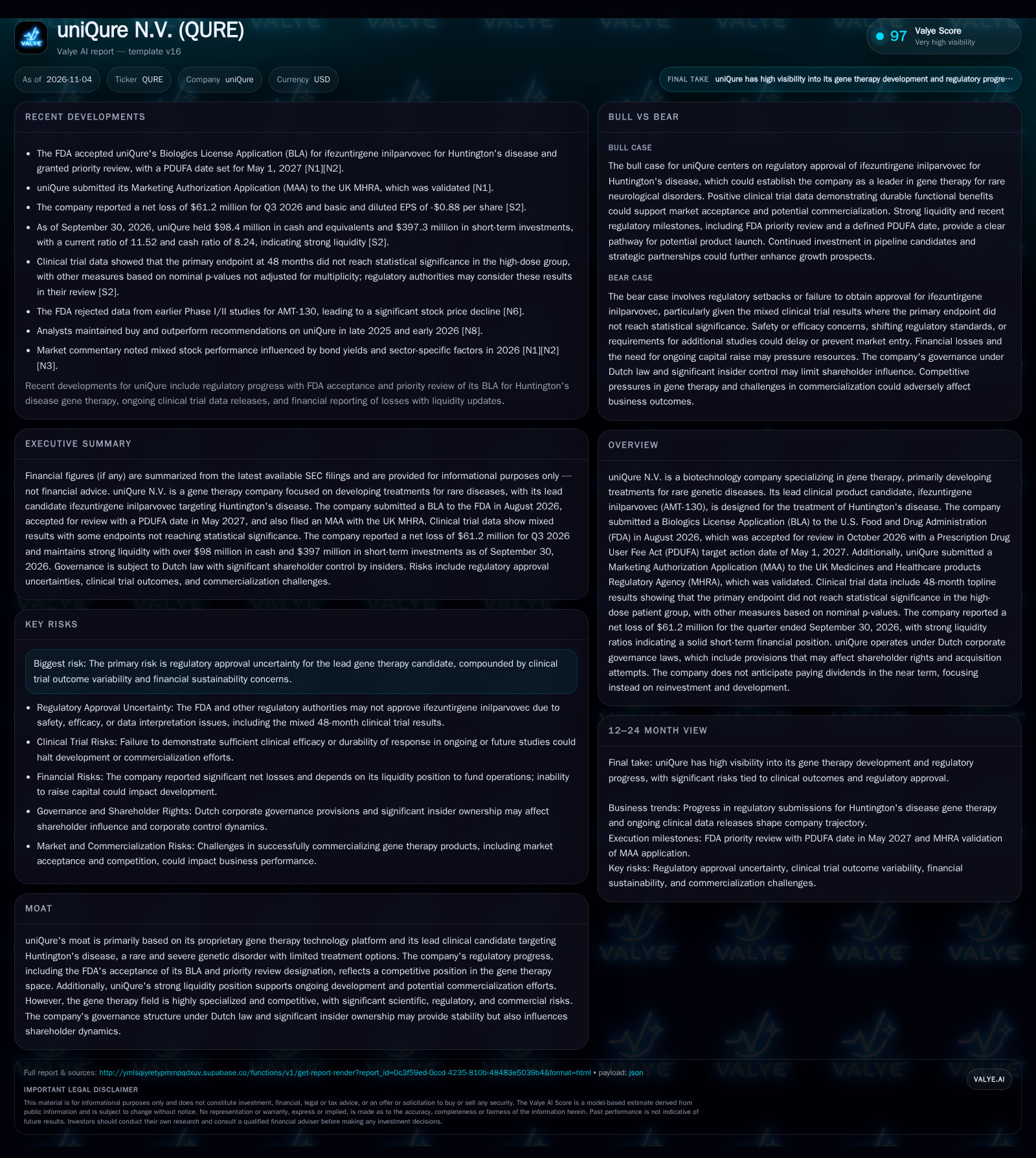
uniQure’s lead gene therapy candidate for Huntington’s disease is under FDA priority review, but mixed 48-month clinical data leave regulatory approval uncertain. Investors should focus on regulatory milestones, commercial execution plans, and pipeline progress as key determinants of future value. [S2]
uniQure N.V. enters late 2026 at a defining moment: its first major gene therapy, ifezuntirgene inilparvovec for Huntington’s disease, is now in the hands of regulators after a long and costly development path. While the FDA’s acceptance of the BLA and priority review signals regulatory traction, lingering doubts about clinical efficacy inject real uncertainty into the approval process. With nearly $500 million in cash and short-term investments, uniQure has the resources to navigate the next phase—but faces a classic biotech test: can scientific promise be converted into real-world patient and shareholder value?
Regulatory Review and Financial Position Define uniQure’s Pivotal Year
uniQure’s most immediate catalyst is the FDA’s ongoing priority review of ifezuntirgene inilparvovec for Huntington’s disease, following BLA acceptance in October 2026 and a scheduled PDUFA action date of May 1, 2027. This milestone represents the culmination of years of R&D investment and will determine whether uniQure transitions from a clinical-stage to a commercial-stage company. However, the pivotal trial’s 48-month topline data failed to reach statistical significance on the primary endpoint in the high-dose cohort—a fact that introduces substantial regulatory risk, as the FDA and other agencies may interpret these results differently than management’s nominally positive take. [S2]
On the financial side, uniQure reported a Q3 2026 net loss of $61.2 million, consistent with the high burn rates typical of late-stage biotech firms. Importantly, the company holds $98.4 million in cash and $397.3 million in short-term investments as of September 30, 2026. The company reported cash and liquidity metrics for the period; these figures do not by themselves establish operating runway, investment capacity, financial flexibility, or financing capacity. [S2]
Governance is shaped by Dutch corporate law, with insider and major shareholder control potentially affecting both strategic flexibility and the attractiveness of the company as an acquisition target. [S2]
Gene Therapy Economics: High Stakes, High Upfront Investment, Uncertain Returns
uniQure’s business model is emblematic of advanced gene therapy companies: years of high cash burn to develop a single transformative therapy, followed by the potential for large, infrequent revenue events if the product is approved and adopted. If successful, gene therapies for rare diseases can command premium pricing—sometimes in the range of hundreds of thousands to over a million dollars per dose—reflecting their one-time or durable intervention profile and the lack of alternative treatments.
However, the economics are fundamentally binary: absent approval, there is little to no revenue, while approval could create a step-change in cash flow. Even with approval, initial revenues depend on patient identification, payor acceptance, and the ability to scale manufacturing and distribution. For Huntington’s disease, the addressable population is relatively limited, which places a ceiling on volume but could allow for high per-patient pricing if the product is viewed as providing substantial functional benefit.
Operating leverage is extreme: R&D and SG&A are largely fixed until a product is commercialized, at which point gross margins could be attractive if manufacturing and distribution are efficiently scaled. Capital needs remain significant, both to support further pipeline development and to prepare for commercial launch, including investment in medical affairs, market access, and post-marketing studies. Should the initial launch succeed, follow-on pipeline assets could benefit from platform synergies and established commercial infrastructure.
Navigating a Crowded and Rapidly Evolving Gene Therapy Landscape
uniQure’s competitive positioning in the gene therapy market is defined by its focus on Huntington’s disease—a rare, fatal neurodegenerative disorder with limited treatment options. The company’s lead candidate, ifezuntirgene inilparvovec, is among the most advanced gene therapies in this indication. This gives uniQure a potential first-mover advantage if approval is secured.
However, the broader gene therapy field is intensely competitive and marked by rapid scientific advances. Large pharmaceutical companies, other biotech players, and academic spinouts are all pursuing gene therapies for various CNS and rare disease targets. Substitution risk is significant: should another company demonstrate superior efficacy, safety, or durability in Huntington’s or adjacent indications, uniQure’s commercial window could narrow quickly.
Barriers to entry in gene therapy remain high due to manufacturing complexity, regulatory hurdles, and the specialized expertise required. Yet, these same barriers do not guarantee commercial success—especially if clinical efficacy is equivocal or payors balk at high pricing. Platform breadth, IP protection, and the ability to execute on additional pipeline assets will be critical for maintaining any sustainable edge.
A Regulatory Green Light Unlocks Commercial and Pipeline Potential
The most favorable scenario sees the FDA and other regulators grant approval to ifezuntirgene inilparvovec, accepting the totality of evidence as sufficient for a meaningful clinical benefit in Huntington’s disease. In this case, uniQure could launch the first approved gene therapy for this devastating condition, commanding premium pricing and establishing itself as a leader in CNS gene therapy.
Confirmation of this scenario would come from a positive Advisory Committee vote, regulatory approval decisions, and early evidence of payor coverage and patient uptake. Commercial success could provide the cash flow and credibility needed to accelerate pipeline development and potentially attract strategic partners or acquirers.
Falsification would occur if the FDA or other agencies reject the BLA or require additional trials, undermining both near-term revenue prospects and longer-term pipeline viability.
Mixed Clinical Evidence Leads to a Protracted Approval and Uptake Process
The most plausible outcome is a nuanced regulatory process: the FDA may seek additional data, impose post-marketing requirements, or grant approval for a narrower patient subset. Commercial uptake could be gradual, as clinicians and payors assess the real-world benefit in light of the mixed efficacy data.
Evidence for this scenario would include regulatory delays, requests for more data, or conditional approvals with restricted labeling. Uptake metrics—such as initial patient starts, reimbursement rates, and real-world outcomes—would likely show a slow ramp as the medical community builds confidence in the therapy.
Falsification would come from either an outright rejection (pushing the scenario to the downside) or unexpectedly rapid and broad adoption (shifting toward the upside case).
Regulatory Setback and Commercial Hurdles Derail uniQure’s Transition
In the adverse scenario, regulators determine that the pivotal trial’s failure to reach statistical significance on the primary endpoint is a fatal flaw, leading to a BLA rejection or a requirement for additional, costly trials. This would delay or cancel the near-term revenue opportunity and force uniQure to continue operating as a pre-commercial biotech, burning cash without a clear path to market.
Further downside could come from safety issues, competitive advances, or inability to secure reimbursement even if the product is approved. Evidence would include negative regulatory decisions, clinical holds, or disclosures of payor pushback and slow patient uptake.
Recovery from this scenario would likely require cost-cutting, additional capital raises, or a strategic reset focused on other pipeline assets—a challenging prospect given the concentration of value in the lead asset.
Milestones and External Factors That Will Shape uniQure’s Value Proposition
Outcome of the FDA Advisory Committee meeting and clarity on the regulatory stance regarding the interpretation of the pivotal trial’s mixed results.
Actual FDA decision on the BLA for ifezuntirgene inilparvovec by or before the May 2027 PDUFA date.
Early signals on payor willingness to reimburse for the therapy and the pricing framework ultimately achieved, if approved.
Initial patient uptake rates, including number of treated patients and market penetration, would help test commercial viability.
Updates on post-marketing requirements or additional data requests from regulators, which could affect both costs and market access.
Progress of pipeline assets and any new clinical data or regulatory submissions that diversify the company’s risk profile.
Any announced strategic partnerships, licensing deals, or acquisition interest—especially in the wake of regulatory outcomes.
Changes in insider ownership, board composition, or governance structure that could influence strategic direction or capital allocation.
Disclaimer: This is research-only, informational analysis and not investment advice. It may include AI-generated interpretation and general industry context. Always verify important details using primary sources.

Comments