
Rapport Therapeutics: Clinical Milestones, Capital Strength, and the Stakes of Neurology Drug Development
With RAP-219 demonstrating positive Phase II results in bipolar mania and epilepsy, and a reported liquidity position, Rapport Therapeutics faces a classic biopharma inflection: can it convert clinical promise and regional partnerships into regulatory approval and commercial traction before capital needs intensify?
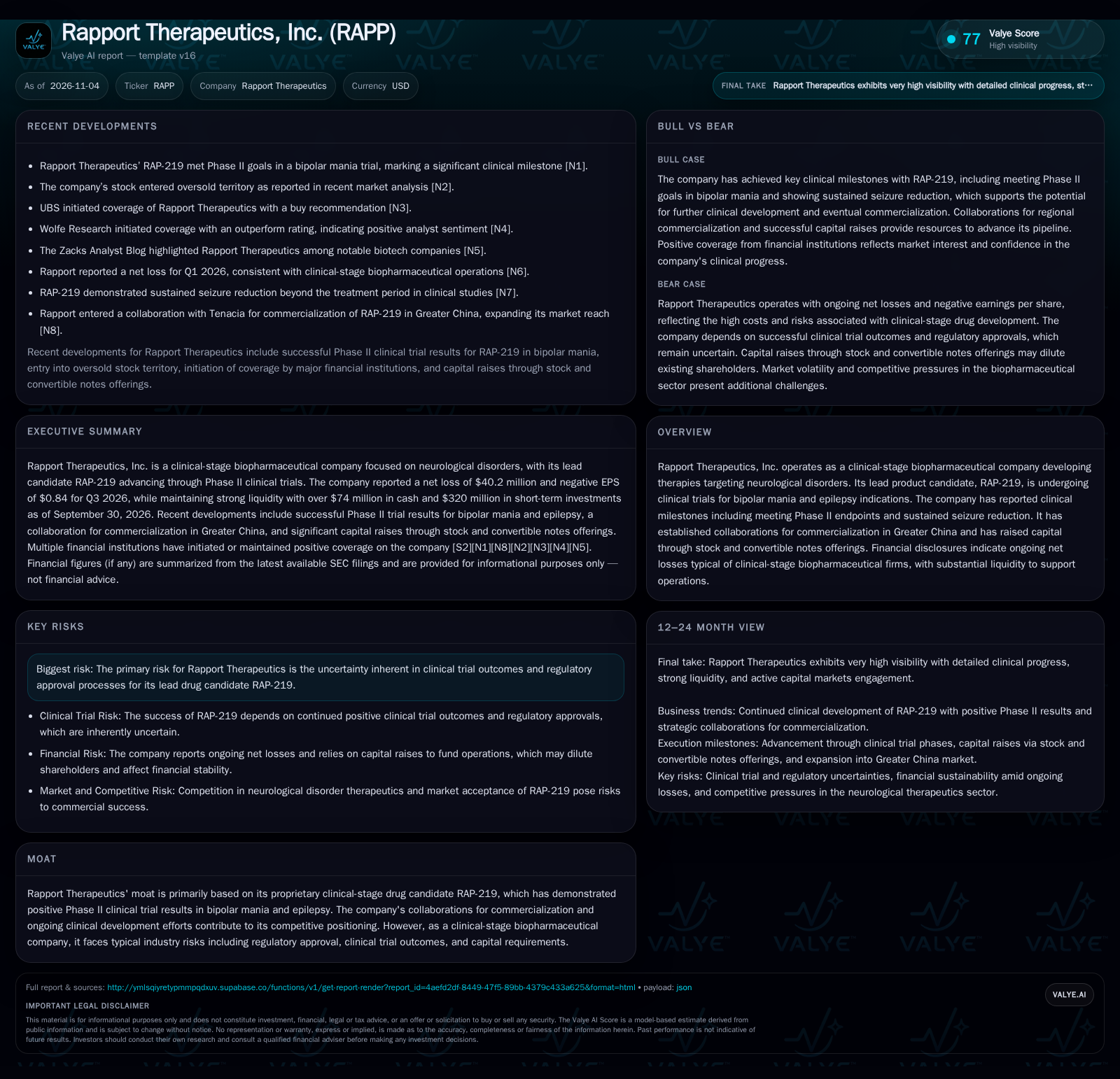
Rapport Therapeutics’ lead candidate RAP-219 has met key Phase II endpoints in bipolar mania and sustained seizure reduction, while the company maintains reported liquidity position with over $395 million in cash and short-term investments as of September 2026. A new commercialization partnership in Greater China expands potential market reach. The company remains loss-making, reflecting the high-risk, high-investment nature of clinical-stage biopharma, with future value hinging on further clinical and regulatory progress and eventual market acceptance. [S2] [N1] [N7] [N8]
Rapport Therapeutics sits at a pivotal point in its trajectory: its lead asset, RAP-219, has now cleared important Phase II clinical hurdles in bipolar mania and epilepsy, supporting the case for continued advancement toward late-stage trials. With nearly $400 million in liquidity, the company is well-positioned to pursue these next steps while managing the persistent losses typical of clinical-stage biotechs. However, the transition from promising data to regulatory approval and commercial uptake—especially in crowded neurological indications—will ultimately determine whether Rapport’s recent progress translates into durable shareholder value.
Phase II Success and Capital Position Define the Near-Term Outlook
Rapport Therapeutics’ lead drug candidate, RAP-219, has achieved positive Phase II results in bipolar mania and demonstrated sustained seizure reduction beyond the treatment period in epilepsy trials. These milestones mark crucial clinical validation steps, increasing the likelihood of advancing to pivotal Phase III studies or strategic partnerships. The company reported a net loss of $40.2 million for Q3 2026, consistent with the high burn rates typical of this sector. Additionally, Rapport’s recent collaboration with Tenacia for the commercialization of RAP-219 in Greater China opens new market opportunities beyond the U.S. and Europe. [S2] [N1] [N7] [N8]
How Rapport’s Business Model Could Unlock Value—Or Amplify Risk
Like most clinical-stage biopharma firms, Rapport Therapeutics generates no product revenue and relies on external capital to fund R&D, clinical trials, and overhead. The core economic engine is the potential future value of RAP-219, predicated on its ability to achieve regulatory approval and commercial adoption in large neurological markets such as bipolar disorder and epilepsy. If successful, pricing for CNS (central nervous system) drugs can be robust, particularly for first-in-class or best-in-class therapies addressing unmet needs. However, fixed costs remain high until commercialization, with variable expenses scaling with trial scope and geography.
Operating leverage is significant: if RAP-219 advances to market, incremental revenue may far outpace the additional costs, particularly if the company can expand indications or geographic reach (e.g., via the Tenacia collaboration). Conversely, the capital intensity and long timelines mean that delays or negative clinical outcomes can rapidly erode balance sheet strength. The structure and economics of the Tenacia partnership are not disclosed, but such arrangements often involve upfront payments, milestones, and royalties, providing non-dilutive capital and risk-sharing but also limiting upside in partnered territories.
Capital needs are likely to remain high until at least one asset is approved and generating revenue, and future funding rounds—via equity or partnerships—are probable unless near-term value inflections (e.g., a lucrative licensing deal or acquisition) occur.
Navigating a Crowded Neurology Landscape: Differentiation and Defensibility
The competitive environment for CNS therapeutics is intense, with numerous incumbents and emerging players targeting bipolar disorder and epilepsy. Differentiation in efficacy, safety, or patient convenience is essential for securing market share. RAP-219’s positive Phase II results are encouraging, but the durability, magnitude, and risk-benefit profile relative to existing therapies will be critical in later-stage trials and commercial positioning.
Switching costs for prescribers and patients can be moderate in neurology, where therapeutic inertia and payer scrutiny are significant barriers. However, unmet needs—especially for patients refractory to current treatments—can create openings for new entrants. The company’s regional collaboration with Tenacia may provide strategic access to the Greater China market, where regulatory and commercial landscapes differ from Western markets, but also introduces execution and partnership risks.
Rapport’s moat currently rests on its proprietary clinical data and intellectual property around RAP-219. Without established commercial infrastructure or a diversified pipeline, the company is vulnerable to setbacks in its lead program and to rapid shifts in competitive dynamics.
If RAP-219 Proves Out: Accelerated Value Creation Through Late-Stage Success and Global Expansion
In a favorable scenario, RAP-219 continues to demonstrate robust efficacy and safety in Phase III trials, leading to regulatory approvals in major markets. The Greater China collaboration with Tenacia could accelerate access and uptake in that region, providing early non-dilutive revenue through milestones or royalties. Positive Phase III data, especially showing advantages over standard-of-care, would likely attract additional licensing or co-development partners, or even acquisition interest from larger pharmaceutical companies seeking to bolster CNS portfolios.
Key confirming evidence would include: initiation and rapid enrollment of pivotal trials, regulatory fast-track or breakthrough therapy designations, announcement of upfront or milestone payments from Tenacia or other partners, and early feedback from payers or key opinion leaders supporting RAP-219’s clinical and economic value. Downstream, first commercial sales or strong pre-launch demand forecasts would further validate the upside case.
Clinical Progress Continues, But Value Realization Remains Down the Road
The most plausible near-term scenario is that Rapport advances RAP-219 into late-stage clinical trials, incurring continued operating losses and high cash burn as it seeks pivotal data. Analyst coverage remains positive, reflecting optimism about the clinical trajectory, but the company’s valuation will likely remain sensitive to trial progress, regulatory feedback, and sector-wide risk sentiment.
This scenario would be confirmed by steady trial enrollment, ongoing R&D spend in line with prior quarters, and periodic pipeline updates without major clinical setbacks. Signs of extended timelines, increased competition, or lack of additional partnerships would temper the outlook, but would not fundamentally shift the trajectory unless accompanied by negative data.
Setbacks in Clinical Data or Delayed Timelines Could Trigger Dilution and Erode Value
The principal risk is that RAP-219 encounters efficacy or safety issues in late-stage trials, or that regulatory agencies require additional data, delaying timelines and increasing costs. In this scenario, Rapport’s cash reserves could be depleted more rapidly, forcing the company to raise dilutive capital at unfavorable terms or to scale back development ambitions. Failure to secure additional partnerships or upfront payments would heighten this risk.
Downside confirmation would come from negative or equivocal late-stage trial results, regulatory setbacks (such as clinical holds or requests for additional studies), or disclosures of sharply increased cash burn and the need for near-term financing. Loss of analyst support and declining peer sentiment could exacerbate pressure on both valuation and access to capital.
Milestones That Will Shape Rapport’s Trajectory in Neurological Therapeutics
Progression of RAP-219 into Phase III trials, including trial design, enrollment rates, and any regulatory feedback on endpoints or study structure.
Updates on the Tenacia collaboration: upfront payments, milestone achievements, regulatory submissions, and early commercial planning in Greater China.
Cash burn rate and projected runway, particularly in relation to expected trial timelines and any changes in operating expense structure.
Announcement of additional partnerships, licensing agreements, or non-dilutive financings that could extend capital runway or validate RAP-219’s market potential.
Emergence of competitive data or new entrants in the bipolar mania and epilepsy treatment spaces that could impact commercial prospects or payer positioning.
If disclosed, feedback from regulatory agencies (FDA, NMPA) on RAP-219’s trial data and submission readiness.
Analyst and institutional coverage trends, especially any material changes in sentiment or coverage following new data releases.
Disclaimer: This is research-only, informational analysis and not investment advice. It may include AI-generated interpretation and general industry context. Always verify important details using primary sources.

Comments