
Atlanta Braves Holdings in 2026: BravesVision’s Gamble, Debt Pressure, and the Stakes of Direct Media Control
Braves Holdings’ transition from third-party media to direct broadcasting with BravesVision marks a pivotal shift in its revenue model.
Atlanta Braves Holdings has launched BravesVision, taking control of its media distribution and advertising, while managing $741 million in stadium and development debt. Execution on direct broadcasting and tenant retention will determine whether Braves Holdings can convert its asset base and brand strength into resilient, diversified cash flows.
Atlanta Braves Holdings, Inc. stands at a crossroads in late 2026, having pivoted from third-party regional sports networks to direct media operations with the launch of BravesVision. The success or failure of BravesVision, tenant stability in the Mixed-Use Development, and the ability to manage operational disruptions will define whether Braves Holdings can transform its brand and asset base into a more durable, multi-channel sports and entertainment platform.
BravesVision Debuts Amid Heavy Debt and Tight Liquidity
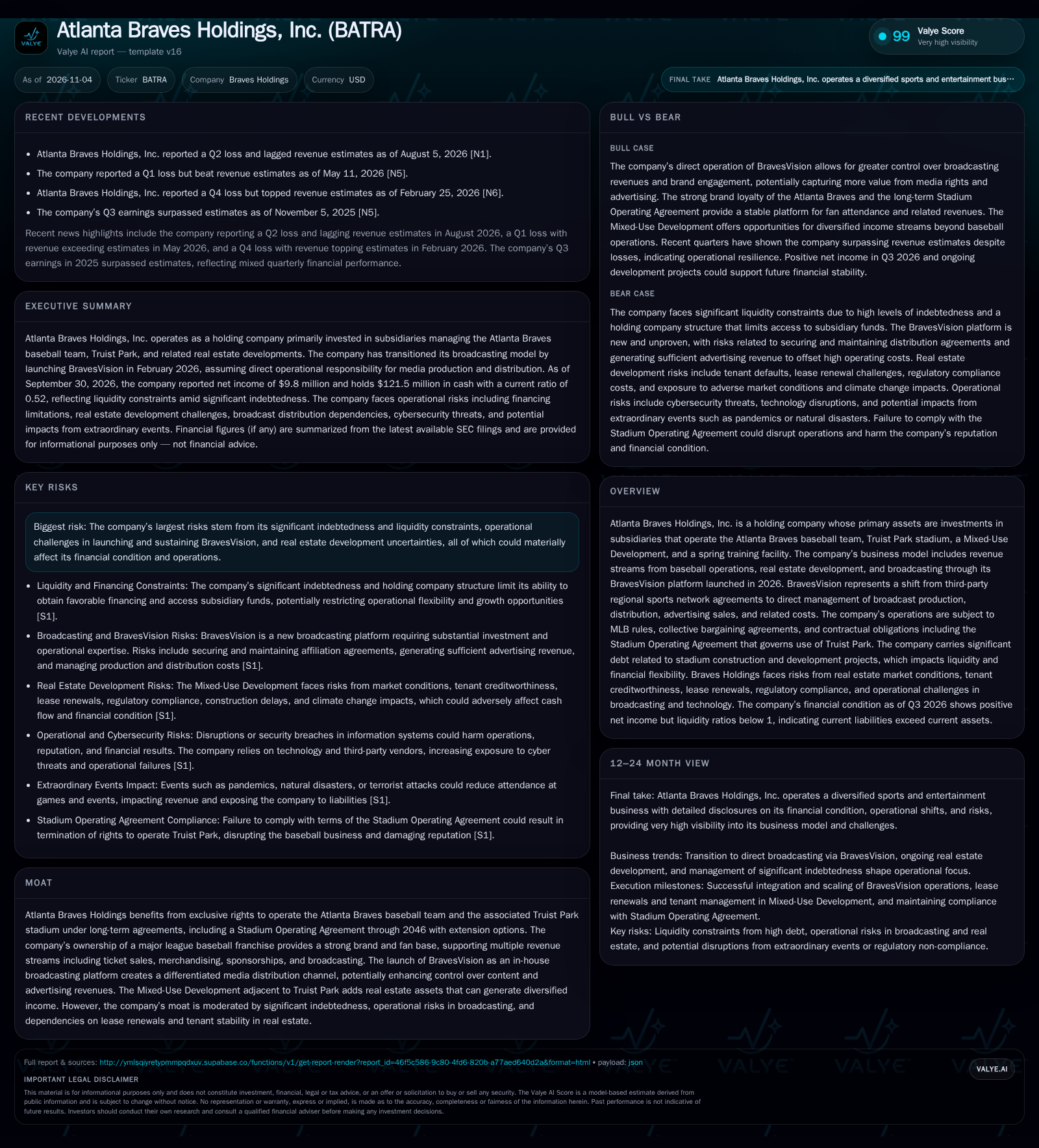
The most material development for Atlanta Braves Holdings in 2026 is the launch of BravesVision, its in-house multimedia platform for broadcasting Braves games. This transition from third-party regional sports network deals to self-managed production, distribution, and advertising signals a major shift in both risk and potential reward for the company [S1]. The company reported cash and liquidity metrics for the period; these figures do not by themselves establish operating runway, investment capacity, financial flexibility, or financing capacity. [S2]
The company’s debt load is substantial, with $223.8 million outstanding for Truist Park stadium, $487.3 million tied to the Mixed-Use Development, and $30 million for the spring training facility as of year-end 2025 [S1]. While Q3 2026 saw positive net income of $9.8 million, the company has experienced recent quarterly losses and revenue volatility [N1] [N5] [N6].
These facts matter because Braves Holdings’ ability to manage the operational complexity and upfront costs of BravesVision, while servicing debt and maintaining liquidity, will determine whether the new media strategy can be a sustainable value driver—or a source of new financial strain.
How Braves Holdings Makes—and Risks—Its Money
The company’s business model now fuses three primary revenue streams: core baseball operations (ticket sales, licensing, sponsorships), real estate income from the Mixed-Use Development, and direct media monetization via BravesVision. Each stream has distinct economics and risk profiles.
BravesVision introduces both revenue upside and cost complexity. Instead of receiving a fixed or formulaic share from a regional sports network, Braves Holdings now bears responsibility for production, distribution, advertising sales, and affiliate negotiations. If the company secures strong MVPD/vMVPD carriage and advertising demand, BravesVision could yield higher margins over time; however, the platform also exposes Braves Holdings to fixed costs for technology, content, and personnel, as well as variable costs that may fluctuate seasonally or with audience ratings.
Real estate economics hinge on occupancy, tenant quality, and lease renewals. The Mixed-Use Development can provide recurring rental income, but market conditions, tenant defaults, or lease churn could pressure cash flows and raise refinancing risk. Meanwhile, stadium operations benefit from a long-term lease and a loyal fan base, but are vulnerable to attendance shocks, labor disputes, or extraordinary events.
High leverage amplifies both upside and downside. Interest expense and required debt amortization reduce potential financial flexibility, especially when current liabilities exceed current assets. The holding company structure may further limit the ability to move cash between subsidiaries or access external financing on favorable terms.
Brand Strength Meets Broadcast and Real Estate Rivalry
Atlanta Braves Holdings enjoys a unique position as the exclusive operator of a Major League Baseball franchise in a major market, with the associated stadium and real estate assets. This brand and fan base confer advantages in ticket sales, merchandising, and sponsorships that are difficult for new entrants to replicate.
However, BravesVision enters a fiercely competitive media environment. Regional sports networks are under pressure from cord-cutting, while national platforms and streaming services compete for sports rights and audience attention. Braves Holdings must now secure carriage with MVPDs and vMVPDs—entities with negotiating leverage and alternative programming options. The risk is that BravesVision could face distribution bottlenecks or unfavorable terms, especially if consumer preferences shift toward streaming or if advertisers pull back.
In real estate, the Mixed-Use Development must compete with other entertainment districts, office parks, and mixed-use centers for tenants and foot traffic. Lease renewals and occupancy rates may be pressured by local economic cycles or broader commercial real estate trends. Braves Holdings’ competitive edge depends on maintaining a vibrant, year-round destination linked to the team’s brand and events calendar.
If BravesVision Captures the Audience: Direct Media Profits and Diversification
In a favorable scenario, Braves Holdings successfully negotiates carriage for BravesVision across major MVPDs and vMVPDs, ensuring broad distribution and stable affiliate fees. Strong audience engagement—bolstered by the Braves’ brand and on-field performance—attracts premium advertisers and enables the company to command higher CPMs, offsetting production and technology investments.
If the Mixed-Use Development maintains high occupancy, with creditworthy tenants and successful lease renewals, real estate income could provide a reliable counterbalance to the more volatile baseball and media segments. The company’s long-term stadium agreement sustains core operations, while diversified revenue streams reduce sensitivity to any single shock.
Evidence that would confirm this scenario includes: expanding BravesVision distribution deals, rising advertising revenue and viewership metrics (if disclosed), stable or rising real estate occupancy rates, and consistent positive net income with improving liquidity ratios.
Managing Complexity: Incremental Progress but Ongoing Strain
The most plausible trajectory is one of incremental progress and persistent challenges. Braves Holdings may achieve modest success with BravesVision—securing key distribution agreements but at less favorable terms than legacy regional sports networks, while advertising revenue is subject to sports performance and macroeconomic trends.
Real estate income may remain steady but not materially expand, as tenant churn and market headwinds offset new leases. The company continues to generate positive net income in some quarters but struggles to build a liquidity buffer, with debt service and operating costs constraining flexibility.
Confirmation of this scenario would be continued quarterly profits interspersed with losses, stable but not expanding occupancy in the Mixed-Use Development, and liquidity ratios that remain below 1 but do not deteriorate further. Falsification would occur if BravesVision fails to secure meaningful distribution or if a major tenant defaults, causing a sharp drop in cash flows.
When Debt and Distribution Risks Collide: The Case for Financial Distress
In a negative scenario, BravesVision struggles to secure MVPD/vMVPD carriage, limiting distribution and advertising reach, while production and technology costs remain high. Audience fragmentation and advertising weakness could lead to operating losses in the media segment.
If the real estate market weakens or key tenants default, rental income could fall short of debt service requirements, especially given the company’s already tight liquidity. A failure to comply with the Stadium Operating Agreement—perhaps due to cash shortfalls or operational disruptions—could trigger contractual penalties or even jeopardize the right to play at Truist Park, severely damaging core operations and reputation.
Evidence for this scenario would include a sustained drop in reported advertising or rental revenues (if disclosed), deteriorating liquidity ratios, missed debt payments, or public disclosures of challenges in securing broadcast distribution or tenant renewals.
Milestones That Will Test Braves Holdings’ Direct Media and Diversification Thesis
BravesVision distribution reach: The number and quality of MVPD/vMVPD carriage agreements signed, including any disclosures on subscriber counts or geographic coverage, will be crucial for revenue and audience scale.
Advertising revenue trends: Reported advertising sales and CPMs (if disclosed) from BravesVision broadcasts will indicate whether direct control is translating into higher monetization or falling short of expectations.
Mixed-Use Development occupancy: Quarterly updates on tenant occupancy rates, lease renewals, and tenant quality would help gauge the stability and resilience of real estate income.
Liquidity ratio evolution: Monitoring whether the company can improve its current and cash ratios, particularly in the wake of BravesVision’s ramp-up and real estate performance.
Debt service coverage: Any disclosures on interest expense, debt amortization schedules, and the company’s ability to meet these obligations from operating cash flows.
Stadium Operating Agreement compliance: Updates on compliance status and any risks of breach—especially if operational or financial pressures mount.
Cybersecurity or operational disruptions: Any incidents or disclosures regarding technology outages or cyber threats impacting BravesVision or stadium operations.
Extraordinary event impact: Attendance and revenue trends following weather events, pandemics, or other external shocks that could test the resilience of both game-day and non-baseball revenues.
Disclaimer: This is research-only, informational analysis and not investment advice. It may include AI-generated interpretation and general industry context. Always verify important details using primary sources.

Comments