
NewAmsterdam Pharma in Late 2026: CETP Inhibition, Cardiometabolic Opportunity, and the Stakes of Regulatory and Commercial Execution
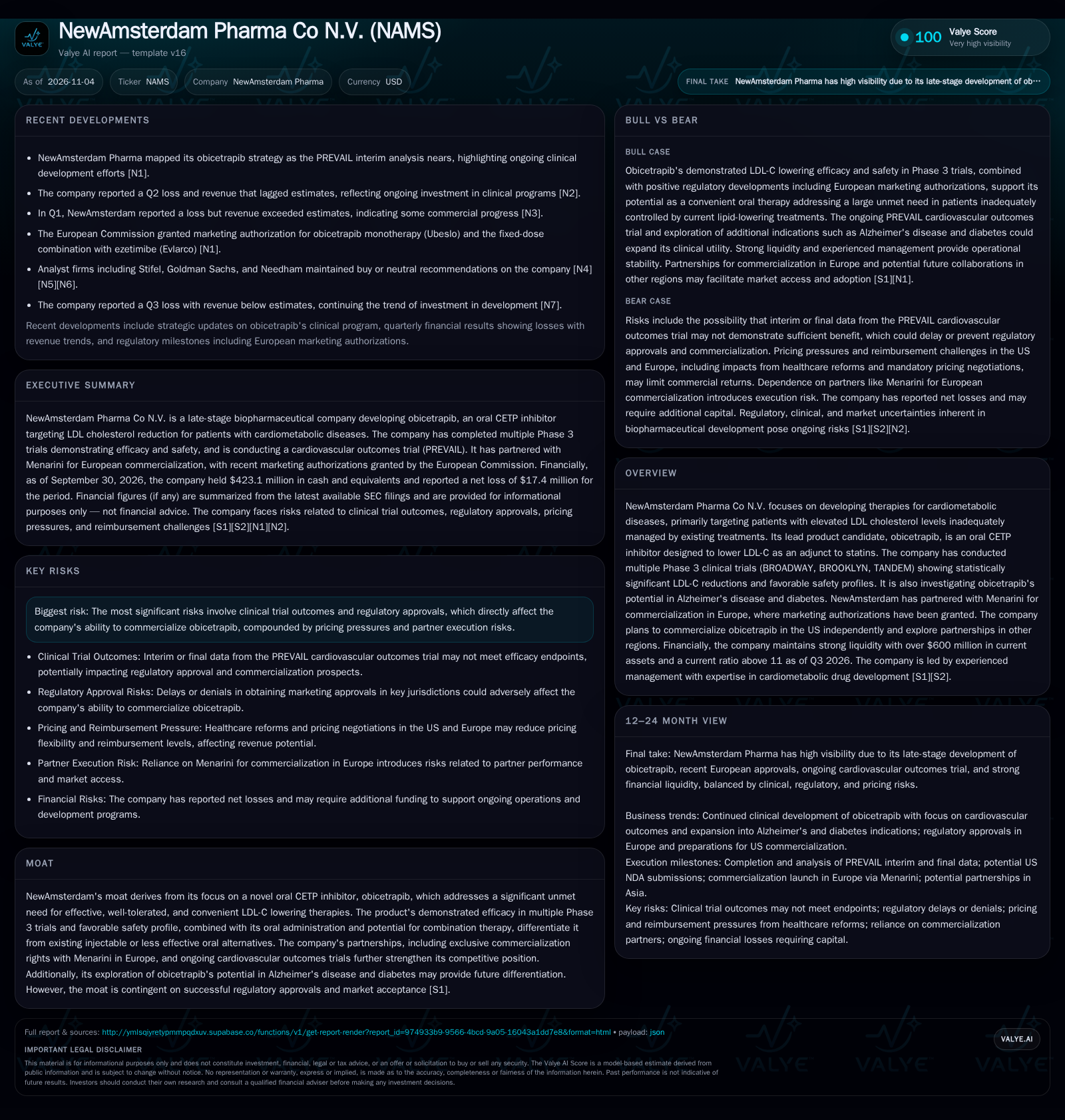
NewAmsterdam Pharma has achieved European marketing authorization for its oral CETP inhibitor obicetrapib, targeting patients inadequately served by current LDL-C lowering therapies. With reported liquidity position and a pivotal cardiovascular outcomes trial nearing readout, the company faces a complex path to commercial adoption, pricing pressure, and partnership execution in the US and beyond.
NewAmsterdam Pharma's obicetrapib secured European marketing authorization in 2026, marking a major milestone for its CETP inhibitor franchise. Commercial success will hinge on translating clinical data into real-world cardiovascular outcomes, navigating payer dynamics, and executing on regional partnerships, particularly as pricing and reimbursement headwinds intensify in both Europe and the US.
NewAmsterdam Pharma enters late 2026 at a critical juncture: its oral CETP inhibitor obicetrapib has achieved European marketing authorization, positioning the company to address a substantial unmet need in LDL-C lowering for high-risk cardiometabolic patients. With the pivotal PREVAIL cardiovascular outcomes trial underway and a robust balance sheet, NewAmsterdam must now convert regulatory and clinical progress into meaningful commercial traction. The coming year will test the company’s ability to navigate the complex realities of payer acceptance, pricing constraints, and regional execution—particularly as competition and healthcare reforms reshape the cholesterol management landscape.
European Approval and PREVAIL Timing Shape NewAmsterdam’s 2026 Outlook
The most material current development is the European Commission’s marketing authorization for obicetrapib monotherapy (Ubeslo) and its fixed-dose combination with ezetimibe (Evlarco) in September 2026. This regulatory milestone validates NewAmsterdam’s clinical program and clears the way for commercial launch in Europe through its partner Menarini [S1] [N1].
Meanwhile, the pivotal PREVAIL cardiovascular outcomes trial has completed enrollment and is ongoing, with interim data expected to be a decisive catalyst for US regulatory submission and broader global adoption [S1] [N1].
Financially, NewAmsterdam reported $423.1 million in cash and equivalents and $205.1 million in short-term investments as of September 30, 2026, with a net loss of $17.4 million for the period [S2]. The company reported cash and liquidity metrics for the period; these figures do not by themselves establish operating runway, investment capacity, financial flexibility, or financing capacity.
Collectively, these milestones frame a transition from late-stage development risk toward the complexities of commercial execution and scale, with clinical outcomes, regulatory events, and payer response now central to the thesis.
How CETP Inhibition Could Reshape Cardiometabolic Economics
NewAmsterdam’s core business model depends on converting clinical evidence of LDL-C lowering and cardiovascular benefit into broad adoption among high-risk patients who are not adequately managed by existing statin or PCSK9 regimens. Obicetrapib’s oral, once-daily dosing is designed to offer a convenience and adherence advantage over injectable alternatives, potentially expanding the treatable population and supporting premium pricing—if sufficiently differentiated outcomes are demonstrated.
Pricing dynamics will likely be regionally varied. In Europe, Menarini’s commercialization will be subject to national payer negotiations, which have grown more stringent post-pandemic and under evolving EU pricing frameworks. In the US, NewAmsterdam intends to commercialize independently, but future net pricing will hinge on the strength of PREVAIL outcomes data, relative positioning to PCSK9 inhibitors, and the ability to secure broad formulary inclusion.
Gross-to-net adjustments, mandatory rebates, and step-edit requirements could significantly impact realized revenue per patient. The company’s ability to drive high-volume adoption will also depend on targeting statin-intolerant, high-risk, or otherwise poorly controlled patients—a segment with high medical need but potentially complex reimbursement hurdles.
Fixed versus variable cost structure will evolve as the company transitions from R&D to commercial operations. While initial sales and marketing investments are likely to be substantial, especially for a first-in-class oral CETP inhibitor, operating leverage could emerge if broad adoption is achieved. However, as with most specialty pharma launches, the risk of slow uptake and high initial SG&A must be considered.
Assessing Differentiation Amidst Statins, PCSK9s, and Other LDL-C Lowering Agents
Obicetrapib’s potential moat rests on its oral administration, CETP inhibition mechanism, and statistically significant LDL-C reduction with a placebo-like safety profile seen in Phase 3 trials [S1]. This positions it as a differentiated adjunct to statins, especially for patients inadequately served by current oral or injectable options.
However, the competitive landscape is formidable. Generic statins remain the standard of care for most, while PCSK9 inhibitors (alirocumab, evolocumab, inclisiran) have set efficacy benchmarks, albeit with injectable administration and higher costs. Bempedoic acid and ezetimibe offer additional oral alternatives but have varying efficacy and tolerability profiles.
The key question is whether obicetrapib can demonstrate not only LDL-C lowering but also a clear reduction in major adverse cardiovascular events (MACE) in PREVAIL—an outcome that would be critical for payer adoption and guideline inclusion. If PREVAIL shows only a biomarker effect without clinical event reduction, payer pressure and step-edit requirements could limit its role.
NewAmsterdam’s European partnership with Menarini provides commercial reach but introduces counterparty execution risk and may dilute economics compared to direct US commercialization. Further, as CETP inhibitors have faced historical skepticism due to past failures in the class, market education and real-world evidence will be needed to drive uptake.
If PREVAIL Delivers: The Pathway to Rapid Uptake and Expanding Franchise Value
In the bullish scenario, the PREVAIL trial demonstrates a statistically significant reduction in MACE, positioning obicetrapib as not only a biomarker-driven therapy but a proven agent for improving hard cardiovascular outcomes. This would likely enable guideline inclusion and strong payer support in both the US and Europe, unlocking broad access for high- and very-high-risk patients inadequately controlled on statins.
Such a result could justify premium pricing—especially in the US—and accelerate adoption among cardiologists, particularly given the convenience of oral administration. The fixed-dose combination with ezetimibe (Evlarco) would further expand the addressable market, targeting patients requiring multi-mechanism LDL lowering.
Confirmation of this scenario would require positive PREVAIL top-line results, rapid regulatory review and label expansion in the US, and evidence of strong early adoption metrics in Menarini’s European launch. Early signs of formulary inclusion, limited step-edits, and positive real-world adherence would further validate the upside thesis.
Commercialization Progresses Incrementally Amid Payer Scrutiny and Data Watchpoints
The most plausible path is a measured commercial rollout where obicetrapib achieves moderate uptake in Europe through Menarini, primarily among patients failing other oral therapies or those ineligible for PCSK9s. US regulatory submission follows PREVAIL data, but payers require robust outcomes evidence before granting broad access.
In this scenario, pricing is constrained by payer negotiations and step-edit requirements, particularly if PREVAIL shows non-inferiority or a smaller-than-hoped MACE reduction. Uptake is steady but not explosive, and NewAmsterdam’s US launch requires substantial investment in sales, education, and real-world evidence generation.
Evidence confirming this scenario would include gradual revenue growth in Europe, delayed or cautious US payer coverage, and ongoing net losses as launch costs persist. Falsification would require either rapid, guideline-driven adoption or a major regulatory or data setback.
PREVAIL Disappoints or Commercial Execution Stalls: The Risk of Marginalization
The adverse chain is triggered if PREVAIL fails to demonstrate a significant reduction in cardiovascular events, limiting obicetrapib’s label to LDL-C lowering without proven clinical benefit. Payers respond by enforcing strict step-edit criteria, relegating use to narrow populations and compressing pricing power.
Commercial execution in Europe could also falter if Menarini’s launch is slow, reimbursement is delayed, or real-world uptake is limited by skepticism toward the CETP inhibitor class. US launch plans could be postponed or require a partner if initial sales fail to offset ongoing net losses.
Confirmation would come from regulatory delays, negative or neutral PREVAIL data, weak early sales figures in Europe, and a need for dilutive financing or strategic pivots toward new indications.
Milestones That Will Define Obicetrapib’s Real-World Impact and Franchise Potential
Top-line PREVAIL cardiovascular outcomes data and its magnitude of MACE reduction, if any.
Speed and breadth of Menarini’s commercial rollout in Europe, including country-by-country reimbursement timelines and reported sales (if disclosed).
Initial US regulatory submission timing and FDA review feedback following PREVAIL results.
Early signals of payer acceptance: formulary inclusion, step-edit requirements, and net pricing in both Europe and the US (if disclosed).
Real-world adherence and persistence rates for obicetrapib and Evlarco, especially relative to PCSK9s and other orals (would help test the thesis).
Any disclosed partnership activity or licensing in Asia, particularly Japan and China.
Cash burn rate and timing of potential financing needs if commercial ramp is slower than expected.
Clinical progress or data readouts for Alzheimer's and diabetes indications (if disclosed), which would indicate pipeline optionality.
Disclaimer: This is research-only, informational analysis and not investment advice. It may include AI-generated interpretation and general industry context. Always verify important details using primary sources.

Comments